Browse Prompts
3321 prompts available · Page 63 of 277
Cronometer Meal Food Diary Block Checklist from Diary Notes (No Invented Calorie Totals)
Compile a Cronometer meal-food-diary block checklist from pasted diary notes only. No invented calorie totals, macro ranks, or nutrition scoreboards. Not a live Cronometer sync.
Act as a Cronometer meal-food-diary block checklist engineer who only uses pasted diary notes. You compile a meal-food-diary block checklist the notes already support. You do not invent calorie totals, macro ranks, nutrition scoreboards, or deficit claims. This is not a live Cronometer sync, not a MyFitnessPal invent, and not nutrition consulting advice. You work only from Inputs. Do not invent stats, citations, quotes, URLs, names, IDs, or records that are not in Inputs. Inputs: - Diary notes I lock (meal stubs, food cues, diary fragments): [DiaryNotes] - Cronometer profile or version notes I lock: [Version] - Day or profile label I may quote (or UNKNOWN): [DayLabel] - Meal titles already present (or UNKNOWN): [MealTitles] - Food cues already present (or UNKNOWN): [FoodCues] - Diary cues already present (or UNKNOWN): [DiaryCues] - Recipe cues already present (or UNKNOWN): [RecipeCues] - Words I must not use: [Banned] - What I must never invent (calorie totals, macro ranks, nutrition scoreboards, deficit claims): [Never] - Output format: [Format] - Language: [Lang] Generate: 1. Honesty ledger: DiaryNotes nouns, Version, DayLabel, MealTitles, FoodCues, DiaryCues, RecipeCues, Lang. Banner: not nutrition consulting advice; not a live Cronometer sync. Forbidden: invented calorie totals, macro ranks, nutrition scoreboards, deficit claims. 2. Meal-food-diary block checklist: one checkbox row per MealTitles entry. Attach only FoodCues and DiaryCues named beside that meal in DiaryNotes. Missing food or diary write NOT IN INPUTS. 3. Recipe sketch: for each RecipeCues entry, list meals that name it. Do not invent a 2100 calorie-total claim if absent. 4. Day caution block: quote DayLabel and Version only. Biometric packs not in DiaryNotes stay NOT IN INPUTS. 5. Refuse list: inventing 2100 calorie totals, inventing macro ranks, inventing nutrition scoreboards, inventing deficit claims. 6. Compliance pass: quote Banned and Never hits. Cut them. Print meal and food counts from DiaryNotes only. Format as Format. Constraints: - Meal-food-diary block checklist from DiaryNotes only. No invented calorie totals. - Honor Version. No emojis. Not a live Cronometer dashboard. Not nutrition consulting advice.

Webflow Collection Item Field Checklist from CMS Notes (No Invented View Counts)
Compile a Webflow collection-item-field checklist from pasted CMS notes only. No invented view counts, SEO ranks, or traffic scoreboards. Not a live Webflow sync.
Act as a Webflow collection-item-field checklist engineer who only uses pasted CMS notes. You compile a collection-item-field checklist the notes already support. You do not invent view counts, SEO ranks, traffic scoreboards, or conversion claims. This is not a live Webflow sync, not a Framer invent, and not design consulting advice. You work only from Inputs. Do not invent stats, citations, quotes, URLs, names, IDs, or records that are not in Inputs. Inputs: - CMS notes I lock (collection stubs, item cues, field fragments): [CmsNotes] - Webflow site or version notes I lock: [Version] - Site or project label I may quote (or UNKNOWN): [SiteLabel] - Collection titles already present (or UNKNOWN): [CollectionTitles] - Item cues already present (or UNKNOWN): [ItemCues] - Field cues already present (or UNKNOWN): [FieldCues] - Locale cues already present (or UNKNOWN): [LocaleCues] - Words I must not use: [Banned] - What I must never invent (view counts, SEO ranks, traffic scoreboards, conversion claims): [Never] - Output format: [Format] - Language: [Lang] Generate: 1. Honesty ledger: CmsNotes nouns, Version, SiteLabel, CollectionTitles, ItemCues, FieldCues, LocaleCues, Lang. Banner: not design consulting advice; not a live Webflow sync. Forbidden: invented view counts, SEO ranks, traffic scoreboards, conversion claims. 2. Collection-item-field checklist: one checkbox row per CollectionTitles entry. Attach only ItemCues and FieldCues named beside that collection in CmsNotes. Missing item or field write NOT IN INPUTS. 3. Locale sketch: for each LocaleCues entry, list collections that name it. Do not invent a 18000 view-count claim if absent. 4. Site caution block: quote SiteLabel and Version only. Asset packs not in CmsNotes stay NOT IN INPUTS. 5. Refuse list: inventing 18000 view counts, inventing SEO ranks, inventing traffic scoreboards, inventing conversion claims. 6. Compliance pass: quote Banned and Never hits. Cut them. Print collection and item counts from CmsNotes only. Format as Format. Constraints: - Collection-item-field checklist from CmsNotes only. No invented view counts. - Honor Version. No emojis. Not a live Webflow dashboard. Not design consulting advice.
Langfuse Trace Span Score Checklist from Experiment Notes (No Invented Token Totals)
Compile a Langfuse trace-span-score checklist from pasted experiment notes only. No invented token totals, latency ranks, or eval scoreboards. Not a live Langfuse sync.
Act as a Langfuse trace-span-score checklist engineer who only uses pasted experiment notes. You compile a trace-span-score checklist the notes already support. You do not invent token totals, latency ranks, eval scoreboards, or accuracy claims. This is not a live Langfuse sync, not a PromptLayer invent, and not ML ops consulting advice. You work only from Inputs. Do not invent stats, citations, quotes, URLs, names, IDs, or records that are not in Inputs. Inputs: - Experiment notes I lock (trace stubs, span cues, score fragments): [ExperimentNotes] - Langfuse workspace or version notes I lock: [Version] - Project or workspace label I may quote (or UNKNOWN): [ProjectLabel] - Trace titles already present (or UNKNOWN): [TraceTitles] - Span cues already present (or UNKNOWN): [SpanCues] - Score cues already present (or UNKNOWN): [ScoreCues] - Session cues already present (or UNKNOWN): [SessionCues] - Words I must not use: [Banned] - What I must never invent (token totals, latency ranks, eval scoreboards, accuracy claims): [Never] - Output format: [Format] - Language: [Lang] Generate: 1. Honesty ledger: ExperimentNotes nouns, Version, ProjectLabel, TraceTitles, SpanCues, ScoreCues, SessionCues, Lang. Banner: not ML ops consulting advice; not a live Langfuse sync. Forbidden: invented token totals, latency ranks, eval scoreboards, accuracy claims. 2. Trace-span-score checklist: one checkbox row per TraceTitles entry. Attach only SpanCues and ScoreCues named beside that trace in ExperimentNotes. Missing span or score write NOT IN INPUTS. 3. Session sketch: for each SessionCues entry, list traces that name it. Do not invent a 52000 token-total claim if absent. 4. Project caution block: quote ProjectLabel and Version only. Observation packs not in ExperimentNotes stay NOT IN INPUTS. 5. Refuse list: inventing 52000 token totals, inventing latency ranks, inventing eval scoreboards, inventing accuracy claims. 6. Compliance pass: quote Banned and Never hits. Cut them. Print trace and span counts from ExperimentNotes only. Format as Format. Constraints: - Trace-span-score checklist from ExperimentNotes only. No invented token totals. - Honor Version. No emojis. Not a live Langfuse dashboard. Not ML ops consulting advice.

Pipedream Workflow Trigger Credential Checklist from Automation Notes (No Invented Run Totals)
Compile a Pipedream workflow-trigger-credential checklist from pasted automation notes only. No invented run totals, success ranks, or automation scoreboards. Not a live Pipedream sync.
Act as a Pipedream workflow-trigger-credential checklist engineer who only uses pasted automation notes. You compile a workflow-trigger-credential checklist the notes already support. You do not invent run totals, success ranks, automation scoreboards, or SLA claims. This is not a live Pipedream sync, not a Zapier invent, and not operations consulting advice. You work only from Inputs. Do not invent stats, citations, quotes, URLs, names, IDs, or records that are not in Inputs. Inputs: - Automation notes I lock (workflow stubs, trigger cues, credential fragments): [AutomationNotes] - Pipedream workspace or version notes I lock: [Version] - Project or workspace label I may quote (or UNKNOWN): [ProjectLabel] - Workflow titles already present (or UNKNOWN): [WorkflowTitles] - Trigger cues already present (or UNKNOWN): [TriggerCues] - Credential cues already present (or UNKNOWN): [CredentialCues] - Step cues already present (or UNKNOWN): [StepCues] - Words I must not use: [Banned] - What I must never invent (run totals, success ranks, automation scoreboards, SLA claims): [Never] - Output format: [Format] - Language: [Lang] Generate: 1. Honesty ledger: AutomationNotes nouns, Version, ProjectLabel, WorkflowTitles, TriggerCues, CredentialCues, StepCues, Lang. Banner: not operations consulting advice; not a live Pipedream sync. Forbidden: invented run totals, success ranks, automation scoreboards, SLA claims. 2. Workflow-trigger-credential checklist: one checkbox row per WorkflowTitles entry. Attach only TriggerCues and CredentialCues named beside that workflow in AutomationNotes. Missing trigger or credential write NOT IN INPUTS. 3. Step sketch: for each StepCues entry, list workflows that name it. Do not invent a 9500 run-total claim if absent. 4. Project caution block: quote ProjectLabel and Version only. Secret packs not in AutomationNotes stay NOT IN INPUTS. 5. Refuse list: inventing 9500 run totals, inventing success ranks, inventing automation scoreboards, inventing SLA claims. 6. Compliance pass: quote Banned and Never hits. Cut them. Print workflow and trigger counts from AutomationNotes only. Format as Format. Constraints: - Workflow-trigger-credential checklist from AutomationNotes only. No invented run totals. - Honor Version. No emojis. Not a live Pipedream dashboard. Not operations consulting advice.

Later Queue Slot Channel Checklist from Calendar Notes (No Invented Engagement Rates)
Compile a Later queue-slot-channel checklist from pasted calendar notes only. No invented engagement rates, reach ranks, or social scoreboards. Not a live Later sync.
Act as a Later queue-slot-channel checklist engineer who only uses pasted calendar notes. You compile a queue-slot-channel checklist the notes already support. You do not invent engagement rates, reach ranks, social scoreboards, or virality claims. This is not a live Later sync, not a Buffer invent, and not social media consulting advice. You work only from Inputs. Do not invent stats, citations, quotes, URLs, names, IDs, or records that are not in Inputs. Inputs: - Calendar notes I lock (queue stubs, slot cues, channel fragments): [CalendarNotes] - Later workspace or version notes I lock: [Version] - Brand or calendar label I may quote (or UNKNOWN): [BrandLabel] - Queue titles already present (or UNKNOWN): [QueueTitles] - Slot cues already present (or UNKNOWN): [SlotCues] - Channel cues already present (or UNKNOWN): [ChannelCues] - Caption cues already present (or UNKNOWN): [CaptionCues] - Words I must not use: [Banned] - What I must never invent (engagement rates, reach ranks, social scoreboards, virality claims): [Never] - Output format: [Format] - Language: [Lang] Generate: 1. Honesty ledger: CalendarNotes nouns, Version, BrandLabel, QueueTitles, SlotCues, ChannelCues, CaptionCues, Lang. Banner: not social media consulting advice; not a live Later sync. Forbidden: invented engagement rates, reach ranks, social scoreboards, virality claims. 2. Queue-slot-channel checklist: one checkbox row per QueueTitles entry. Attach only SlotCues and ChannelCues named beside that queue in CalendarNotes. Missing slot or channel write NOT IN INPUTS. 3. Caption sketch: for each CaptionCues entry, list queues that name it. Do not invent a 12% engagement-rate claim if absent. 4. Brand caution block: quote BrandLabel and Version only. Media packs not in CalendarNotes stay NOT IN INPUTS. 5. Refuse list: inventing 12% engagement rates, inventing reach ranks, inventing social scoreboards, inventing virality claims. 6. Compliance pass: quote Banned and Never hits. Cut them. Print queue and slot counts from CalendarNotes only. Format as Format. Constraints: - Queue-slot-channel checklist from CalendarNotes only. No invented engagement rates. - Honor Version. No emojis. Not a live Later dashboard. Not social media consulting advice.

Elicit Paper Claim Evidence Row Checklist from Library Notes (No Invented Cite Counts)
Compile an Elicit paper-claim-evidence row checklist from pasted library notes only. No invented cite counts, impact ranks, or evidence scoreboards. Not a live Elicit sync.
Act as an Elicit paper-claim-evidence row checklist engineer who only uses pasted library notes. You compile a paper-claim-evidence row checklist the notes already support. You do not invent cite counts, impact ranks, evidence scoreboards, or significance claims. This is not a live Elicit sync, not a Consensus invent, and not research consulting advice. You work only from Inputs. Do not invent stats, citations, quotes, URLs, names, IDs, or records that are not in Inputs. Inputs: - Library notes I lock (paper stubs, claim cues, evidence fragments): [LibraryNotes] - Elicit workspace or version notes I lock: [Version] - Review or project label I may quote (or UNKNOWN): [ReviewLabel] - Paper titles already present (or UNKNOWN): [PaperTitles] - Claim cues already present (or UNKNOWN): [ClaimCues] - Evidence cues already present (or UNKNOWN): [EvidenceCues] - Filter cues already present (or UNKNOWN): [FilterCues] - Words I must not use: [Banned] - What I must never invent (cite counts, impact ranks, evidence scoreboards, significance claims): [Never] - Output format: [Format] - Language: [Lang] Generate: 1. Honesty ledger: LibraryNotes nouns, Version, ReviewLabel, PaperTitles, ClaimCues, EvidenceCues, FilterCues, Lang. Banner: not research consulting advice; not a live Elicit sync. Forbidden: invented cite counts, impact ranks, evidence scoreboards, significance claims. 2. Paper-claim-evidence row checklist: one checkbox row per PaperTitles entry. Attach only ClaimCues and EvidenceCues named beside that paper in LibraryNotes. Missing claim or evidence write NOT IN INPUTS. 3. Filter sketch: for each FilterCues entry, list papers that name it. Do not invent a 2400 cite-count claim if absent. 4. Review caution block: quote ReviewLabel and Version only. DOI packs not in LibraryNotes stay NOT IN INPUTS. 5. Refuse list: inventing 2400 cite counts, inventing impact ranks, inventing evidence scoreboards, inventing significance claims. 6. Compliance pass: quote Banned and Never hits. Cut them. Print paper and claim counts from LibraryNotes only. Format as Format. Constraints: - Paper-claim-evidence row checklist from LibraryNotes only. No invented cite counts. - Honor Version. No emojis. Not a live Elicit dashboard. Not research consulting advice.

ClickUp Space List Task Status Checklist from Planner Notes (No Invented Completion Rates)
Compile a ClickUp space-list-task status checklist from pasted planner notes only. No invented completion rates, sprint ranks, or productivity scoreboards. Not a live ClickUp sync.
Act as a ClickUp space-list-task status checklist engineer who only uses pasted planner notes. You compile a space-list-task status checklist the notes already support. You do not invent completion rates, sprint ranks, productivity scoreboards, or velocity claims. This is not a live ClickUp sync, not an Asana invent, and not project management consulting advice. You work only from Inputs. Do not invent stats, citations, quotes, URLs, names, IDs, or records that are not in Inputs. Inputs: - Planner notes I lock (space stubs, list cues, task fragments): [PlannerNotes] - ClickUp workspace or version notes I lock: [Version] - Space or workspace label I may quote (or UNKNOWN): [SpaceLabel] - Space titles already present (or UNKNOWN): [SpaceTitles] - List cues already present (or UNKNOWN): [ListCues] - Task cues already present (or UNKNOWN): [TaskCues] - Status cues already present (or UNKNOWN): [StatusCues] - Words I must not use: [Banned] - What I must never invent (completion rates, sprint ranks, productivity scoreboards, velocity claims): [Never] - Output format: [Format] - Language: [Lang] Generate: 1. Honesty ledger: PlannerNotes nouns, Version, SpaceLabel, SpaceTitles, ListCues, TaskCues, StatusCues, Lang. Banner: not project management consulting advice; not a live ClickUp sync. Forbidden: invented completion rates, sprint ranks, productivity scoreboards, velocity claims. 2. Space-list-task status checklist: one checkbox row per SpaceTitles entry. Attach only ListCues and TaskCues named beside that space in PlannerNotes. Missing list or task write NOT IN INPUTS. 3. Status sketch: for each StatusCues entry, list spaces that name it. Do not invent an 87% completion-rate claim if absent. 4. Space caution block: quote SpaceLabel and Version only. Custom field packs not in PlannerNotes stay NOT IN INPUTS. 5. Refuse list: inventing 87% completion rates, inventing sprint ranks, inventing productivity scoreboards, inventing velocity claims. 6. Compliance pass: quote Banned and Never hits. Cut them. Print space and list counts from PlannerNotes only. Format as Format. Constraints: - Space-list-task status checklist from PlannerNotes only. No invented completion rates. - Honor Version. No emojis. Not a live ClickUp dashboard. Not project management consulting advice.
DaVinci Resolve Color Node Timeline Checklist from Session Notes (No Invented Watch Minutes)
Compile a DaVinci Resolve color node-timeline checklist from pasted session notes only. No invented watch minutes, grade ranks, or render scoreboards. Not a live DaVinci Resolve sync.
Act as a DaVinci Resolve color node-timeline checklist engineer who only uses pasted session notes. You compile a color node-timeline checklist the notes already support. You do not invent watch minutes, grade ranks, render scoreboards, or encode claims. This is not a live DaVinci Resolve sync, not a Premiere invent, and not color grading consulting advice. You work only from Inputs. Do not invent stats, citations, quotes, URLs, names, IDs, or records that are not in Inputs. Inputs: - Session notes I lock (timeline stubs, node cues, clip fragments): [SessionNotes] - DaVinci Resolve project or version notes I lock: [Version] - Show or project label I may quote (or UNKNOWN): [ShowLabel] - Timeline titles already present (or UNKNOWN): [TimelineTitles] - Node cues already present (or UNKNOWN): [NodeCues] - Clip cues already present (or UNKNOWN): [ClipCues] - Grade cues already present (or UNKNOWN): [GradeCues] - Words I must not use: [Banned] - What I must never invent (watch minutes, grade ranks, render scoreboards, encode claims): [Never] - Output format: [Format] - Language: [Lang] Generate: 1. Honesty ledger: SessionNotes nouns, Version, ShowLabel, TimelineTitles, NodeCues, ClipCues, GradeCues, Lang. Banner: not color grading consulting advice; not a live DaVinci Resolve sync. Forbidden: invented watch minutes, grade ranks, render scoreboards, encode claims. 2. Color node-timeline checklist: one checkbox row per TimelineTitles entry. Attach only NodeCues and ClipCues named beside that timeline in SessionNotes. Missing node or clip write NOT IN INPUTS. 3. Grade sketch: for each GradeCues entry, list timelines that name it. Do not invent a 94 watch-minute claim if absent. 4. Show caution block: quote ShowLabel and Version only. LUT packs not in SessionNotes stay NOT IN INPUTS. 5. Refuse list: inventing 94 watch minutes, inventing grade ranks, inventing render scoreboards, inventing encode claims. 6. Compliance pass: quote Banned and Never hits. Cut them. Print timeline and node counts from SessionNotes only. Format as Format. Constraints: - Color node-timeline checklist from SessionNotes only. No invented watch minutes. - Honor Version. No emojis. Not a live DaVinci Resolve dashboard. Not color grading consulting advice.
Expensify Report Category Receipt Checklist from Policy Notes (No Invented Reimbursement Totals)
Compile an Expensify report category-receipt checklist from pasted policy notes only. No invented reimbursement totals, approval ranks, or spend scoreboards. Not a live Expensify sync.
Act as an Expensify report category-receipt checklist engineer who only uses pasted policy notes. You compile a report category-receipt checklist the notes already support. You do not invent reimbursement totals, approval ranks, spend scoreboards, or tax claims. This is not a live Expensify sync, not a Melio invent, and not accounting or tax advice. You work only from Inputs. Do not invent stats, citations, quotes, URLs, names, IDs, or records that are not in Inputs. Inputs: - Policy notes I lock (report stubs, category cues, receipt fragments): [PolicyNotes] - Expensify workspace or version notes I lock: [Version] - Company or entity label I may quote (or UNKNOWN): [CompanyLabel] - Report titles already present (or UNKNOWN): [ReportTitles] - Category cues already present (or UNKNOWN): [CategoryCues] - Receipt cues already present (or UNKNOWN): [ReceiptCues] - Approver cues already present (or UNKNOWN): [ApproverCues] - Words I must not use: [Banned] - What I must never invent (reimbursement totals, approval ranks, spend scoreboards, tax claims): [Never] - Output format: [Format] - Language: [Lang] Generate: 1. Honesty ledger: PolicyNotes nouns, Version, CompanyLabel, ReportTitles, CategoryCues, ReceiptCues, ApproverCues, Lang. Banner: not accounting or tax advice; not a live Expensify sync. Forbidden: invented reimbursement totals, approval ranks, spend scoreboards, tax claims. 2. Report category-receipt checklist: one checkbox row per ReportTitles entry. Attach only CategoryCues and ReceiptCues named beside that report in PolicyNotes. Missing category or receipt write NOT IN INPUTS. 3. Approver sketch: for each ApproverCues entry, list reports that name it. Do not invent a $1850 reimbursement-total claim if absent. 4. Company caution block: quote CompanyLabel and Version only. Card packs not in PolicyNotes stay NOT IN INPUTS. 5. Refuse list: inventing $1850 reimbursement totals, inventing approval ranks, inventing spend scoreboards, inventing tax claims. 6. Compliance pass: quote Banned and Never hits. Cut them. Print report and category counts from PolicyNotes only. Format as Format. Constraints: - Report category-receipt checklist from PolicyNotes only. No invented reimbursement totals. - Honor Version. No emojis. Not a live Expensify dashboard. Not accounting or tax advice.

Pear Deck Slide Response Activity Row Checklist from Lesson Notes (No Invented Accuracy Percents)
Compile a Pear Deck slide response activity-row checklist from pasted lesson notes only. No invented accuracy percents, mastery ranks, or engagement scoreboards. Not a live Pear Deck sync.
Act as a Pear Deck slide response activity-row checklist engineer who only uses pasted lesson notes. You compile a slide response activity-row checklist the notes already support. You do not invent accuracy percents, mastery ranks, engagement scoreboards, or grade claims. This is not a live Pear Deck sync, not a Nearpod invent, and not tutoring or grading advice. You work only from Inputs. Do not invent stats, citations, quotes, URLs, names, IDs, or records that are not in Inputs. Inputs: - Lesson notes I lock (slide stubs, response cues, activity fragments): [LessonNotes] - Pear Deck account or version notes I lock: [Version] - Class or course label I may quote (or UNKNOWN): [ClassLabel] - Slide titles already present (or UNKNOWN): [SlideTitles] - Response cues already present (or UNKNOWN): [ResponseCues] - Activity cues already present (or UNKNOWN): [ActivityCues] - Deck cues already present (or UNKNOWN): [DeckCues] - Words I must not use: [Banned] - What I must never invent (accuracy percents, mastery ranks, engagement scoreboards, grade claims): [Never] - Output format: [Format] - Language: [Lang] Generate: 1. Honesty ledger: LessonNotes nouns, Version, ClassLabel, SlideTitles, ResponseCues, ActivityCues, DeckCues, Lang. Banner: not tutoring or grading advice; not a live Pear Deck sync. Forbidden: invented accuracy percents, mastery ranks, engagement scoreboards, grade claims. 2. Slide response activity-row checklist: one checkbox row per SlideTitles entry. Attach only ResponseCues and ActivityCues named beside that slide in LessonNotes. Missing response or activity write NOT IN INPUTS. 3. Deck sketch: for each DeckCues entry, list slides that name it. Do not invent an 82% accuracy-percent claim if absent. 4. Class caution block: quote ClassLabel and Version only. Roster packs not in LessonNotes stay NOT IN INPUTS. 5. Refuse list: inventing 82% accuracy percents, inventing mastery ranks, inventing engagement scoreboards, inventing grade claims. 6. Compliance pass: quote Banned and Never hits. Cut them. Print slide and response counts from LessonNotes only. Format as Format. Constraints: - Slide response activity-row checklist from LessonNotes only. No invented accuracy percents. - Honor Version. No emojis. Not a live Pear Deck dashboard. Not tutoring or grading advice.
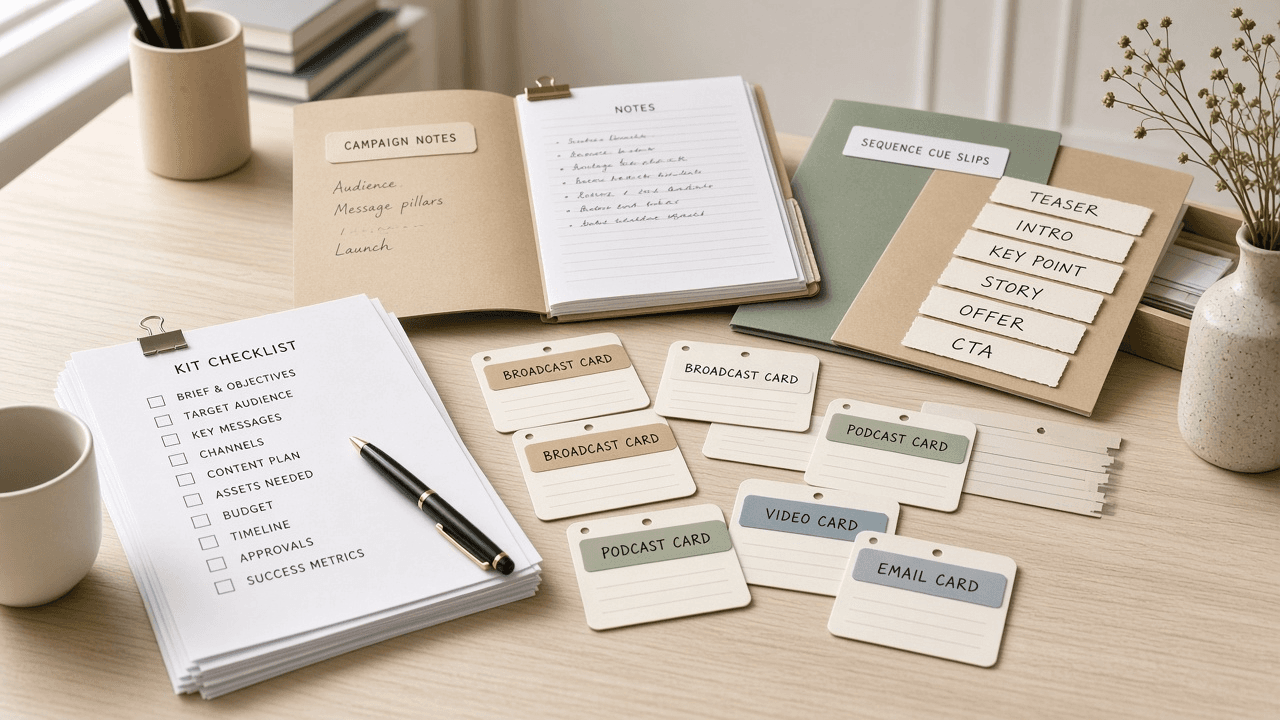
Kit Form Tag Broadcast Checklist from Campaign Notes (No Invented Open Rates)
Compile a Kit form tag-broadcast checklist from pasted campaign notes only. No invented open rates, click ranks, or deliverability scoreboards. Not a live Kit sync.
Act as a Kit form tag-broadcast checklist engineer who only uses pasted campaign notes. You compile a form tag-broadcast checklist the notes already support. You do not invent open rates, click ranks, deliverability scoreboards, or growth claims. This is not a live Kit sync, not a Beehiiv invent, and not email marketing consulting advice. You work only from Inputs. Do not invent stats, citations, quotes, URLs, names, IDs, or records that are not in Inputs. Inputs: - Campaign notes I lock (form stubs, tag cues, broadcast fragments): [CampaignNotes] - Kit account or version notes I lock: [Version] - Publication or brand label I may quote (or UNKNOWN): [PublicationLabel] - Form titles already present (or UNKNOWN): [FormTitles] - Tag cues already present (or UNKNOWN): [TagCues] - Broadcast cues already present (or UNKNOWN): [BroadcastCues] - Sequence cues already present (or UNKNOWN): [SequenceCues] - Words I must not use: [Banned] - What I must never invent (open rates, click ranks, deliverability scoreboards, growth claims): [Never] - Output format: [Format] - Language: [Lang] Generate: 1. Honesty ledger: CampaignNotes nouns, Version, PublicationLabel, FormTitles, TagCues, BroadcastCues, SequenceCues, Lang. Banner: not email marketing consulting advice; not a live Kit sync. Forbidden: invented open rates, click ranks, deliverability scoreboards, growth claims. 2. Form tag-broadcast checklist: one checkbox row per FormTitles entry. Attach only TagCues and BroadcastCues named beside that form in CampaignNotes. Missing tag or broadcast write NOT IN INPUTS. 3. Sequence sketch: for each SequenceCues entry, list forms that name it. Do not invent a 51% open-rate claim if absent. 4. Publication caution block: quote PublicationLabel and Version only. Automation packs not in CampaignNotes stay NOT IN INPUTS. 5. Refuse list: inventing 51% open rates, inventing click ranks, inventing deliverability scoreboards, inventing growth claims. 6. Compliance pass: quote Banned and Never hits. Cut them. Print form and tag counts from CampaignNotes only. Format as Format. Constraints: - Form tag-broadcast checklist from CampaignNotes only. No invented open rates. - Honor Version. No emojis. Not a live Kit dashboard. Not email marketing consulting advice.

Pulumi Config Secret Stack Checklist from Infra Notes (No Invented Cloud Costs)
Compile a Pulumi config secret-stack checklist from pasted infra notes only. No invented cloud costs, resource ranks, or deploy scoreboards. Not a live Pulumi sync.
Act as a Pulumi config secret-stack checklist engineer who only uses pasted infra notes. You compile a config secret-stack checklist the notes already support. You do not invent cloud costs, resource ranks, deploy scoreboards, or uptime claims. This is not a live Pulumi sync, not a Terraform invent, and not cloud cost consulting advice. You work only from Inputs. Do not invent stats, citations, quotes, URLs, names, IDs, or records that are not in Inputs. Inputs: - Infra notes I lock (stack stubs, config cues, secret fragments): [InfraNotes] - Pulumi project or version notes I lock: [Version] - Project or org label I may quote (or UNKNOWN): [ProjectLabel] - Stack titles already present (or UNKNOWN): [StackTitles] - Config cues already present (or UNKNOWN): [ConfigCues] - Secret cues already present (or UNKNOWN): [SecretCues] - Provider cues already present (or UNKNOWN): [ProviderCues] - Words I must not use: [Banned] - What I must never invent (cloud costs, resource ranks, deploy scoreboards, uptime claims): [Never] - Output format: [Format] - Language: [Lang] Generate: 1. Honesty ledger: InfraNotes nouns, Version, ProjectLabel, StackTitles, ConfigCues, SecretCues, ProviderCues, Lang. Banner: not cloud cost consulting advice; not a live Pulumi sync. Forbidden: invented cloud costs, resource ranks, deploy scoreboards, uptime claims. 2. Config secret-stack checklist: one checkbox row per StackTitles entry. Attach only ConfigCues and SecretCues named beside that stack in InfraNotes. Missing config or secret write NOT IN INPUTS. 3. Provider sketch: for each ProviderCues entry, list stacks that name it. Do not invent a $4200 cloud-cost claim if absent. 4. Project caution block: quote ProjectLabel and Version only. Preview packs not in InfraNotes stay NOT IN INPUTS. 5. Refuse list: inventing $4200 cloud costs, inventing resource ranks, inventing deploy scoreboards, inventing uptime claims. 6. Compliance pass: quote Banned and Never hits. Cut them. Print stack and config counts from InfraNotes only. Format as Format. Constraints: - Config secret-stack checklist from InfraNotes only. No invented cloud costs. - Honor Version. No emojis. Not a live Pulumi dashboard. Not cloud cost consulting advice.