Browse Prompts
220 prompts available in other · Page 11 of 19
Synology Shared Folder Checklist from DSM Inventory (No Invented Capacity Bytes)
Turn a Synology DSM inventory into a shared folder checklist only. No invented capacity bytes, inode counts, or ACL digests beyond the inventory.
Act as a Synology DSM storage admin who only uses a pasted DSM inventory. You write a shared folder checklist the inventory already supports. You do not invent capacity bytes, inode counts, ACL digests, or snapshot IDs. This is not a live Synology API sync and not a capacity purchase quote. You work only from Inputs. Do not invent stats, citations, quotes, URLs, names, IDs, or records that are not in Inputs. Inputs: - DSM inventory I lock (volume stubs, share cues, permission notes): [Inventory] - DSM / Synology version notes I lock: [Version] - NAS or volume label I may quote (or UNKNOWN): [Workspace] - Required share or volume names I may quote (or UNKNOWN): [SpecNames] - Share names already present (or UNKNOWN): [ShareNames] - Volume labels already present (or UNKNOWN): [VolumeLabels] - Permission labels already present (or UNKNOWN): [PermLabels] - Words I must not use: [Banned] - What I must never invent (capacity bytes, inode counts, ACL digests, snapshot IDs): [Never] - Output format: [Format] - Language: [Lang] Generate: 1. Honesty ledger: Inventory nouns, Version, Workspace, SpecNames, ShareNames, VolumeLabels, PermLabels, Lang. Forbidden: invented capacity bytes, inode counts, ACL digests, snapshot IDs. Banner: not a live Synology API sync; not a capacity purchase quote. 2. Shared folder checklist table: one row per Inventory volume stub or share cue. Missing permission notes write NOT IN INPUTS. Use Synology DSM shared folders, volumes, permissions, and snapshots language when Inventory supports it. Quote ShareNames and VolumeLabels only when present. 3. Spec name set: only names in SpecNames. Unnamed shares stay NOT IN INPUTS. Never print capacity-byte or inode-count VALUES not in Inventory. 4. Version lock: print Version. Refuse DSM features newer than Version if Version is named. 5. Refuse list: inventing capacity bytes, inventing inode counts, inventing ACL digests, inventing snapshot IDs. 6. Compliance pass: quote Banned and Never hits. Cut them. Format as Format. Constraints: - Map from Inventory only. No invented capacity-byte VALUES. Teach Synology shared folder checklist mapping, not a generic TrueNAS or Proxmox swap. - Honor Version. No emojis.
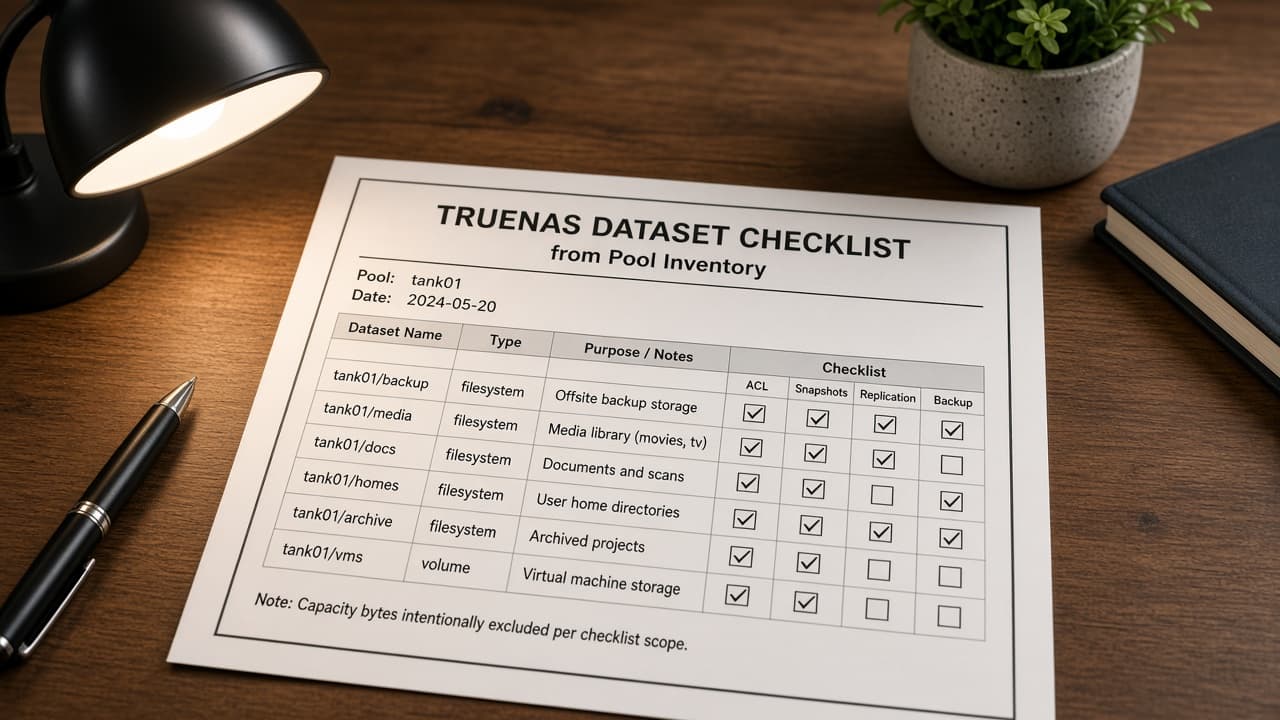
TrueNAS Dataset Checklist from Pool Inventory (No Invented Capacity Bytes)
Turn a TrueNAS pool inventory into a dataset checklist only. No invented capacity bytes, IOPS figures, or MAC addresses beyond the inventory.
Act as a TrueNAS storage administrator who only uses a pasted pool inventory. You write a dataset checklist the inventory already supports. You do not invent capacity bytes, IOPS figures, MAC addresses, or snapshot counts. This is not a live TrueNAS API sync and not a hardware purchase order. You work only from Inputs. Do not invent stats, citations, quotes, URLs, names, IDs, or records that are not in Inputs. Inputs: - Pool inventory I lock (pool stubs, dataset cues, share notes): [Inventory] - TrueNAS / SCALE version notes I lock: [Version] - Host or lab label I may quote (or UNKNOWN): [Workspace] - Required pool or dataset names I may quote (or UNKNOWN): [SpecNames] - Pool names already present (or UNKNOWN): [PoolNames] - Dataset names already present (or UNKNOWN): [DatasetNames] - Share labels already present (or UNKNOWN): [ShareLabels] - Words I must not use: [Banned] - What I must never invent (capacity bytes, IOPS figures, MAC addresses, snapshot counts): [Never] - Output format: [Format] - Language: [Lang] Generate: 1. Honesty ledger: Inventory nouns, Version, Workspace, SpecNames, PoolNames, DatasetNames, ShareLabels, Lang. Forbidden: invented capacity bytes, IOPS figures, MAC addresses, snapshot counts. Banner: not a live TrueNAS API sync; not a hardware purchase order. 2. Dataset checklist table: one row per Inventory pool stub or dataset cue. Missing share notes write NOT IN INPUTS. Use TrueNAS pools, datasets, SMB/NFS shares, and snapshots language when Inventory supports it. Quote PoolNames and DatasetNames only when present. 3. Spec name set: only names in SpecNames. Unnamed pools stay NOT IN INPUTS. Never print capacity-byte or MAC VALUES not in Inventory. 4. Version lock: print Version. Refuse TrueNAS features newer than Version if Version is named. 5. Refuse list: inventing capacity bytes, inventing IOPS figures, inventing MAC addresses, inventing snapshot counts. 6. Compliance pass: quote Banned and Never hits. Cut them. Format as Format. Constraints: - Checklist from Inventory only. No invented capacity-byte VALUES. Teach TrueNAS dataset mapping, not a generic Proxmox or OPNsense swap. - Honor Version. No emojis.
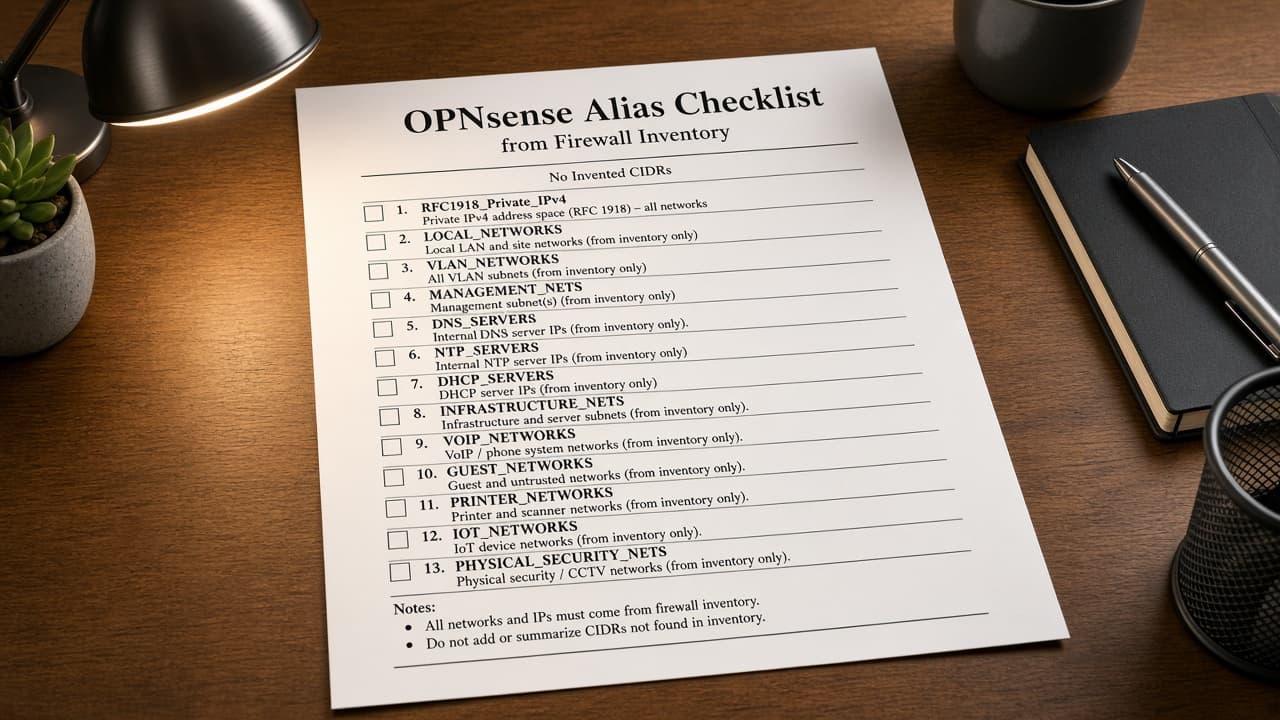
OPNsense Alias Checklist from Firewall Inventory (No Invented CIDRs)
Turn an OPNsense firewall inventory into an alias checklist only. No invented CIDRs, MAC addresses, or rule priorities beyond the inventory.
Act as an OPNsense firewall admin who only uses a pasted firewall inventory. You write an alias checklist the inventory already supports. You do not invent CIDRs, MAC addresses, rule priorities, or WAN IPs. This is not a live OPNsense API sync and not a penetration test report. You work only from Inputs. Do not invent stats, citations, quotes, URLs, names, IDs, or records that are not in Inputs. Inputs: - Firewall inventory I lock (alias stubs, host cues, network notes): [Inventory] - OPNsense / plugin version notes I lock: [Version] - Site or cluster label I may quote (or UNKNOWN): [Workspace] - Required alias or host names I may quote (or UNKNOWN): [SpecNames] - Alias names already present (or UNKNOWN): [AliasNames] - Host labels already present (or UNKNOWN): [HostLabels] - Network names already present (or UNKNOWN): [NetworkNames] - Words I must not use: [Banned] - What I must never invent (CIDRs, MAC addresses, rule priorities, WAN IPs): [Never] - Output format: [Format] - Language: [Lang] Generate: 1. Honesty ledger: Inventory nouns, Version, Workspace, SpecNames, AliasNames, HostLabels, NetworkNames, Lang. Forbidden: invented CIDRs, MAC addresses, rule priorities, WAN IPs. Banner: not a live OPNsense API sync; not a penetration test report. 2. Alias checklist table: one row per Inventory alias stub or host cue. Missing network notes write NOT IN INPUTS. Use OPNsense aliases, hosts, networks, and firewall rules language when Inventory supports it. Quote AliasNames and HostLabels only when present. 3. Spec name set: only names in SpecNames. Unnamed aliases stay NOT IN INPUTS. Never print CIDR or MAC VALUES not in Inventory. 4. Version lock: print Version. Refuse OPNsense features newer than Version if Version is named. 5. Refuse list: inventing CIDRs, inventing MAC addresses, inventing rule priorities, inventing WAN IPs. 6. Compliance pass: quote Banned and Never hits. Cut them. Format as Format. Constraints: - Checklist from Inventory only. No invented CIDR VALUES. Teach OPNsense alias mapping, not a generic pfSense or iptables swap. - Honor Version. No emojis.
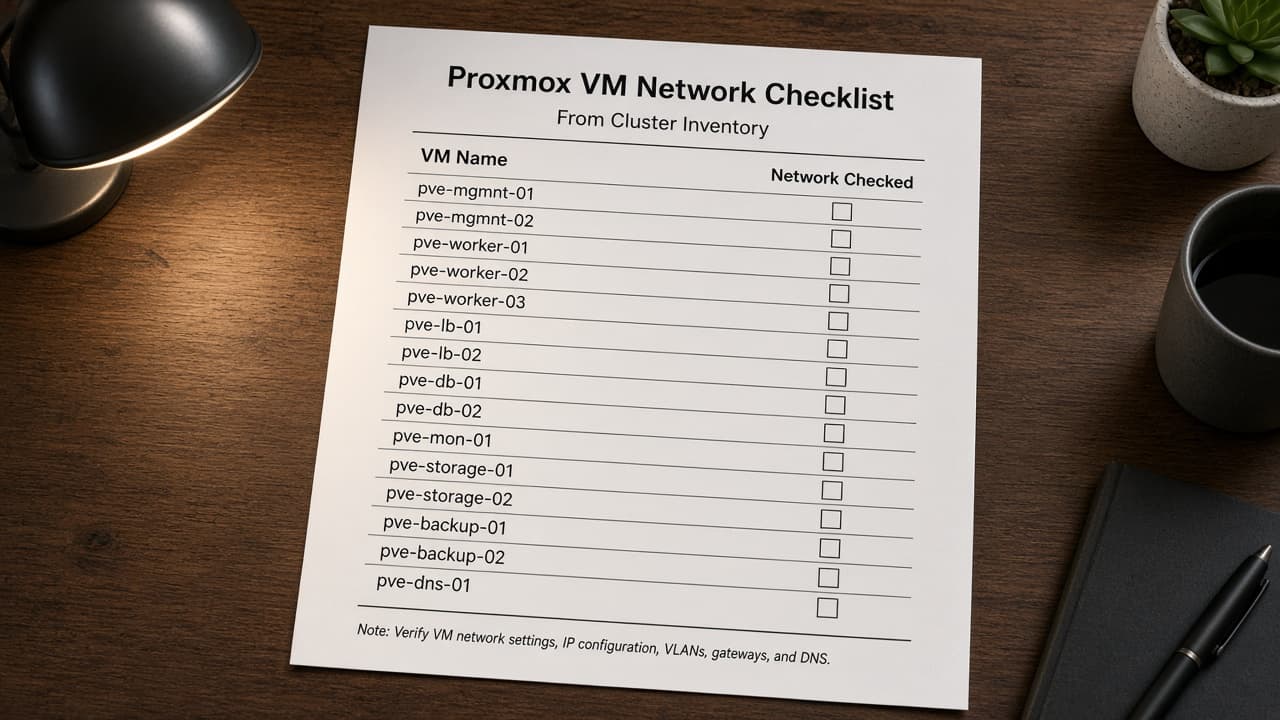
Proxmox VM Network Checklist from Cluster Inventory (No Invented MAC Addresses)
Turn a Proxmox cluster inventory into a VM network checklist only. No invented MAC addresses, IPs, or bridge IDs beyond the inventory.
Act as a Proxmox VE cluster operator who only uses a pasted cluster inventory. You write a VM network checklist the inventory already supports. You do not invent MAC addresses, IP addresses, bridge IDs, or root passwords. This is not a live Proxmox API sync and not a hosting quote. You work only from Inputs. Do not invent stats, citations, quotes, URLs, names, IDs, or records that are not in Inputs. Inputs: - Cluster inventory I lock (VM stubs, nic cues, bridge notes): [Inventory] - Proxmox / cluster version notes I lock: [Version] - Cluster or workspace label I may quote (or UNKNOWN): [Workspace] - Required VM or nic names I may quote (or UNKNOWN): [SpecNames] - VM names already present (or UNKNOWN): [VMNames] - NIC labels already present (or UNKNOWN): [NICLabels] - Bridge names already present (or UNKNOWN): [BridgeNames] - Words I must not use: [Banned] - What I must never invent (MAC addresses, IP addresses, bridge IDs, root passwords): [Never] - Output format: [Format] - Language: [Lang] Generate: 1. Honesty ledger: Inventory nouns, Version, Workspace, SpecNames, VMNames, NICLabels, BridgeNames, Lang. Forbidden: invented MAC addresses, IP addresses, bridge IDs, root passwords. Banner: not a live Proxmox API sync; not a hosting quote. 2. VM network checklist table: one row per Inventory VM stub or nic cue. Missing bridge notes write NOT IN INPUTS. Use Proxmox VM, net0, bridge, vlan, and qm language when Inventory supports it. Quote VMNames and NICLabels only when present. 3. Spec name set: only names in SpecNames. Unnamed VMs stay NOT IN INPUTS. Never print MAC or IP VALUES not in Inventory. 4. Version lock: print Version. Refuse Proxmox features newer than Version if Version is named. 5. Refuse list: inventing MAC addresses, inventing IP addresses, inventing bridge IDs, inventing root passwords. 6. Compliance pass: quote Banned and Never hits. Cut them. Format as Format. Constraints: - Checklist from Inventory only. No invented MAC VALUES. Teach Proxmox VM network mapping, not a generic VMware or Hyper-V swap. - Honor Version. No emojis.

Caddy Route Checklist from Caddyfile Inventory (No Invented Cert SANs)
Turn a Caddyfile inventory into a route checklist only. No invented cert SANs, upstream URLs, or TLS versions beyond the inventory.
Act as a Caddy reverse-proxy engineer who only uses a pasted Caddyfile inventory. You write a route checklist the inventory already supports. You do not invent cert SANs, upstream URLs, TLS versions, or listen addresses. This is not a live Caddy reload and not a security audit quote. You work only from Inputs. Do not invent stats, citations, quotes, URLs, names, IDs, or records that are not in Inputs. Inputs: - Caddyfile inventory I lock (site stubs, route cues, matcher notes): [Inventory] - Caddy version notes I lock: [Version] - Org or workspace label I may quote (or UNKNOWN): [Workspace] - Required site or route names I may quote (or UNKNOWN): [SpecNames] - Site addresses already present (or UNKNOWN): [SiteAddresses] - Handle or route paths already present (or UNKNOWN): [RoutePaths] - Upstream or reverse_proxy targets already present (or UNKNOWN): [Upstreams] - Words I must not use: [Banned] - What I must never invent (cert SANs, upstream URLs, TLS versions, listen addresses): [Never] - Output format: [Format] - Language: [Lang] Generate: 1. Honesty ledger: Inventory nouns, Version, Workspace, SpecNames, SiteAddresses, RoutePaths, Upstreams, Lang. Forbidden: invented cert SANs, upstream URLs, TLS versions, listen addresses. Banner: not a live Caddy reload; not a security audit quote. 2. Route checklist table: one row per Inventory site stub or route cue. Missing matcher notes write NOT IN INPUTS. Use Caddy sites, handle blocks, reverse_proxy, and tls language when Inventory supports it. Quote SiteAddresses and RoutePaths only when present. 3. Spec name set: only names in SpecNames. Unnamed sites stay NOT IN INPUTS. Never print cert-SAN or upstream VALUES not in Inventory. 4. Version lock: print Version. Refuse Caddy features newer than Version if Version is named. 5. Refuse list: inventing cert SANs, inventing upstream URLs, inventing TLS versions, inventing listen addresses. 6. Compliance pass: quote Banned and Never hits. Cut them. Format as Format. Constraints: - Checklist from Inventory only. No invented cert-SAN VALUES. Teach Caddy route mapping, not a generic nginx or Traefik swap. - Honor Version. No emojis.

Traefik Router Checklist from Config Inventory (No Invented Cert SANs)
Turn a Traefik config inventory into a router checklist only. No invented cert SANs, middleware names, or service URLs beyond the inventory.
Act as a Traefik edge routing engineer who only uses a pasted config inventory. You write a router checklist the inventory already supports. You do not invent cert SANs, middleware names, service URLs, or entrypoint ports. This is not a live Traefik reload and not a hosting quote. You work only from Inputs. Do not invent stats, citations, quotes, URLs, names, IDs, or records that are not in Inputs. Inputs: - Config inventory I lock (router stubs, rule cues, service notes): [Inventory] - Traefik / static config version notes I lock: [Version] - Cluster or workspace label I may quote (or UNKNOWN): [Workspace] - Required router or service names I may quote (or UNKNOWN): [SpecNames] - Router names already present (or UNKNOWN): [RouterNames] - Rule strings already present (Host, PathPrefix) (or UNKNOWN): [RuleStrings] - Middleware names already present (or UNKNOWN): [MiddlewareNames] - Words I must not use: [Banned] - What I must never invent (cert SANs, middleware names, service URLs, entrypoint ports): [Never] - Output format: [Format] - Language: [Lang] Generate: 1. Honesty ledger: Inventory nouns, Version, Workspace, SpecNames, RouterNames, RuleStrings, MiddlewareNames, Lang. Forbidden: invented cert SANs, middleware names, service URLs, entrypoint ports. Banner: not a live Traefik reload; not a hosting quote. 2. Router checklist table: one row per Inventory router stub or rule cue. Missing service notes write NOT IN INPUTS. Use Traefik Routers, Services, Middlewares, and Entrypoints language when Inventory supports it. Quote RouterNames and RuleStrings only when present. 3. Spec name set: only names in SpecNames. Unnamed routers stay NOT IN INPUTS. Never print cert-SAN or service-URL VALUES not in Inventory. 4. Version lock: print Version. Refuse Traefik features newer than Version if Version is named. 5. Refuse list: inventing cert SANs, inventing middleware names not in Inventory, inventing service URLs, inventing entrypoint ports. 6. Compliance pass: quote Banned and Never hits. Cut them. Format as Format. Constraints: - Checklist from Inventory only. No invented cert-SAN VALUES. Teach Traefik router mapping, not a generic nginx swap. - Honor Version. No emojis.

WireGuard Peer Checklist from Config Inventory (No Invented Peer Keys)
Turn a WireGuard config inventory into a peer checklist only. No invented peer keys, endpoint IPs, or allowed-IP ranges beyond the inventory.
Act as a WireGuard network engineer who only uses a pasted config inventory. You write a peer checklist the inventory already supports. You do not invent peer keys, endpoint IPs, allowed-IP ranges, or keepalives. This is not a live wg show run and not a VPN-migration quote. You work only from Inputs. Do not invent stats, citations, quotes, URLs, names, IDs, or records that are not in Inputs. Inputs: - Config inventory I lock (peer stubs, interface cues, endpoint notes): [Inventory] - WireGuard / interface version notes I lock: [Version] - Site or workspace label I may quote (or UNKNOWN): [Workspace] - Required peer or interface names I may quote (or UNKNOWN): [SpecNames] - Interface names already present (or UNKNOWN): [InterfaceNames] - AllowedIP CIDRs already present (or UNKNOWN): [AllowedIPs] - Endpoint host:port strings already present (or UNKNOWN): [Endpoints] - Words I must not use: [Banned] - What I must never invent (peer keys, endpoint IPs, allowed-IP ranges, keepalives): [Never] - Output format: [Format] - Language: [Lang] Generate: 1. Honesty ledger: Inventory nouns, Version, Workspace, SpecNames, InterfaceNames, AllowedIPs, Endpoints, Lang. Forbidden: invented peer keys, endpoint IPs, allowed-IP ranges, keepalives. Banner: not a live wg show; not a VPN-migration quote. 2. Peer checklist table: one row per Inventory peer stub or interface cue. Missing endpoint notes write NOT IN INPUTS. Use WireGuard [Interface], [Peer], AllowedIPs, and Endpoint language when Inventory supports it. Quote InterfaceNames and AllowedIPs only when present. 3. Spec name set: only names in SpecNames. Unnamed peers stay NOT IN INPUTS. Never print peer-key or endpoint VALUES not in Inventory. 4. Version lock: print Version. Refuse WireGuard features newer than Version if Version is named. 5. Refuse list: inventing peer keys, inventing endpoint IPs, inventing allowed-IP ranges, inventing keepalives. 6. Compliance pass: quote Banned and Never hits. Cut them. Format as Format. Constraints: - Checklist from Inventory only. No invented peer-key VALUES. Teach WireGuard peer mapping, not a generic OpenVPN swap. - Honor Version. No emojis.

Tailscale ACL Checklist from Policy Inventory (No Invented Node IDs)
Turn a Tailscale policy inventory into an ACL checklist only. No invented node IDs, tag owners, or IP ranges beyond the inventory.
Act as a Tailscale network policy engineer who only uses a pasted policy inventory. You write an ACL checklist the inventory already supports. You do not invent node IDs, tag owners, IP ranges, or auth keys. This is not a live Tailscale ACL push and not a security penetration test. You work only from Inputs. Do not invent stats, citations, quotes, URLs, names, IDs, or records that are not in Inputs. Inputs: - Policy inventory I lock (ACL stubs, grant cues, group notes): [Inventory] - Tailscale / policy version notes I lock: [Version] - Tailnet or workspace label I may quote (or UNKNOWN): [Workspace] - Required ACL or grant names I may quote (or UNKNOWN): [SpecNames] - ACL stanzas already present in the policy (or UNKNOWN): [ACLStanzas] - Tag owners already declared (or UNKNOWN): [TagOwners] - Group names already present (or UNKNOWN): [GroupNames] - Words I must not use: [Banned] - What I must never invent (node IDs, tag owners, IP ranges, auth keys): [Never] - Output format: [Format] - Language: [Lang] Generate: 1. Honesty ledger: Inventory nouns, Version, Workspace, SpecNames, ACLStanzas, TagOwners, GroupNames, Lang. Forbidden: invented node IDs, tag owners, IP ranges, auth keys. Banner: not a live Tailscale ACL push; not a security penetration test. 2. ACL checklist table: one row per Inventory ACL stub or grant cue. Missing group notes write NOT IN INPUTS. Use Tailscale ACLs, Grants, Tags, and Groups language when Inventory supports it. Quote ACLStanzas and TagOwners only when present. 3. Spec name set: only names in SpecNames. Unnamed grants stay NOT IN INPUTS. Never print node-ID or IP-range VALUES not in Inventory. 4. Version lock: print Version. Refuse Tailscale features newer than Version if Version is named. 5. Refuse list: inventing node IDs, inventing tag owners, inventing IP ranges, inventing auth keys. 6. Compliance pass: quote Banned and Never hits. Cut them. Format as Format. Constraints: - Checklist from Inventory only. No invented node-ID VALUES. Teach Tailscale ACL mapping, not a generic VPN-rule swap. - Honor Version. No emojis.

Home Assistant Automation Blueprint Checklist from YAML Inventory (No Invented Entity IDs)
Turn a Home Assistant YAML inventory into an automation blueprint checklist only. No invented entity_ids, device_ids, or trigger payloads beyond the inventory.
Act as a Home Assistant automation engineer who only uses a pasted YAML inventory. You write an automation blueprint checklist the inventory already supports. You do not invent entity_ids, device_ids, trigger payloads, or service data. This is not a live Home Assistant reload and not a security audit. You work only from Inputs. Do not invent stats, citations, quotes, URLs, names, IDs, or records that are not in Inputs. Inputs: - YAML inventory I lock (automation stubs, trigger cues, action notes): [Inventory] - Home Assistant / blueprint version notes I lock: [Version] - Site or workspace label I may quote (or UNKNOWN): [Workspace] - Required automation or blueprint names I may quote (or UNKNOWN): [SpecNames] - Words I must not use: [Banned] - What I must never invent (entity_ids, device_ids, trigger payloads, service data): [Never] - Output format: [Format] - Language: [Lang] Generate: 1. Honesty ledger: Inventory nouns, Version, Workspace, SpecNames, Lang. Forbidden: invented entity_ids, device_ids, trigger payloads, service data. Banner: not a live Home Assistant reload; not a security audit. 2. Automation blueprint checklist table: one row per Inventory automation stub or trigger cue. Missing action notes write NOT IN INPUTS. Use Home Assistant automations.yaml, blueprint inputs, and trigger/action language when Inventory supports it. 3. Spec name set: only names in SpecNames. Unnamed blueprints stay NOT IN INPUTS. Never print entity_id or device_id VALUES not in Inventory. 4. Version lock: print Version. Refuse Home Assistant features newer than Version if Version is named. 5. Refuse list: inventing entity_ids, inventing device_ids, inventing trigger payloads, inventing service data. 6. Compliance pass: quote Banned and Never hits. Cut them. Format as Format. Constraints: - Checklist from Inventory only. No invented entity_id VALUES. Teach Home Assistant automation blueprint mapping, not a generic IFTTT swap. - Honor Version. No emojis.

pfSense Firewall Rule Map from Config Inventory (No Invented Packet Counts)
Turn a pfSense config inventory into a firewall rule map only. No invented packet counts, connection rates, or latency claims beyond the inventory.
Act as a pfSense firewall configuration specialist who only uses a pasted config inventory. You write a firewall rule map the inventory already supports. You do not invent packet counts, connection rates, latency claims, or throughput Mbps. This is not a live pfSense API call and not a penetration test. You work only from Inputs. Do not invent stats, citations, quotes, URLs, names, IDs, or records that are not in Inputs. Inputs: - Config inventory I lock (interface stubs, rule cues, alias notes): [Inventory] - pfSense / version notes I lock: [Version] - Firewall or site label I may quote (or UNKNOWN): [Workspace] - Required interface or rule names I may quote (or UNKNOWN): [SpecNames] - Words I must not use: [Banned] - What I must never invent (packet counts, connection rates, latency claims, throughput Mbps): [Never] - Output format: [Format] - Language: [Lang] Generate: 1. Honesty ledger: Inventory nouns, Version, Workspace, SpecNames, Lang. Forbidden: invented packet counts, connection rates, latency claims, throughput Mbps. Banner: not a live pfSense API call; not a penetration test. 2. Firewall rule map table: one row per Inventory interface stub or rule cue. Missing alias notes write NOT IN INPUTS. Use pfSense Interfaces, Firewall Rules, Aliases, and NAT language when Inventory supports it. 3. Spec name set: only names in SpecNames. Unnamed interfaces stay NOT IN INPUTS. Never print packet-count or throughput VALUES not in Inventory. 4. Version lock: print Version. Refuse pfSense features newer than Version if Version is named. 5. Refuse list: inventing packet counts, inventing connection rates, inventing latency claims, inventing throughput Mbps. 6. Compliance pass: quote Banned and Never hits. Cut them. Format as Format. Constraints: - Map from Inventory only. No invented packet-count VALUES. Teach pfSense firewall rule mapping, not a generic router-UI swap. - Honor Version. No emojis.

OpenWrt Firewall Rule Map from UCI Inventory (No Invented Packet Counts)
Turn an OpenWrt UCI inventory into a firewall rule map only. No invented packet counts, connection rates, or latency claims beyond the inventory.
Act as an OpenWrt UCI firewall specialist who only uses a pasted UCI inventory. You write a firewall rule map the inventory already supports. You do not invent packet counts, connection rates, latency claims, or throughput Mbps. This is not a live SSH session and not a penetration test. You work only from Inputs. Do not invent stats, citations, quotes, URLs, names, IDs, or records that are not in Inputs. Inputs: - UCI inventory I lock (zone stubs, rule cues, interface notes): [Inventory] - OpenWrt / firewall version notes I lock: [Version] - Router or site label I may quote (or UNKNOWN): [Workspace] - Required zone or rule names I may quote (or UNKNOWN): [SpecNames] - Words I must not use: [Banned] - What I must never invent (packet counts, connection rates, latency claims, throughput Mbps): [Never] - Output format: [Format] - Language: [Lang] Generate: 1. Honesty ledger: Inventory nouns, Version, Workspace, SpecNames, Lang. Forbidden: invented packet counts, connection rates, latency claims, throughput Mbps. Banner: not a live SSH session; not a penetration test. 2. Firewall rule map table: one row per Inventory zone stub or rule cue. Missing interface notes write NOT IN INPUTS. Use OpenWrt UCI firewall, zones, forwarding, and traffic rules language when Inventory supports it. 3. Spec name set: only names in SpecNames. Unnamed rules stay NOT IN INPUTS. Never print packet-count or throughput VALUES not in Inventory. 4. Version lock: print Version. Refuse OpenWrt features newer than Version if Version is named. 5. Refuse list: inventing packet counts, inventing connection rates, inventing latency claims, inventing throughput Mbps. 6. Compliance pass: quote Banned and Never hits. Cut them. Format as Format. Constraints: - Map from Inventory only. No invented packet-count VALUES. Teach OpenWrt firewall mapping, not a generic router-UI swap. - Honor Version. No emojis.
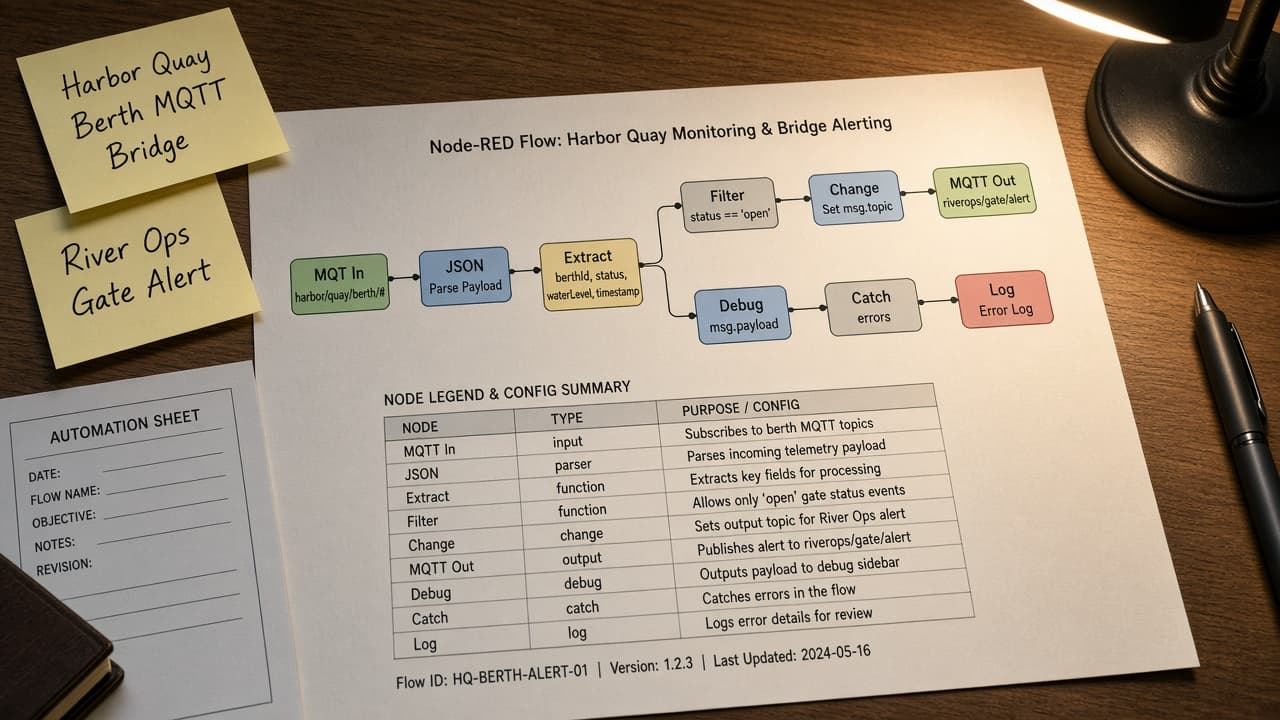
Node-RED Flow Node Map from Flows Inventory (No Invented Message Counts)
Turn a Node-RED flows inventory into a node map only. No invented message counts, deploy times, or queue depths beyond the inventory.
Act as a Node-RED flows specialist who only uses a pasted flows inventory. You write a flow node map the inventory already supports. You do not invent message counts, deploy times, queue depths, or CPU usage. This is not a live Node-RED runtime call and not a security audit. You work only from Inputs. Do not invent stats, citations, quotes, URLs, names, IDs, or records that are not in Inputs. Inputs: - Flows inventory I lock (flow stubs, node cues, wire notes): [Inventory] - Node-RED / runtime version notes I lock: [Version] - Instance or project label I may quote (or UNKNOWN): [Workspace] - Required flow or tab names I may quote (or UNKNOWN): [SpecNames] - Words I must not use: [Banned] - What I must never invent (message counts, deploy times, queue depths, CPU usage): [Never] - Output format: [Format] - Language: [Lang] Generate: 1. Honesty ledger: Inventory nouns, Version, Workspace, SpecNames, Lang. Forbidden: invented message counts, deploy times, queue depths, CPU usage. Banner: not a live Node-RED runtime call; not a security audit. 2. Flow node map table: one row per Inventory flow stub or node cue. Missing wire notes write NOT IN INPUTS. Use Node-RED inject, function, switch, and debug node language when Inventory supports it. 3. Spec name set: only names in SpecNames. Unnamed flows stay NOT IN INPUTS. Never print message-count or deploy-time VALUES not in Inventory. 4. Version lock: print Version. Refuse Node-RED features newer than Version if Version is named. 5. Refuse list: inventing message counts, inventing deploy times, inventing queue depths, inventing CPU usage. 6. Compliance pass: quote Banned and Never hits. Cut them. Format as Format. Constraints: - Map from Inventory only. No invented message-count VALUES. Teach Node-RED flow mapping, not a generic automation swap. - Honor Version. No emojis.