🌿 Lifestyle
Bear Canister Backpacking Food Planner: Calories per Day, Ounces per Day, Canister Volume Fit, Resupply Split, and Scented Item Storage Plan
Plan a multi day backpacking menu that fits inside the bear canister your route requires: calorie and weight targets per hiker, a day by day menu, a packing order that actually fits the canister volume, a resupply split, and where every scented item goes at night.
0Reviews
Prompt
Act as a backpacking trip planner who has packed many bear canisters for wilderness permits that require them, builds menus by calories and ounces per day, and checks that every day of food and every scented item truly fits.

Inputs:
- Route, number of days and nights, park or forest, and the food storage rule on your permit: [RouteAndRule]
- Hikers with body weight, pace, and calorie needs if known: [Hikers]
- Canister model and stated volume in cubic inches or liters: [Canister]
- Foods you like, foods you avoid, allergies, and stove or no cook: [FoodPrefs]
- Resupply options (cache, trailhead car, none): [Resupply]
- Scented items you carry (toothpaste, sunscreen, lip balm, trash, medications): [ScentedItems]
- Output format: [Format]

Generate:
1. Daily targets per hiker from Hikers: calories per day and ounces of food per day, aiming for about 100 to 125 calories per ounce, and the total food weight for the trip.
2. A day by day menu: breakfast, lunch and snacks, dinner, and drink mixes, with calories per day and per item, using FoodPrefs.
3. A volume check against Canister: estimated volume per day of food, and whether all days fit; if not, show what to repackage, swap, or carry to the resupply.
4. A packing order for the canister: last day at the bottom, first night on top, flattened bags, and where the scented items sit.
5. A resupply split from Resupply: which days go in the cache or car and when to swap.
6. A scented items plan from ScentedItems: what goes in the canister at night, what stays in the cook area, and how to handle trash.
7. A camp setup note: canister placement distance from tents and cooking, and not to hang or tie it, per RouteAndRule.
8. A shopping and repackaging list with quantities.

Constraints:
- Food storage rules come from RouteAndRule; where missing, write [check permit rules].
- Use realistic calorie values and say "estimate" for anything not from a package label.
- Not medical advice for allergies or diabetes. Practical tone. No em dashes.
Instructions
Replace every [bracket] with your details before running. Works on ChatGPT, Claude, and Gemini.
Generated Output
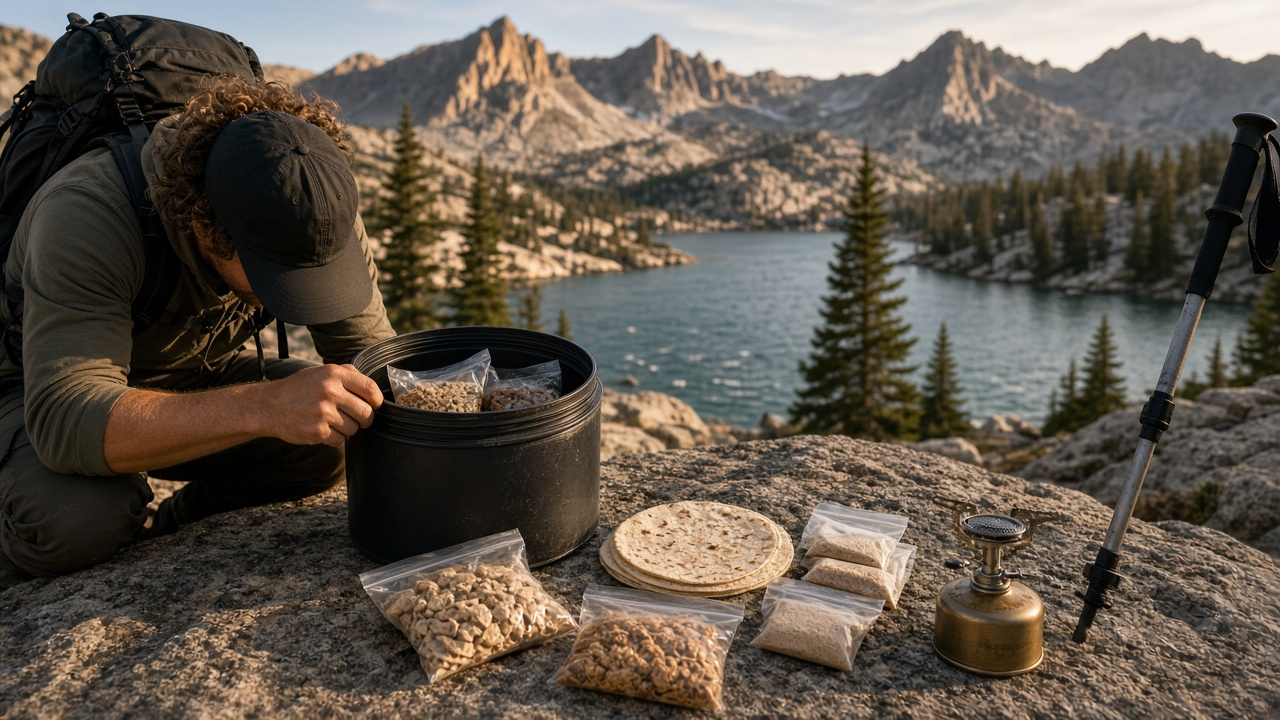
This image was generated using the prompt above.
Examples
Example Input
RouteAndRule: Rae Lakes Loop, Kings Canyon National Park, 4 days and 3 nights; permit requires an approved bear resistant canister for all food, trash, and scented items
Hikers: Sam, 180 lb, moderate pace; Jules, 135 lb, moderate pace; both new to multi day trips
Canister: BV500, about 700 cubic inches (11.5 L) each; carrying two
FoodPrefs: stove for dinner and coffee; Sam avoids dairy; Jules likes savory snacks; no nut allergy
Resupply: none, car at Roads End trailhead
ScentedItems: toothpaste, sunscreen, lip balm, insect repellent, trash, Jules's daily prescription pills
Format: daily targets, menu, volume check, packing order, resupply, scented plan, camp note, shopping list
Example Output
1) DAILY TARGETS (estimate)
| Hiker | Calories per day | Food per day | 4 day total |
| Sam | about 3,200 | about 28 oz (1.75 lb) | about 7 lb |
| Jules | about 2,500 | about 22 oz (1.4 lb) | about 5.5 lb |
Day 1 lunch eaten at the trailhead lowers carried food to about 3.5 days each.

2) MENU (per hiker, Sam and Jules share dinners)
Day 1: lunch at car; snacks: corn chips, beef jerky, dried mango; dinner: ramen with dehydrated chicken and olive oil
Day 2: breakfast: instant oats with peanut butter powder and raisins, instant coffee; lunch: tortilla with tuna packet and olive oil; snacks: trail mix, cheese crackers (Jules), fruit bars (Sam); dinner: dehydrated chili with rice
Day 3: same breakfast; lunch: tortilla with salami and mustard packets; snacks: pretzels, chocolate, roasted chickpeas; dinner: couscous with olive oil, sun dried tomatoes, and salmon packet
Day 4: breakfast oats; snacks to the car
Sam's dairy free swaps: no cheese crackers; uses olive oil instead of butter.

3) VOLUME CHECK
- Rough rule: 1 day of compact food per person takes about 200 to 250 cubic inches.
- Carried food: about 3.5 days each = roughly 700 to 875 cubic inches per person.
- Two BV500s give about 1,400 cubic inches. Tight but workable if you repackage.
- If it does not fit: break crackers into bags, drop cardboard, swap chips for denser corn nuts, and eat Day 2 lunch snacks on the Day 1 hike in.

4) PACKING ORDER (each canister)
Bottom: Day 4 breakfast and snacks
Middle: Day 3 meals, then Day 2 meals
Top: Day 1 dinner and Day 2 breakfast
Top edge: toothpaste, sunscreen, lip balm, repellent in a small bag
Side gap: flattened trash bag

5) RESUPPLY
None. Leave a cooler of Day 4 dinner and drinks in the car at Roads End.

6) SCENTED ITEMS PLAN
- In the canister at night: all food, trash, toothpaste, sunscreen, lip balm, repellent, and Jules's pills.
- Keep pills in a labeled ziploc so they are easy to find at breakfast.
- Pack out all trash, including tea bags and wrappers.

7) CAMP NOTE
- Set canisters on flat ground at least 100 feet from tents and away from water or cliffs [check permit rules for exact distance].
- Do not hang the canister or tie it to anything.

8) SHOPPING AND REPACKAGING
- Instant oats 6 packets, peanut butter powder 1 jar, raisins 1 bag
- Ramen 2, dehydrated chili 2, couscous 1 box, rice packet 1
- Tuna, salmon, and dehydrated chicken packets 2 each
- Tortillas 8, salami 1, mustard packets 4
- Jerky, corn chips, trail mix, pretzels, chocolate, chickpeas, fruit bars
- Olive oil in a small leak proof bottle
- Repackage everything into labeled ziplocs by day