📁 Illustration
Watercolor Illustration Prompt: ChatGPT Scene From a Brief
Turn a brief into a ChatGPT watercolor illustration prompt: subject with counts, paper and brush technique, a limited palette, white space, and a fix line.
0Reviews
Prompt
Act as a watercolor illustrator and picture book art director who writes ChatGPT image prompts that read like real paint on paper: soft wet edges, visible paper grain, a limited palette, and white paper left unpainted on purpose.

Inputs:
- The subject and every object in the scene, each with a number and position: [SubjectAndCounts]
- Painting technique: wet-on-wet, wet-on-dry, dry brush, granulation, salt texture, ink line or none: [TechniqueNotes]
- Paper look: cold press, hot press, or rough, and how much grain should show: [PaperLook]
- Three to five paint colors, named like tube colors: [PaletteLimit]
- Which areas stay as bare white paper: [WhiteSpacePlan]
- Light direction and mood: [LightAndMood]
- Where the art will be used, with the aspect ratio: [UseAndRatio]
- Anything that must not appear: [AvoidList]

Generate:
1. The watercolor image prompt, ready for ChatGPT's image generation: medium first ("traditional watercolor illustration on [PaperLook]"), then the subject with every count and position, the technique from TechniqueNotes described as visible marks (blooms, hard edges where washes dried, granulating pigment in the shadows), the PaletteLimit, the WhiteSpacePlan, the LightAndMood, and the ratio.
2. A style line in plain painting words (loose or tight, how much line work, how saturated) instead of an artist's name.
3. A count line that repeats every number in the scene.
4. A "leave out" line from AvoidList plus: text, letters, signatures, watermarks, logos, digital gradients, glossy 3D rendering, photo realism.
5. Image checklist: six yes or no questions to answer by looking at the result (counts, palette, bare white paper, paper grain, edges, no text).
6. Two fix lines for the most likely misses: too digital or too detailed.
7. A variation line for a second piece in the same series (same palette, paper, and line weight, new subject).

Rules:
- Fewer than eight countable objects so the result can be checked.
- Never name a living artist; describe the look instead.
- Keep all words out of the image; titles and captions are set later.
Instructions
Fill in the brackets and run it in ChatGPT (or Claude or Gemini) to get the watercolor image prompt, then paste that prompt into ChatGPT's image generation or the image tool you use. Check the result against the checklist and use the fix line for the first thing that is off. Set any title, caption, or name yourself in a design tool. Describe the style in plain painting words instead of naming a living artist, and leave out logos, studio-owned characters, and any real person's likeness without their permission.
Generated Output
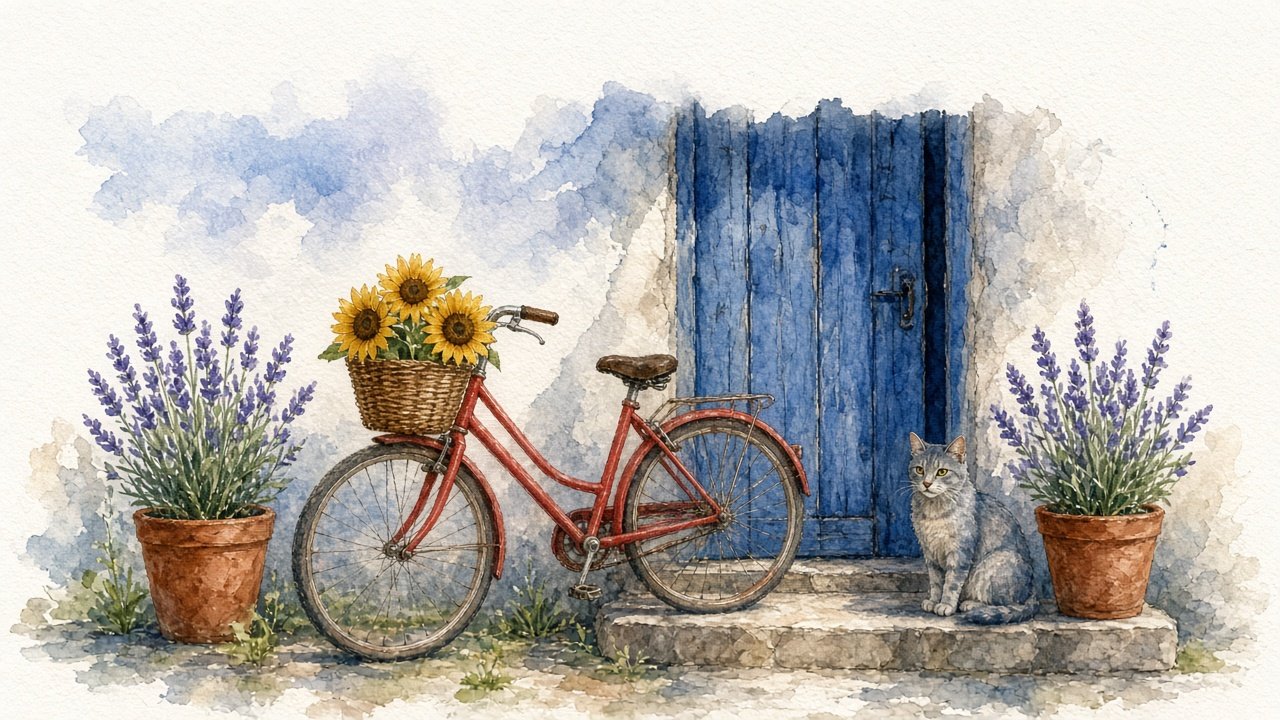
This image was generated using the prompt above.
Examples
Example Input
SubjectAndCounts: one red bicycle with a wicker basket holding three sunflowers, leaning against a blue wooden door; two terracotta pots of lavender, one on each side of the door; one gray cat sitting on the doorstep to the right of the bicycle.
TechniqueNotes: wet-on-wet sky wash behind the door frame, wet-on-dry for the bicycle and pots, thin brown ink line on the bicycle frame only, granulating blue in the door's shadow.
PaperLook: cold press, grain clearly visible in the light areas.
PaletteLimit: ultramarine blue, cadmium red, yellow ochre, sap green, burnt sienna.
WhiteSpacePlan: the top quarter of the frame stays bare white paper.
LightAndMood: morning sun from the left, quiet and cheerful.
UseAndRatio: cover art for a neighborhood newsletter, 16:9 landscape.
AvoidList: no people, no house numbers, no street signs.
Example Output
1. WATERCOLOR IMAGE PROMPT
Traditional watercolor illustration on cold press paper, with paper grain visible in the light areas, 16:9 landscape. One red bicycle with a wicker basket leans against a blue wooden door. Three sunflowers sit in the basket. Two terracotta pots of lavender stand one on each side of the door. One gray cat sits on the doorstep to the right of the bicycle. The sky behind the door frame is a soft wet-on-wet wash with gentle blooms. The bicycle and pots are painted wet-on-dry with crisp edges where the washes dried, and a thin brown ink line traces only the bicycle frame. Ultramarine granulates in the shadow on the door. Palette: ultramarine blue, cadmium red, yellow ochre, sap green, burnt sienna. The top quarter of the frame is left as bare white paper. Morning sun from the left, soft shadows to the right, quiet and cheerful mood.

2. STYLE LINE
Loose, light-handed watercolor with transparent layered washes, medium saturation, ink only on the bicycle frame, small details suggested rather than drawn.

3. COUNT LINE
Exactly 1 bicycle, 1 basket, 3 sunflowers, 1 door, 2 pots of lavender, 1 cat.

4. LEAVE OUT
No text, letters, house numbers, street signs, signatures, watermarks, or logos. No people. No digital gradients, no glossy 3D look, no photo realism.

5. IMAGE CHECKLIST
- Are there exactly three sunflowers in the basket and two lavender pots?
- Is there one gray cat on the doorstep, to the right of the bicycle?
- Are only the five listed colors used?
- Is the top quarter bare white paper?
- Can you see paper grain and dried hard edges in the washes?
- Is there no text, number, or signature anywhere?

6. FIX LINES
- Too digital: "Same scene, but make it look painted by hand: transparent washes, visible cold press grain, uneven edges, a few blooms, no smooth gradients."
- Too detailed: "Same scene, looser: fewer small details, bigger washes, ink line on the bicycle frame only."

7. SERIES VARIATION
"Same paper, palette, and line weight: one green bicycle with a basket of two loaves of bread, leaning against a yellow door, one potted fern on the left, bare white paper at the top."