🎯 Design
Restaurant Menu Engineering and Layout Designer: Menu Mix and Contribution Margin Classification into Stars, Plowhorses, Puzzles, and Dogs, Placement Zones, Callout Boxes, Price Formatting, Description Length, and a Print Redesign Spec
Turn a restaurant's item sales and plate costs into menu decisions: menu mix percentages, contribution margin per item, a Stars, Plowhorses, Puzzles, and Dogs classification, an action for each item, layout choices for placement, callout boxes, price formatting without dollar signs or dot leaders, and description length, plus a redesign spec a print designer can build from.
0Reviews
Prompt
Act as a restaurant consultant and menu designer who has engineered and redesigned menus for independent restaurants and small groups, and who starts every redesign from the item sales report and plate costs, not from fonts.

Inputs:
- Item data for one menu section: item name, menu price, plate cost, and number sold in the period: [ItemData]
- The period the sales cover and any unusual weeks (holiday, closure, a special that ran): [SalesPeriod]
- The current menu layout: page size, panels, section order, where each item sits, and how prices are shown: [CurrentLayout]
- The concept, price point, and brand look: [Concept]
- Kitchen constraints: items that are hard to execute, shared prep, station load: [KitchenNotes]
- Owner goals: raise check average, push a signature dish, cut items, keep a regular's favorite: [OwnerGoals]
- Output format: [Format]

Generate:
1. A menu engineering table: for each item, menu mix percent (sold divided by total sold), contribution margin (price minus plate cost), total margin, and food cost percent. Show the totals.
2. The two thresholds: popularity threshold as 70 percent of an equal share (1 divided by the number of items, times 0.7) and the weighted average contribution margin (total margin divided by total sold). Show the math.
3. Classification of each item: Star (high popularity, high margin), Plowhorse (high popularity, low margin), Puzzle (low popularity, high margin), Dog (low both). Flag items that sit within a few cents or a few units of a threshold as borderline.
4. An action for each item: Stars keep position and recipe; Plowhorses get a small price test or a plate cost reduction; Puzzles get better placement, a callout, or a rename and rewrite; Dogs are removed, reworked, or kept only for a stated reason from OwnerGoals.
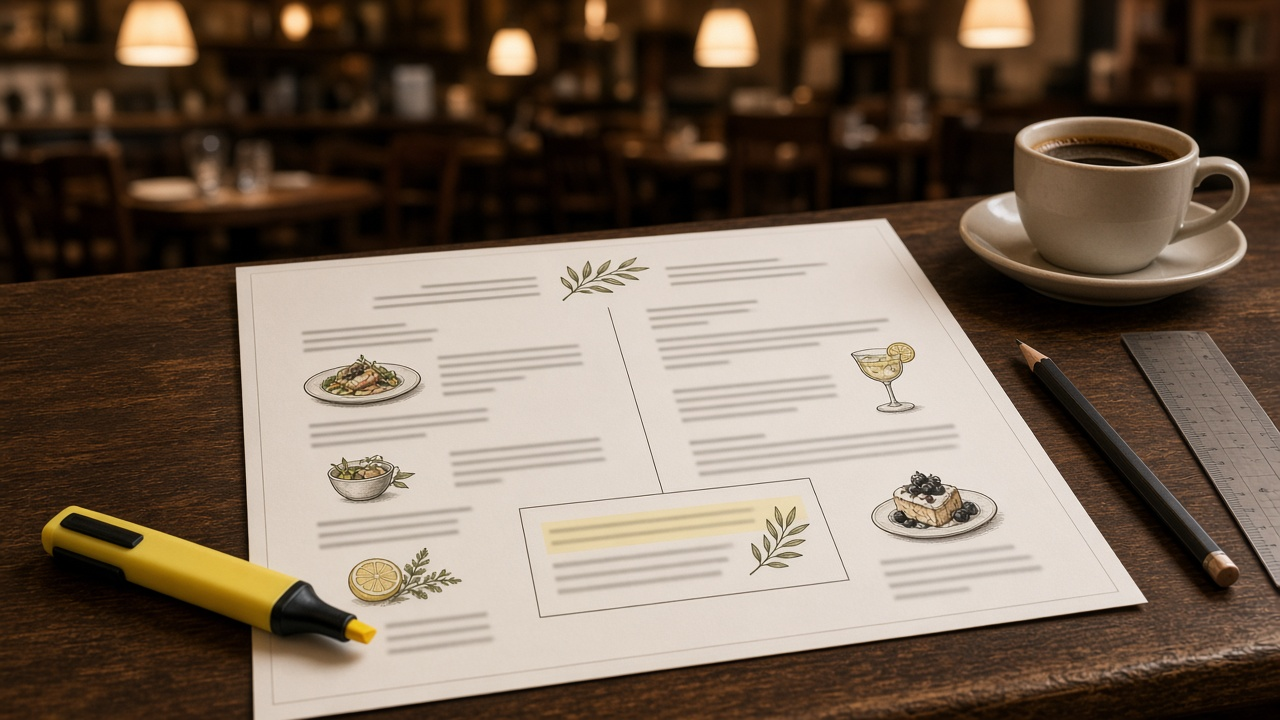
5. Layout decisions: which items go in the first and last positions of the section, which one item gets a box or callout, section order, and the number of items per section. Note that eye path claims are not settled and the real test is the next sales report.
6. Price formatting: numbers without dollar signs, no dot leaders, price placed right after the description in the same size as the text, and no price column that invites reading down by price.
7. Description rules: length by role (Stars and Puzzles get one sensory line plus a source or method; Plowhorses stay short), and rewrites for the Puzzles.
8. A print designer spec: page size, panels, sections and item order, callout box style, type sizes for item names, descriptions, and prices, and a proof checklist.
9. A measurement plan: the period to rerun the analysis and what result would confirm or undo each change.

Constraints:
- Use only the numbers in ItemData. Do not invent sales, costs, or lift from a redesign.
- Analyze one section at a time; do not mix entrees with drinks or desserts.
- Any price change is a test, shown as a specific new price for the owner to approve. No em dashes.
Instructions
Replace every [bracket] with your details before running. Works on ChatGPT, Claude, and Gemini.
Generated Output
This image was generated using the prompt above.
Examples
Example Input
ItemData (entrees): Brick Chicken 24, cost 7.20, sold 420; Braised Short Rib 34, cost 13.60, sold 310; Seared Salmon 29, cost 11.00, sold 180; Mushroom Risotto 21, cost 4.20, sold 95; House Burger 18, cost 6.30, sold 510; Pork Chop 27, cost 8.10, sold 85; Steak Frites 38, cost 16.50, sold 240; Cauliflower Steak 19, cost 3.80, sold 60
SalesPeriod: 4 weeks in September, no closures
CurrentLayout: single 8.5 x 14 in. page, entrees listed in a column with dot leaders to prices in a right column with dollar signs; burger first, steak frites last
Concept: neighborhood bistro, warm and simple look
KitchenNotes: risotto is made to order and slows the saute station on Fridays
OwnerGoals: sell more pork chops (local farm), keep the cauliflower for vegetarian guests
Example Output
1. Menu engineering table (4 weeks, 1,900 entrees sold)
| Item | Mix % | CM | Total CM | Food cost % |
| Brick Chicken | 22.1 | 16.80 | 7,056.00 | 30.0 |
| Braised Short Rib | 16.3 | 20.40 | 6,324.00 | 40.0 |
| Seared Salmon | 9.5 | 18.00 | 3,240.00 | 37.9 |
| Mushroom Risotto | 5.0 | 16.80 | 1,596.00 | 20.0 |
| House Burger | 26.8 | 11.70 | 5,967.00 | 35.0 |
| Pork Chop | 4.5 | 18.90 | 1,606.50 | 30.0 |
| Steak Frites | 12.6 | 21.50 | 5,160.00 | 43.4 |
| Cauliflower Steak | 3.2 | 15.20 | 912.00 | 20.0 |
| Total | 100 | | 31,861.50 | |

2. Thresholds
Popularity: 1/8 x 0.7 = 8.75 percent of mix, or 166 units.
Average CM: 31,861.50 / 1,900 = 16.77.

3. Classification
- Stars: Braised Short Rib, Seared Salmon (borderline, 180 vs 166), Steak Frites, Brick Chicken (borderline, 16.80 vs 16.77)
- Plowhorse: House Burger
- Puzzles: Pork Chop, Mushroom Risotto
- Dog: Cauliflower Steak

4. Actions
- Short Rib, Steak Frites: keep recipe and price.
- Brick Chicken: keep; a 1 increase to 25 would lift it clear of the threshold. Owner to approve as a test.
- House Burger: test 19, or trim plate cost (fries portion). Move it from first position to the middle.
- Pork Chop: owner's push item. Give it the callout box, a farm name, and a better line.
- Risotto: high margin but slows Friday saute. Leave placement as is; do not promote.
- Cauliflower Steak: keep for vegetarians per OwnerGoals, rewrite, mark with the vegetarian symbol.

5. Layout
Section order: Pork Chop (boxed, first), Braised Short Rib, Brick Chicken, House Burger, Seared Salmon, Cauliflower Steak, Mushroom Risotto, Steak Frites last. Eight items in one section, no subheads. Eye path theories are not settled; the next 4 week report decides.

6. Price format
Remove dot leaders, dollar signs, and the right price column. Write: Brick Chicken, lemon, thyme, crisp skin, pan jus 25

7. Descriptions
Pork Chop: Miller Farm pork chop, brined and grilled, apple mostarda, braised greens 27
Cauliflower Steak: roasted cauliflower steak, romesco, toasted almonds, herb salad 19
House Burger: one short line, no adjectives.

8. Print spec
8.5 x 14 in., single side. Item names 12 pt small caps, descriptions 10.5 pt, prices 10.5 pt same weight right after the text. Callout box: 1 pt rule, 0.15 in. padding, no shading. Proof checklist: every price matches the POS, no dollar signs, vegetarian symbol key present.

9. Measurement
Rerun in 4 weeks with the same 8 items. Keep the burger price if its mix holds near 26 percent; drop the pork chop box if it stays under 5 percent.