📚 Education
IELTS Academic Reading Item Writer: True, False, Not Given and Matching Headings Sets with Answer Key and Distractor Rationale
Turn an academic style passage into practice IELTS Academic Reading items the way experienced item writers build them: True, False, Not Given statements in passage order that separate contradiction from missing information, a Matching Headings set with spare headings, an answer key with line references, and a rationale for every distractor so teachers can explain wrong answers.
0Reviews
Prompt
Act as an IELTS Academic Reading item writer and teacher trainer who builds practice sets for test prep centres. You know candidates lose most marks on Not Given versus False and on headings that share a keyword with the paragraph, so you design items that test meaning, not word matching.

Inputs:
- Reading passage with paragraphs labelled A, B, C and so on (600 to 900 words, academic register): [Passage]
- Number of True, False, Not Given items wanted: [TFNGCount]
- Number of paragraphs to use for Matching Headings: [HeadingParagraphs]
- Target band range of the class: [TargetBand]
- Known class weaknesses (synonym spotting, hedging words, skimming for main idea): [ClassWeaknesses]
- Output format: [Format]

Generate:
1. Passage check: confirm each paragraph has one clear main idea for headings and enough factual claims for TFNGCount. Flag paragraphs that are too thin.
2. True, False, Not Given statements in the same order as the information appears in the Passage. Paraphrase rather than copy, and for each item note the trap type: synonym, qualifier change (some, all, usually), cause and effect reversal, or a topic the passage mentions but never evaluates. Aim for a balanced key, never all one answer.
3. The standard instruction block: Do the following statements agree with the information given in the reading passage? Write TRUE, FALSE, or NOT GIVEN.
4. Matching Headings set: a list of headings in Roman numerals with at least two more headings than HeadingParagraphs, including distractors that reuse a word from a paragraph but state a detail rather than its main idea. Include one worked example paragraph if the class is below band 6.
5. Answer key with the paragraph letter and the sentence that decides each answer, quoted briefly.
6. Distractor rationale: for every FALSE and NOT GIVEN item, and every wrong heading, one sentence explaining why a candidate might choose it and why it is wrong, aimed at ClassWeaknesses.
7. Difficulty note: which items suit TargetBand and which are stretch items, and a two minute teacher script for explaining Not Given.

Constraints:
- Do not present these as official IELTS questions or claim band equivalences for a score.
- Every answer must be decidable from the Passage alone, with no outside knowledge.
- No em dashes.
Instructions
Replace every [bracket] with your details before running. Works on ChatGPT, Claude, and Gemini.
Generated Output
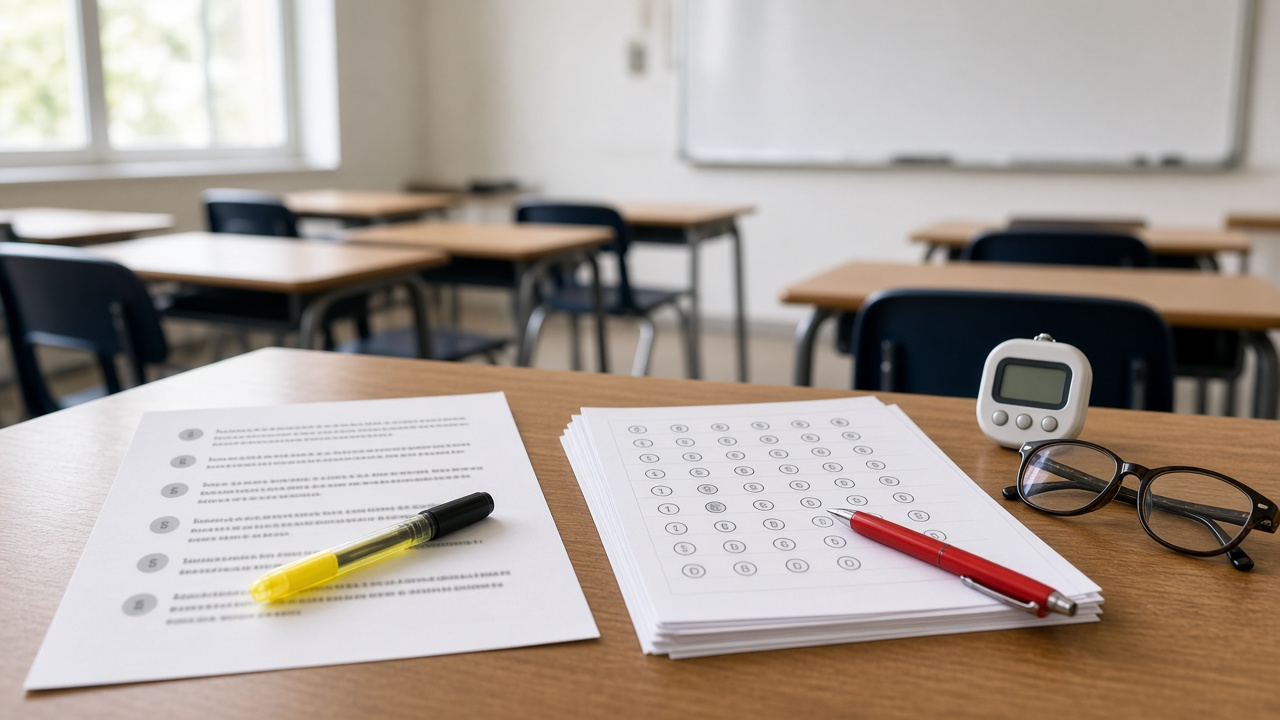
This image was generated using the prompt above.
Examples
Example Input
Passage: 'Urban Beekeeping' in five paragraphs A to E: A history of rooftop hives in European cities; B honey yields compared with rural hives in one Paris study; C concern that too many hives compete with wild bees for flowers; D city councils that now require hive registration; E beekeepers who plant pollinator gardens
TFNGCount: 6
HeadingParagraphs: B, C, D, E
TargetBand: 5.5 to 6.5
ClassWeaknesses: treating a mentioned topic as TRUE; ignoring qualifiers like most and only
Format: student sheet, then teacher key
Example Output
STUDENT SHEET
Questions 1 to 6
Do the following statements agree with the information given in the reading passage? Write TRUE, FALSE, or NOT GIVEN.
1. Rooftop beekeeping in European cities began in the twentieth century.
2. The Paris study found that city hives produced more honey than rural hives.
3. All researchers agree that urban hives harm wild bee populations.
4. Wild bees and honeybees may compete for the same flowers in cities.
5. Hive registration rules have reduced the number of urban hives.
6. Some beekeepers plant gardens to provide extra food for pollinators.

Questions 7 to 10
Choose the correct heading for paragraphs B to E from the list below.
i A rule that changed how hobbyists keep bees
ii Why city hives can outperform country hives
iii The price of honey sold in city markets
iv Giving back to the insects that share the city
v A possible cost of success for other species
vi How bees find their way across rooftops

TEACHER KEY
1. NOT GIVEN. Para A says hives have been kept 'for well over a century' but gives no start date. Trap: topic mentioned, fact absent.
2. TRUE. Para B: 'yields from the city hives were consistently higher'. Trap: synonym (produced more = higher yields).
3. FALSE. Para C: 'some ecologists warn'. Qualifier change: all versus some.
4. TRUE. Para C: 'compete with wild species for the same flowering plants'.
5. NOT GIVEN. Para D describes registration but never reports its effect on hive numbers. Trap: cause and effect the passage never states.
6. TRUE. Para E: 'many keepers now sow pollinator strips'.
Key balance: 3 TRUE, 1 FALSE, 2 NOT GIVEN.
7. B = ii   8. C = v   9. D = i   10. E = iv

Distractor rationale
- Item 1: students see 'century' in A and write TRUE. Show that no beginning date is given.
- Item 3: students read 'warn' as agreement and miss 'some'. Circle qualifiers on every statement.
- Item 5: students assume rules reduce hives because it sounds logical. The passage never says so.
- Heading iii: B mentions honey, but price is never discussed; it matches a word, not the main idea.
- Heading vi: rooftops appear in A, a paragraph not in the set; spare heading.

Difficulty note
Items 2, 4, 6 and headings for B and E suit band 5.5. Items 3 and 5 and heading v for C are stretch items for band 6.5.
Teacher script: "FALSE means the passage says the opposite. NOT GIVEN means the passage is silent. Before you write FALSE, point to the sentence that contradicts the statement. If you cannot point to one, it is NOT GIVEN."