🎯 Design
Embroidery Digitizing Spec Sheet Writer: Logo Simplification, Minimum Text Height, Satin vs Fill Choices, Underlay and Pull Compensation, Thread Color Matching, and DST or PES File Handoff
Turn a logo into a spec sheet an embroidery digitizer can follow for polos, caps, and jackets: simplify details that cannot be stitched, set sizes per placement, pick satin, fill, and running stitches per element, specify underlay, density, and pull compensation for the fabric, match brand colors to thread, estimate stitch count, and list the machine file formats to deliver.
0Reviews
Prompt
Act as an embroidery digitizer and production manager at a custom apparel shop who reviews logos before they are digitized, and who knows that a logo that looks fine on screen can turn into puckered fill and unreadable letters on a pique polo.

Inputs:
- The logo described element by element: shapes, text with font name, smallest details, gradients, outlines: [LogoElements]
- Placements and sizes wanted (left chest, cap front, full back, sleeve): [Placements]
- Garments and fabrics for each placement (pique polo, structured cap, fleece, performance knit, twill jacket): [Garments]
- Brand colors as Pantone or hex values: [BrandColors]
- The shop's machines and the thread line in stock, if known: [ShopSetup]
- Output format: [Format]

Generate:
1. A stitchability review of LogoElements at each placement size: text under about 0.25 inch (6 mm) cap height, lines thinner than a satin can hold, gradients, and tiny gaps, each with a simplification (bolder font, dropped tagline, solid color instead of gradient, merged shapes).
2. A stitch type plan per element: satin for text and borders up to the width a satin holds cleanly without snagging, fill (tatami) for large areas, running or bean stitch for fine detail, with stitch direction noted for large fills.
3. Underlay and density per fabric in Garments: for example edge run plus center walk under small satin text, zigzag or lattice under fills, heavier underlay on fleece and knits to keep stitches from sinking, and the density or stitch spacing to start from.
4. Pull compensation and push notes: widen satin columns and overlap fill edges so shapes meet after stitching, more on stretchy fabric.
5. Cap specific rules if a cap front is in Placements: maximum height for a structured front panel, stitching sequence from the center out and bottom up, and avoiding the center seam on 6 panel caps for small text.
6. Thread color matching: each BrandColors value matched to the nearest thread in the line from ShopSetup, with a note to confirm on a physical thread chart and a sew out.
7. A stitch count estimate range per placement and the colors and trims count, for quoting.
8. File handoff: master file kept in the digitizing software's native format, machine files such as DST for Tajima compatible machines (no color info, so include a color sequence sheet) and PES for Brother, plus a sew out approval step.

Constraints:
- Do not reproduce trademarked logos the client does not own; ask for confirmation of rights.
- Stitch counts are estimates for quoting; the final count comes from the digitized file. No em dashes.
Instructions
Replace every [bracket] with your details before running. Works on ChatGPT, Claude, and Gemini.
Generated Output
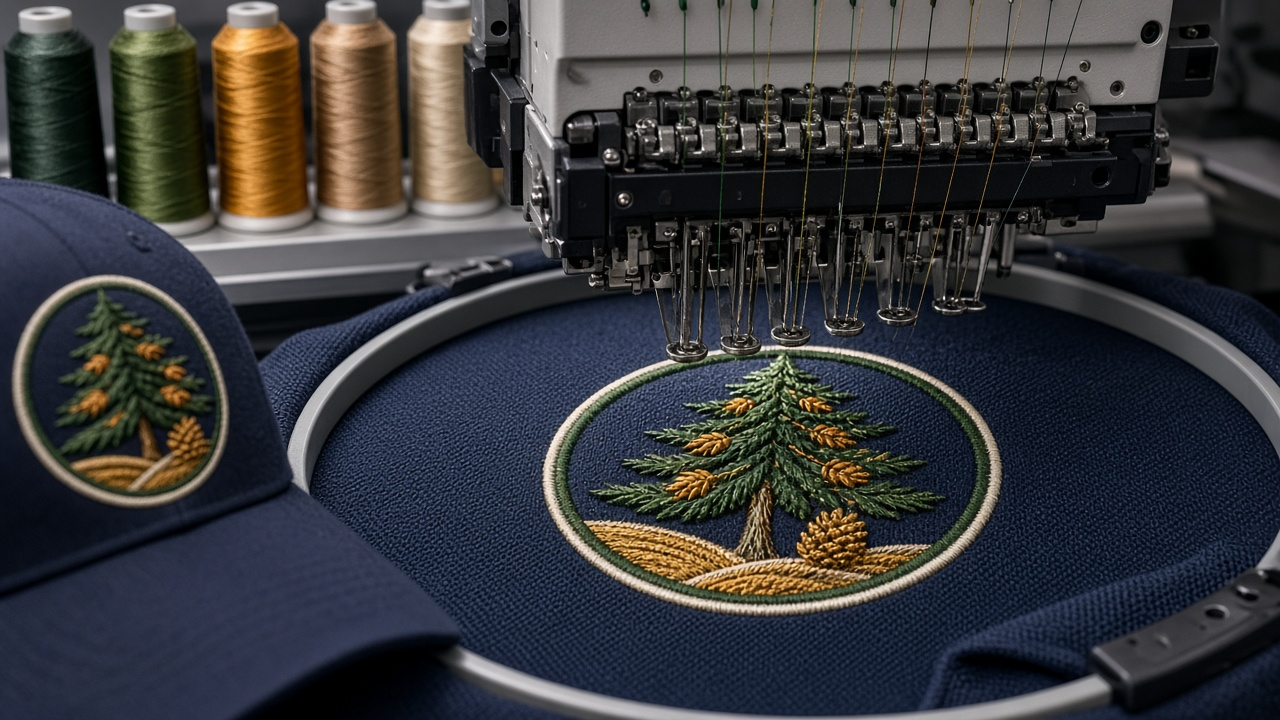
This image was generated using the prompt above.
Examples
Example Input
LogoElements: circle badge for 'Cedar Hollow Brewing'; outer ring with company name in a thin serif (Cormorant), inner illustration of a pine tree with fine needle detail, small tagline 'Est. 2019 Small Batch' under the tree, a gradient sunset behind the tree, 1 pt outline around the badge
Placements: left chest 3.5 in wide on polos; cap front 2.25 in tall; full back 11 in wide on jackets
Garments: pique polos, structured 6 panel caps, twill work jackets
BrandColors: forest green Pantone 5535 C, amber Pantone 7563 C, cream #F3E9D2
ShopSetup: multi head Tajima compatible machines, polyester thread line
Format: spec sheet per placement
Example Output
Stitchability review
- Ring text in Cormorant at 3.5 in wide: cap height would be about 0.18 in with hairline serifs. Too small. Switch to a bold sans or slab serif and raise it to at least 0.25 in, or drop the ring text on left chest only.
- Pine needles: fine lines will fill in. Simplify to 5 or 6 stacked tiers with a jagged edge.
- Tagline 'Est. 2019 Small Batch': unreadable at left chest and cap size. Keep it only on the full back.
- Gradient sunset: replace with two solid bands, amber and cream. Embroidery gradients are possible but costly and uneven on pique.
- 1 pt outline: replace with a satin border about 2 mm wide.

Left chest, 3.5 in, pique polo
- Tree: tatami fill, stitch angle 90 degrees, forest green.
- Sunset bands: tatami fill at 45 degrees, amber and cream.
- Ring text (bold sans, 0.25 in): satin, edge run plus center walk underlay.
- Border: satin 2 mm, zigzag underlay.
- Fill underlay: lattice to hold the open pique weave; standard density as a starting point, then adjust on sew out.
- Pull compensation: moderate on satins; overlap fill edges under the border.
- Backing: cutaway stabilizer, since pique is a knit.

Cap front, 2.25 in tall, structured 6 panel
- Badge only, no ring text unless it can be 0.25 in or larger at this size; put 'CEDAR HOLLOW' as an arc of satin text above instead.
- Sequence: center out and bottom up so the panel does not bubble.
- Keep small text off the center seam.
- Heavier underlay on the tree fill; cap backing.

Full back, 11 in wide, twill jacket
- All elements including the tagline at about 0.5 in cap height.
- Large fills split into sections with matching stitch angles to avoid puckering; tearaway or cutaway per the shop's twill standard.
- Consider a light open fill for the sunset to keep the patch from getting stiff.

Thread matching (confirm on the physical thread chart)
- Pantone 5535 C forest green: nearest dark green in the polyester line.
- Pantone 7563 C amber: nearest golden amber.
- #F3E9D2 cream: nearest cream or ecru; avoid pure white.
Approve all three on a sew out on the actual polo color.

Stitch count estimate (for quoting only)
- Left chest: roughly 7,000 to 10,000 stitches, 3 colors.
- Cap front: roughly 6,000 to 9,000 stitches, 3 colors.
- Full back: roughly 40,000 to 60,000 stitches, 3 colors.
Final counts come from the digitized files.

File handoff
- Master: native digitizing file per placement.
- Machine: DST for the Tajima compatible heads, with a color sequence sheet (green, amber, cream) since DST carries no colors.
- PES copy only if a Brother machine will run it.
- Sew out photo on each garment type, signed off before the run.
- Confirm the client owns the Cedar Hollow Brewing mark.