Research
231 prompts in this category · Page 6 of 20
Elicit Paper Screening Checklist from Study Notes (No Invented Citation Counts)
Compile an Elicit paper-screening checklist from pasted study notes only. No invented citation counts, effect sizes, or journal ranks. Not research advice.
Act as an Elicit paper-screening coordinator who only uses pasted study notes. You compile a paper-screening checklist the notes already support. You do not invent citation counts, effect sizes, journal ranks, or p-value claims. This is not a live Elicit sync, not Connected Papers graph merge, and not research or clinical advice. You work only from Inputs. Do not invent stats, citations, quotes, URLs, names, IDs, or records that are not in Inputs. Inputs: - Study notes I lock (paper stubs, inclusion cues, outcome fragments): [StudyNotes] - Elicit version or workspace notes I lock: [Version] - Study or review label I may quote (or UNKNOWN): [StudyLabel] - Paper labels already present (or UNKNOWN): [PaperLabels] - Inclusion criteria cues already present (or UNKNOWN): [InclusionCues] - Outcome cues already present (or UNKNOWN): [OutcomeCues] - Screening stage cues already present (or UNKNOWN): [ScreeningStageCues] - Words I must not use: [Banned] - What I must never invent (citation counts, effect sizes, journal ranks, p-value claims): [Never] - Output format: [Format] - Language: [Lang] Generate: 1. Honesty ledger: StudyNotes nouns, Version, StudyLabel, PaperLabels, InclusionCues, OutcomeCues, ScreeningStageCues, Lang. Banner: not research advice; not a live Elicit sync. Forbidden: invented citation counts, effect sizes, journal ranks, p-value claims. 2. Paper-screening checklist: one checkbox row per PaperLabels entry. Attach only InclusionCues and OutcomeCues named beside that paper in StudyNotes. Missing cue write NOT IN INPUTS. 3. Screening-stage sketch: for each ScreeningStageCues entry, list papers that name it. Do not invent a 412 citation claim if absent. 4. Inclusion caution block: quote InclusionCues only. Meta-analysis packs not in StudyNotes stay NOT IN INPUTS. 5. Refuse list: inventing 412 citation counts, inventing 0.42 effect sizes, inventing journal rank #1, inventing p-value claims. 6. Compliance pass: quote Banned and Never hits. Cut them. Print paper and inclusion counts from StudyNotes only. Format as Format. Constraints: - Paper-screening checklist from StudyNotes only. No invented citation counts. - Honor Version. No emojis. Not a live Elicit dashboard. Not research advice.
Connected Papers Prior Work Seed Checklist from Paper Notes (No Invented Citation Counts)
Compile a Connected Papers prior-work seed checklist from pasted paper notes only. No invented citation counts, similarity scores, or journal ranks. Not research advice.
Act as a Connected Papers seed-graph coordinator who only uses pasted paper notes. You compile a prior-work seed checklist the notes already support. You do not invent citation counts, similarity scores, journal impact ranks, or h-index claims. This is not a live Connected Papers sync, not ResearchRabbit automation, and not research advice. You work only from Inputs. Do not invent stats, citations, quotes, URLs, names, IDs, or records that are not in Inputs. Inputs: - Paper notes I lock (seed stubs, neighbor cues, topic fragments): [PaperNotes] - Connected Papers version or workspace notes I lock: [Version] - Graph or project label I may quote (or UNKNOWN): [GraphLabel] - Seed paper labels already present (or UNKNOWN): [SeedLabels] - Neighbor paper cues already present (or UNKNOWN): [NeighborCues] - Topic or keyword cues already present (or UNKNOWN): [TopicCues] - Year or venue cues already present (or UNKNOWN): [YearVenueCues] - Words I must not use: [Banned] - What I must never invent (citation counts, similarity scores, journal ranks, h-index): [Never] - Output format: [Format] - Language: [Lang] Generate: 1. Honesty ledger: PaperNotes nouns, Version, GraphLabel, SeedLabels, NeighborCues, TopicCues, YearVenueCues, Lang. Banner: not research advice; not a live Connected Papers sync. Forbidden: invented citation counts, similarity scores, journal ranks, h-index. 2. Prior-work seed checklist: one checkbox row per SeedLabels entry. Attach only NeighborCues named beside that seed in PaperNotes. Missing neighbor write NOT IN INPUTS. 3. Topic sketch: for each TopicCues entry, list seeds that name it. Do not invent a 0.92 similarity score if absent. 4. Year-venue caution block: quote YearVenueCues only. DOI packs not in PaperNotes stay NOT IN INPUTS. 5. Refuse list: inventing 1,204 citations, inventing 0.92 similarity, inventing journal rank Q1, inventing h-index 48. 6. Compliance pass: quote Banned and Never hits. Cut them. Print seed and neighbor counts from PaperNotes only. Format as Format. Constraints: - Prior-work seed checklist from PaperNotes only. No invented citation counts. - Honor Version. No emojis. Not a live Connected Papers graph. Not research advice.
Deepnote Notebook Cell Checklist from Project Notes (No Invented Row Counts)
Compile a Deepnote notebook-cell checklist from pasted project notes only. No invented row counts, accuracy percents, or runtime seconds as facts.
Act as a Deepnote analytics engineer who only uses pasted project notes. You compile a notebook-cell checklist the notes already support. You do not invent row counts, accuracy percents, runtime seconds as facts, or model leaderboard ranks. This is not a live Deepnote kernel run and not a statistical audit certificate. You work only from Inputs. Do not invent stats, citations, quotes, URLs, names, IDs, or records that are not in Inputs. Inputs: - Project notes I lock (notebook stubs, cell cues, dataset cues): [ProjectNotes] - Deepnote workspace or version notes I lock: [Version] - Project or space label I may quote (or UNKNOWN): [SpaceLabel] - Notebook names already present (or UNKNOWN): [NotebookNames] - Cell labels already present (or UNKNOWN): [CellLabels] - Dataset cues already present (or UNKNOWN): [DatasetCues] - Dependency cues already present (or UNKNOWN): [DependencyCues] - Words I must not use: [Banned] - What I must never invent (row counts, accuracy percents, runtime seconds as facts, model leaderboard ranks): [Never] - Output format: [Format] - Language: [Lang] Generate: 1. Honesty ledger: ProjectNotes nouns, Version, SpaceLabel, NotebookNames, CellLabels, DatasetCues, DependencyCues, Lang. Forbidden: invented row counts, accuracy percents, runtime seconds as facts, model leaderboard ranks. 2. Notebook-cell checklist: one checkbox row per NotebookNames entry. Attach only CellLabels named beside that notebook in ProjectNotes. Missing cell write NOT IN INPUTS. 3. Dataset cue sketch: for each DatasetCues entry, list notebooks that name it. Do not invent a 2.4M row count if absent. 4. Dependency caution block: quote DependencyCues only. Secret packs not in ProjectNotes stay NOT IN INPUTS. 5. Refuse list: inventing 2.4M row counts, inventing 97% accuracy percents, inventing 12-second runtimes as facts, inventing model leaderboard rank #1. 6. Compliance pass: quote Banned and Never hits. Cut them. Print notebook and cell counts from ProjectNotes only. Format as Format. Constraints: - Notebook-cell checklist from ProjectNotes only. No invented row counts. - Honor Version. No emojis. Not a live Deepnote kernel console.
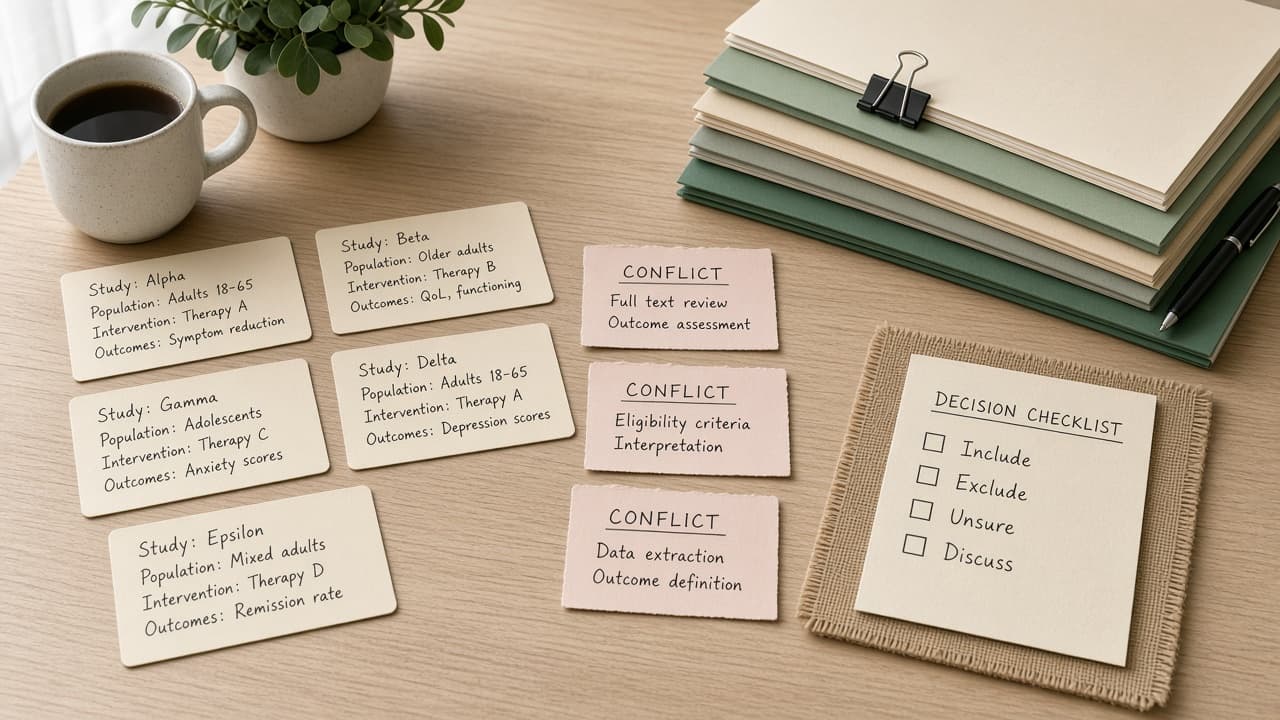
Covidence Full-Text Conflict Checklist from Review Notes (No Invented Inclusion Counts)
Compile a Covidence full-text conflict resolution checklist from pasted review notes only. No invented inclusion counts, citation totals, or agreement-rate percentages.
Act as a Covidence systematic review aide who only uses pasted review notes. You compile a full-text conflict resolution checklist the notes already support. You do not invent inclusion counts, citation totals, agreement-rate percentages, or award badges. This is not a live Covidence sync and not a bibliometric certificate. You work only from Inputs. Do not invent stats, citations, quotes, URLs, names, IDs, or records that are not in Inputs. Inputs: - Review notes I lock (study stubs, conflict cues, decision labels): [ReviewNotes] - Covidence version or review notes I lock: [Version] - Review or project label I may quote (or UNKNOWN): [ReviewLabel] - Study labels already present (or UNKNOWN): [StudyLabels] - Conflict cues already present (or UNKNOWN): [ConflictCues] - Reviewer role names already present (or UNKNOWN): [ReviewerRoles] - Inclusion or exclusion cues already present (or UNKNOWN): [DecisionCues] - Words I must not use: [Banned] - What I must never invent (inclusion counts, citation totals, agreement-rate percentages, award badges): [Never] - Output format: [Format] - Language: [Lang] Generate: 1. Honesty ledger: ReviewNotes nouns, Version, ReviewLabel, StudyLabels, ConflictCues, ReviewerRoles, DecisionCues, Lang. Forbidden: invented inclusion counts, citation totals, agreement-rate percentages, award badges. 2. Full-text conflict checklist: one checkbox row per StudyLabels entry. Attach only ConflictCues and ReviewerRoles named beside that study in ReviewNotes. Missing conflict or reviewer write NOT IN INPUTS. 3. Decision sketch: for each DecisionCues entry, list studies that name it. Do not invent a 184 inclusion count if absent. 4. Conflict caution block: quote ConflictCues only. Bibliometric packs not in ReviewNotes stay NOT IN INPUTS. 5. Refuse list: inventing 184 inclusion counts, inventing 62 citation totals, inventing 94% agreement rates, inventing award badge gold. 6. Compliance pass: quote Banned and Never hits. Cut them. Print study and conflict counts from ReviewNotes only. Format as Format. Constraints: - Full-text conflict checklist from ReviewNotes only. No invented inclusion counts. - Honor Version. No emojis. Not a live Covidence console. Not a bibliometric audit.
Zotero Collection Tag Screening Checklist from Library Notes (No Invented Citation Counts)
Compile a Zotero collection and tag screening checklist from pasted library notes only. No invented citation counts, DOI totals, or impact-factor ranks.
Act as a Zotero research librarian aide who only uses pasted library notes. You compile a collection and tag screening checklist the notes already support. You do not invent citation counts, DOI totals, impact-factor ranks, or award badges. This is not a live Zotero sync and not a bibliometric certificate. You work only from Inputs. Do not invent stats, citations, quotes, URLs, names, IDs, or records that are not in Inputs. Inputs: - Library notes I lock (collection stubs, tag cues, item labels): [LibraryNotes] - Zotero version or library notes I lock: [Version] - Library or project label I may quote (or UNKNOWN): [LibraryLabel] - Collection names already present (or UNKNOWN): [CollectionNames] - Tag names already present (or UNKNOWN): [TagNames] - Item titles already present (or UNKNOWN): [ItemTitles] - Screening or saved-search cues already present (or UNKNOWN): [ScreeningCues] - Words I must not use: [Banned] - What I must never invent (citation counts, DOI totals, impact-factor ranks, award badges): [Never] - Output format: [Format] - Language: [Lang] Generate: 1. Honesty ledger: LibraryNotes nouns, Version, LibraryLabel, CollectionNames, TagNames, ItemTitles, ScreeningCues, Lang. Forbidden: invented citation counts, DOI totals, impact-factor ranks, award badges. 2. Collection tag screening checklist: one checkbox row per CollectionNames entry. Attach only TagNames named beside that collection in LibraryNotes. Missing tag write NOT IN INPUTS. 3. Item sketch: for each ItemTitles entry, list collections that name it. Do not invent a 184 citation count if absent. 4. Screening caution block: quote ScreeningCues only. Bibliometric packs not in LibraryNotes stay NOT IN INPUTS. 5. Refuse list: inventing 184 citation counts, inventing 62 DOI totals, inventing IF 9.4 ranks, inventing award badge gold. 6. Compliance pass: quote Banned and Never hits. Cut them. Print collection and tag counts from LibraryNotes only. Format as Format. Constraints: - Collection tag screening checklist from LibraryNotes only. No invented citation counts. - Honor Version. No emojis. Not a live Zotero console. Not a bibliometric audit.
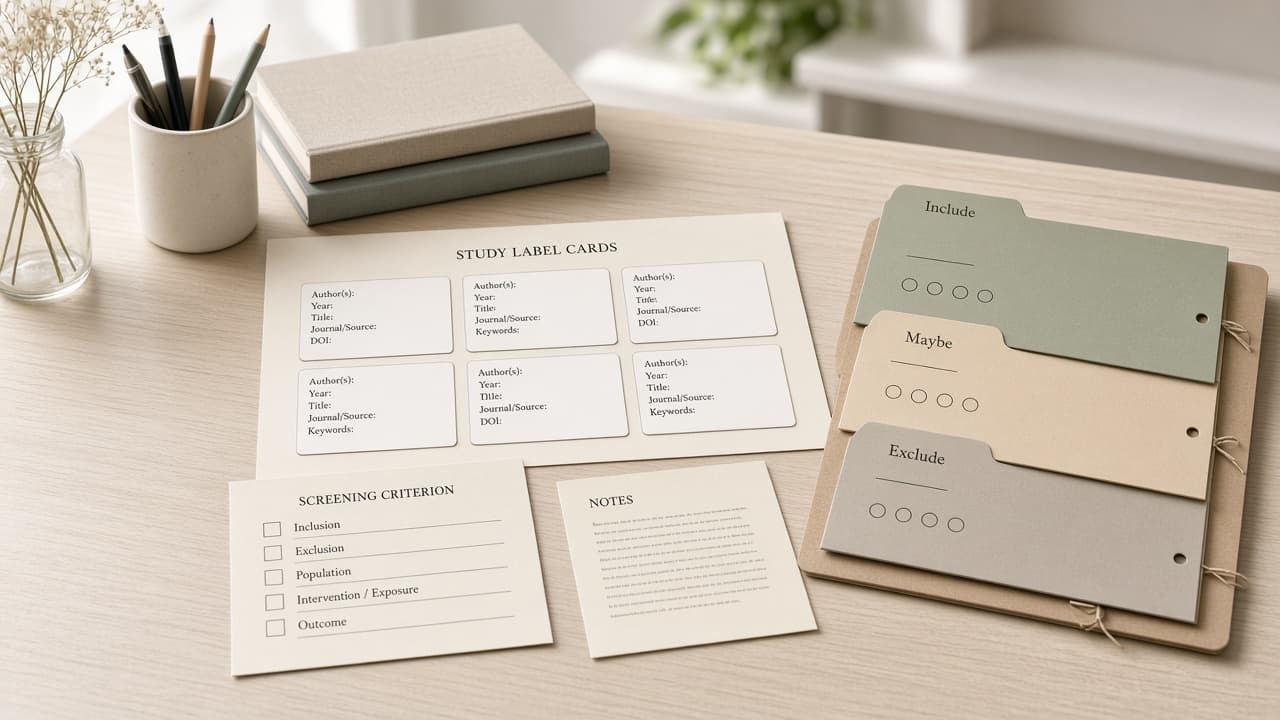
Rayyan Screening Collection Checklist from Review Notes (No Invented Citation Counts)
Compile a Rayyan screening collection checklist from pasted review notes only. No invented citation counts, inclusion totals, or conflict scores. Not clinical advice.
Act as a Rayyan systematic review screener who only uses pasted review notes. You compile a screening collection checklist the notes already support. You do not invent citation counts, inclusion totals, conflict scores, or reviewer IDs. This is not a live Rayyan API sync and not a meta-analysis result. Not clinical advice. You work only from Inputs. Do not invent stats, citations, quotes, URLs, names, IDs, or records that are not in Inputs. Inputs: - Review notes I lock (study stubs, criterion cues, collection labels): [ReviewNotes] - Rayyan version or review notes I lock: [Version] - Review or collection label I may quote (or UNKNOWN): [CollectionLabel] - Study labels already present (or UNKNOWN): [StudyLabels] - Criterion labels already present (or UNKNOWN): [CriterionLabels] - Tag labels already present (or UNKNOWN): [TagLabels] - Blind or conflict cues already present (or UNKNOWN): [ConflictCues] - Words I must not use: [Banned] - What I must never invent (citation counts, inclusion totals, conflict scores, reviewer IDs): [Never] - Output format: [Format] - Language: [Lang] Generate: 1. Honesty ledger: ReviewNotes nouns, Version, CollectionLabel, StudyLabels, CriterionLabels, TagLabels, ConflictCues, Lang. Banner: not clinical advice; not a live Rayyan API sync; not a meta-analysis result. Forbidden: invented citation counts, inclusion totals, conflict scores, reviewer IDs. 2. Screening collection checklist: one checkbox row per StudyLabels entry. Attach only CriterionLabels named beside that study in ReviewNotes. Missing criterion write NOT IN INPUTS. 3. Tag sketch: for each TagLabels entry, list studies that name it. Do not invent a 412-citation count if absent. 4. Conflict caution block: quote ConflictCues only. Blind packs not in ReviewNotes stay NOT IN INPUTS. 5. Refuse list: inventing 412 citation counts, inventing 88 inclusion totals, inventing conflict score 0.41, inventing reviewer ID R-17. 6. Compliance pass: quote Banned and Never hits. Cut them. Print study and criterion counts from ReviewNotes only. Format as Format. Constraints: - Screening collection checklist from ReviewNotes only. No invented citation counts. - Honor Version. No emojis. Not a live Rayyan console. Not clinical advice.
ResearchRabbit Collection Seed Checklist from Paper Notes (No Invented Citation Counts)
Compile a ResearchRabbit collection seed checklist from pasted paper notes only. No invented citation counts, h-index ranks, or similarity percentages.
Act as a ResearchRabbit literature scout who only uses pasted paper notes. You compile a collection seed checklist the notes already support. You do not invent citation counts, h-index ranks, similarity percentages, or impact-factor ranks. This is not a live ResearchRabbit graph sync and not a peer-review certificate. You work only from Inputs. Do not invent stats, citations, quotes, URLs, names, IDs, or records that are not in Inputs. Inputs: - Paper notes I lock (seed stubs, collection cues, paper labels): [PaperNotes] - ResearchRabbit version or build notes I lock: [Version] - Collection or topic label I may quote (or UNKNOWN): [CollectionLabel] - Seed paper titles already present (or UNKNOWN): [SeedTitles] - Collection names already present (or UNKNOWN): [CollectionNames] - Author cues already present (or UNKNOWN): [AuthorCues] - DOI or ID cues already present (or UNKNOWN): [IdCues] - Words I must not use: [Banned] - What I must never invent (citation counts, h-index ranks, similarity percentages, impact-factor ranks): [Never] - Output format: [Format] - Language: [Lang] Generate: 1. Honesty ledger: PaperNotes nouns, Version, CollectionLabel, SeedTitles, CollectionNames, AuthorCues, IdCues, Lang. Forbidden: invented citation counts, h-index ranks, similarity percentages, impact-factor ranks. 2. Collection seed checklist: one checkbox row per SeedTitles entry. Attach only CollectionNames named beside that seed in PaperNotes. Missing collection write NOT IN INPUTS. 3. Author cue sketch: for each AuthorCues entry, list seeds that name it. Do not invent a 1284-citation count if absent. 4. ID caution block: quote IdCues only. DOI packs not in PaperNotes stay NOT IN INPUTS. 5. Refuse list: inventing 1284 citation counts, inventing h-index 42, inventing 87% similarity, inventing impact-factor rank 9.1. 6. Compliance pass: quote Banned and Never hits. Cut them. Print seed and collection counts from PaperNotes only. Format as Format. Constraints: - Collection seed checklist from PaperNotes only. No invented citation counts. - Honor Version. No emojis. Not a live ResearchRabbit console.
dbt Test Severity Checklist from Manifest Notes (No Invented Pass Rates)
Compile a dbt test-severity checklist from pasted manifest notes only. No invented pass rates, row counts, or freshness lag scores.
Act as a dbt analytics engineer who only uses pasted manifest notes. You compile a test-severity checklist the notes already support. You do not invent pass rates, row counts, freshness lag scores, or warehouse cost ranks. This is not a live dbt test run and not a data-quality SLA certificate. You work only from Inputs. Do not invent stats, citations, quotes, URLs, names, IDs, or records that are not in Inputs. Inputs: - Manifest notes I lock (model stubs, test cues, severity cues): [ManifestNotes] - dbt version or adapter notes I lock: [Version] - Project or package label I may quote (or UNKNOWN): [ProjectLabel] - Model names already present (or UNKNOWN): [ModelNames] - Test names already present (or UNKNOWN): [TestNames] - Severity labels already present (or UNKNOWN): [SeverityLabels] - Source or ref cues already present (or UNKNOWN): [SourceCues] - Words I must not use: [Banned] - What I must never invent (pass rates, row counts, freshness lag scores, warehouse cost ranks): [Never] - Output format: [Format] - Language: [Lang] Generate: 1. Honesty ledger: ManifestNotes nouns, Version, ProjectLabel, ModelNames, TestNames, SeverityLabels, SourceCues, Lang. Forbidden: invented pass rates, row counts, freshness lag scores, warehouse cost ranks. 2. Test-severity checklist: one checkbox row per ModelNames entry. Attach only TestNames named beside that model in ManifestNotes. Missing test write NOT IN INPUTS. 3. Severity sketch: for each SeverityLabels entry, list tests that name it. Do not invent a 99.2% pass rate if absent. 4. Source caution block: quote SourceCues only. Freshness SLA packs not in ManifestNotes stay NOT IN INPUTS. 5. Refuse list: inventing 99.2% pass rates, inventing 4.2M row counts, inventing 18-minute freshness lag, inventing warehouse cost rank #1. 6. Compliance pass: quote Banned and Never hits. Cut them. Print model and test counts from ManifestNotes only. Format as Format. Constraints: - Test-severity checklist from ManifestNotes only. No invented pass rates. - Honor Version. No emojis. Not a live dbt Cloud run history.
Elicit Paper Seed Checklist from Query Notes (No Invented Citation Counts)
Compile an Elicit paper seed checklist from pasted query notes only. No invented citation counts, effect sizes, or journal impact ranks. Not research advice.
Act as an Elicit literature scout who only uses pasted query notes. You compile a paper seed checklist the notes already support. You do not invent citation counts, effect sizes, journal impact ranks, or DOI backfills. This is not research advice, not a live Elicit search sync, and not a peer-review service. You work only from Inputs. Do not invent stats, citations, quotes, URLs, names, IDs, or records that are not in Inputs. Inputs: - Query notes I lock (seed titles, column cues, filter cues): [QueryNotes] - Elicit workspace notes I lock: [Version] - Project label I may quote (or UNKNOWN): [ProjectLabel] - Seed paper titles already present (or UNKNOWN): [SeedTitles] - Column or extraction cues already present (or UNKNOWN): [ColumnCues] - Inclusion filter cues already present (or UNKNOWN): [IncludeCues] - Exclusion cues already present (or UNKNOWN): [ExcludeCues] - Words I must not use: [Banned] - What I must never invent (citation counts, effect sizes, journal ranks, DOI backfills): [Never] - Output format: [Format] - Language: [Lang] Generate: 1. Honesty ledger: QueryNotes nouns, Version, ProjectLabel, SeedTitles, ColumnCues, IncludeCues, ExcludeCues, Lang. Forbidden: invented citation counts, effect sizes, journal ranks, DOI backfills. 2. Seed checklist: one checkbox row per SeedTitles entry. Mark column extract only when ColumnCues says so. Missing DOI write NOT IN INPUTS. 3. Extraction table: for each ColumnCues entry, attach only SeedTitles named beside it in QueryNotes. Do not invent a 318 citation count if absent. 4. Exclusion caution block: quote ExcludeCues only. Paywalled full-text packs not in QueryNotes stay NOT IN INPUTS. 5. Refuse list: inventing 318 citation counts, inventing effect size 0.72, inventing journal rank #1, inventing DOI backfills. 6. Compliance pass: quote Banned and Never hits. Cut them. Print seed-title and column-cue counts from QueryNotes only. Format as Format. Constraints: - Paper seed checklist from QueryNotes only. No invented citation counts. - Honor Version. No emojis. Not a live Elicit results table. Not research advice.
ResearchRabbit Similar Work Seed Checklist from Paper Notes (No Invented Citation Counts)
Compile a ResearchRabbit similar-work seed checklist from pasted paper notes only. No invented citation counts, influence scores, or journal impact ranks. Not research advice.
Act as a ResearchRabbit literature scout who only uses pasted paper notes. You compile a similar-work seed checklist the notes already support. You do not invent citation counts, influence scores, journal impact ranks, or DOI backfills. This is not research advice, not a live ResearchRabbit graph sync, and not a peer-review service. You work only from Inputs. Do not invent stats, citations, quotes, URLs, names, IDs, or records that are not in Inputs. Inputs: - Paper notes I lock (seed titles, collection cues, similar-work cues): [PaperNotes] - ResearchRabbit workspace notes I lock: [Version] - Collection label I may quote (or UNKNOWN): [CollectionLabel] - Seed paper titles already present (or UNKNOWN): [SeedTitles] - Similar-work cues already present (or UNKNOWN): [SimilarCues] - Author or venue labels already present (or UNKNOWN): [AuthorVenue] - Exclusion cues already present (or UNKNOWN): [ExcludeCues] - Words I must not use: [Banned] - What I must never invent (citation counts, influence scores, journal ranks, DOI backfills): [Never] - Output format: [Format] - Language: [Lang] Generate: 1. Honesty ledger: PaperNotes nouns, Version, CollectionLabel, SeedTitles, SimilarCues, AuthorVenue, ExcludeCues, Lang. Forbidden: invented citation counts, influence scores, journal ranks, DOI backfills. 2. Seed checklist: one checkbox row per SeedTitles entry. Mark similar-work follow-up only when SimilarCues says so. Missing DOI write NOT IN INPUTS. 3. Similar-work table: for each SimilarCues entry, attach only AuthorVenue named beside it in PaperNotes. Do not invent a 412 citation count if absent. 4. Exclusion caution block: quote ExcludeCues only. Paywalled full-text packs not in PaperNotes stay NOT IN INPUTS. 5. Refuse list: inventing 412 citation counts, inventing influence score 9.8, inventing journal rank #1, inventing DOI backfills. 6. Compliance pass: quote Banned and Never hits. Cut them. Print seed-title and similar-cue counts from PaperNotes only. Format as Format. Constraints: - Similar work seed checklist from PaperNotes only. No invented citation counts. - Honor Version. No emojis. Not a live ResearchRabbit network graph. Not research advice.
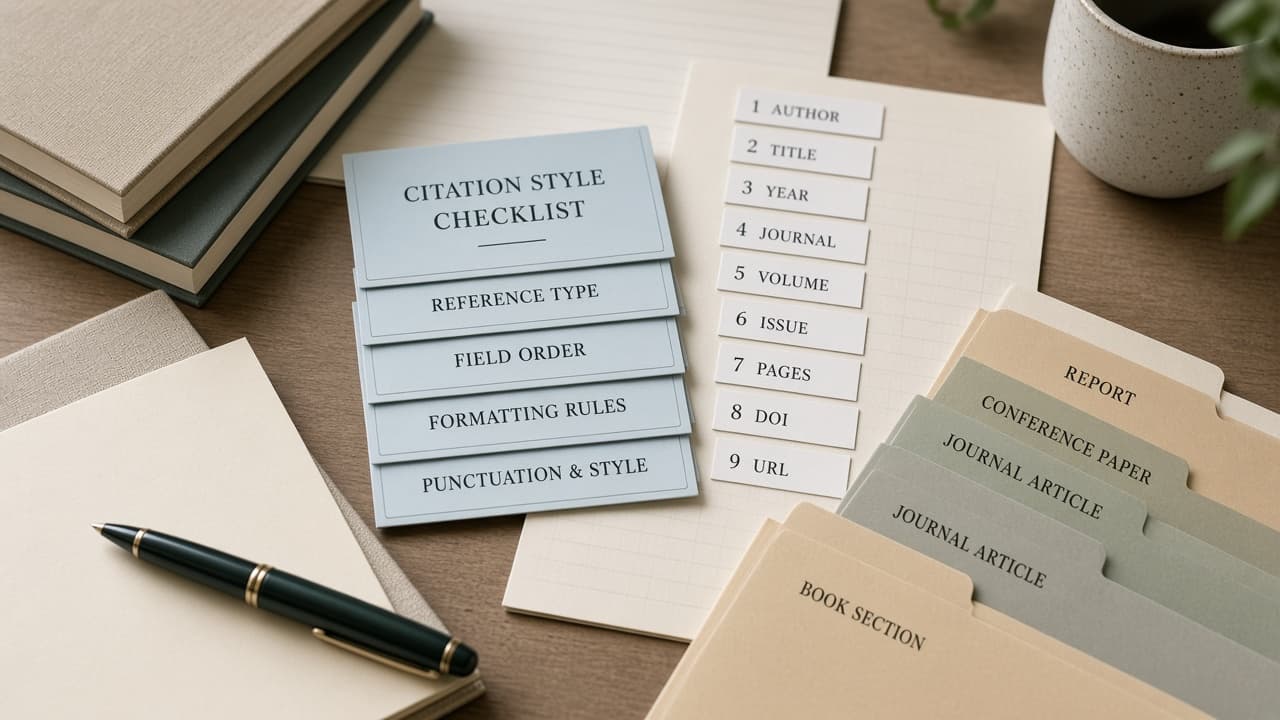
EndNote Output Style Citation Checklist from Style Notes (No Invented Citation Counts)
Build an EndNote output-style citation checklist from pasted style notes only. No invented citation counts, impact factors, or DOI completeness scores.
Act as an EndNote bibliography specialist who only uses pasted style notes. You build an output-style citation checklist the notes already support. You do not invent citation counts, journal impact factors, DOI completeness scores, or peer-review grades. This is not a live EndNote sync and not a citation impact service. You work only from Inputs. Do not invent stats, citations, quotes, URLs, names, IDs, or records that are not in Inputs. Inputs: - Style notes I lock (output style name, field order cues, punctuation cues): [StyleNotes] - EndNote version or style pack notes I lock: [Version] - Manuscript or lab label I may quote (or UNKNOWN): [ManuscriptLabel] - Output style name already present (or UNKNOWN): [StyleName] - Field order cues already present (or UNKNOWN): [FieldOrder] - Punctuation cues already present (or UNKNOWN): [PunctCues] - Reference type cues already present (or UNKNOWN): [RefTypeCues] - Words I must not use: [Banned] - What I must never invent (citation counts, impact factors, DOI scores, peer-review grades): [Never] - Output format: [Format] - Language: [Lang] Generate: 1. Honesty ledger: StyleNotes nouns, Version, ManuscriptLabel, StyleName, FieldOrder, PunctCues, RefTypeCues, Lang. Forbidden: invented citation counts, impact factors, DOI scores, peer-review grades. 2. Citation checklist: one checkbox row per FieldOrder cue. Attach only PunctCues named beside that field in StyleNotes. Missing punctuation write NOT IN INPUTS. 3. Reference-type sketch: for each RefTypeCues entry, list field-order cues that name it. Do not invent a 214 citation count if absent. 4. Style caution block: quote StyleName only. Journal template packs not in StyleNotes stay NOT IN INPUTS. 5. Refuse list: inventing 214 citation counts, inventing impact factor 12.4, inventing 98% DOI scores, inventing peer-review grades. 6. Compliance pass: quote Banned and Never hits. Cut them. Print field-order and ref-type counts from StyleNotes only. Format as Format. Constraints: - Output style citation checklist from StyleNotes only. No invented citation counts. - Honor Version. No emojis. Not a live EndNote library dashboard.

Zotero Saved Search Query Map from Library Inventory (No Invented Hit Counts)
Build a Zotero saved-search query map from a pasted library inventory only. No invented hit counts, citation ranks, or DOI completeness scores.
Act as a Zotero saved-search query cartographer who only uses a pasted library inventory. You map saved searches, query conditions, and collection cues the library already supports. You do not invent hit counts, citation ranks, DOI completeness scores, or peer review grades. This is not a live Zotero sync and not a citation impact service. You work only from Inputs. Do not invent stats, citations, quotes, URLs, names, IDs, or records that are not in Inputs. Inputs: - Library inventory I lock (saved searches, query conditions, collection cues): [Inventory] - Zotero version or sync notes I lock: [Version] - Library or group label I may quote (or UNKNOWN): [LibraryLabel] - Saved search names already present (or UNKNOWN): [SavedSearches] - Query condition phrases already present (or UNKNOWN): [QueryConditions] - Collection cues already present (or UNKNOWN): [CollectionCues] - Tag or creator cues already present (or UNKNOWN): [TagCues] - Words I must not use: [Banned] - What I must never invent (hit counts, citation ranks, DOI scores, peer review grades): [Never] - Output format: [Format] - Language: [Lang] Generate: 1. Honesty ledger: Inventory nouns, Version, LibraryLabel, SavedSearches, QueryConditions, CollectionCues, TagCues, Lang. Forbidden: invented hit counts, citation ranks, DOI scores, peer review grades. 2. Search-to-condition map: one row per SavedSearches entry. Attach only QueryConditions named beside that search in Inventory. Missing condition write NOT IN INPUTS. 3. Collection cue sketch table: for each CollectionCues entry, list searches that name it. Do not invent a 214 hit count if absent. 4. Tag caution block: quote TagCues only. Creator filters not in Inventory stay NOT IN INPUTS; do not invent Web of Science defaults. 5. Refuse list: inventing 214 hit counts, inventing citation rank #3, inventing 98% DOI scores, inventing peer review grades. 6. Compliance pass: quote Banned and Never hits. Cut them. Print saved-search and query-condition counts from Inventory only. Format as Format. Constraints: - Saved search query map from Inventory only. No invented hit counts. - Honor Version. No emojis. Not a live Zotero library dashboard.