How to Use the Sourdough Bake Schedule Prompt to Time Your Loaves Around a Real Weekend
Plan a sourdough bake around your own weekend: check that your starter is ready, size a levain build that peaks when you need it, write the formula in baker's percentages with true total hydration, set water temperature from a desired dough temperature, lay out folds, bulk, shaping, and cold retard on a clock, and finish with Dutch oven bake steps.
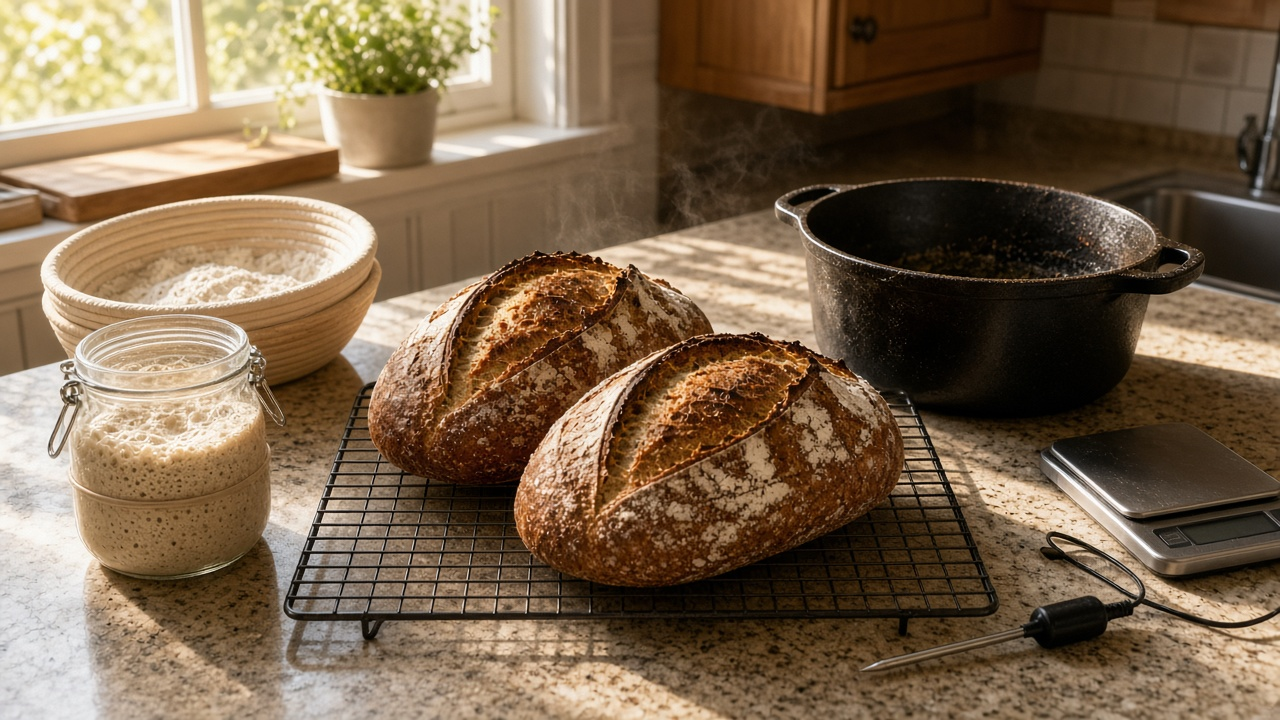
Sourdough recipes often read as if you have nothing else to do all day. Then the levain peaks while you are out, the dough sits in a cold kitchen and barely moves, and the loaves come out of the fridge flat. The fix is a plan built around your own starter, your kitchen temperature, and your actual schedule. The Sourdough Bake Schedule Planner for Home Bakers: Starter Readiness Check, Levain Build Ratio, Baker's Percentage Formula with Total Hydration, Desired Dough Temperature Water Math, Bulk and Cold Retard Timeline, and Bake Steps prompt writes that plan, with the formula in baker's percentages and every calculation shown.
What the prompt produces
- A starter readiness check with the signs to look for and a recovery plan if it is sluggish.
- A levain build sized for your formula, with a feed ratio chosen so it peaks near mix time.
- A formula table in grams and baker's percentages, with true total hydration that counts the water and flour inside the levain.
- Water temperature math from a desired dough temperature.
- A mixing sequence with autolyse, levain, and salt steps.
- A bulk ferment plan with folds, temperature checks, an aliquot jar, and end of bulk signs.
- Shaping and cold retard steps that fit your schedule.
- Bake steps for your oven and pot, with doneness by color and internal temperature.
- A one page timeline and a note on slow or fast bulk.
How to fill the inputs
StarterStatus describes how you feed your starter, its hydration, and how long it takes to rise after a feed. This tells the prompt how active it is.
FormulaGoal covers how many loaves, which flours, and the crumb you want. A hydration target helps.
KitchenTemps gives room and flour temperature and any warm spot you can use, such as an oven with the light on.
Schedule is when you are free and when you want bread.
Equipment lists your oven, Dutch oven or steel, bannetons, scale, and thermometer.
Reading the example output
The example plans two loaves for a Sunday brunch with a 70 F kitchen:
- The levain is built to peak overnight. A 1:5:5 feed of 20 g starter, 100 g flour, and 100 g water slows it down so it is ready Saturday morning.
- Hydration is calculated honestly. The recipe water is 72 percent, but counting the levain gives 820 g water over 1100 g flour, or 74.5 percent.
- Salt is shown both ways: 2 percent of the main flour and 1.8 percent of total flour.
- Water temperature is worked out: 78 times 4 minus the room, flour, levain, and friction numbers gives 98 F.
- Bulk is run by the dough. Folds are on the clock, but the end of bulk depends on signs like a domed, jiggly dough and the aliquot jar rise.
- The bake fits the brunch. Two loaves bake one after another in a single Dutch oven, and both have at least an hour to cool before 10 am.
Tips for better results
- Take the dough temperature at every fold and write it down. It explains most of the difference between bakes.
- Use the aliquot jar for a few bakes, then compare its rise with your crumb photos to set your own target.
- If your kitchen changes with the seasons, update KitchenTemps and rerun the water math.
- Ask the prompt for a weekday version with a longer cold retard if weekends are busy.
Mistakes to avoid
- Do not use a levain that has already fallen far past its peak.
- Do not end bulk by the clock alone.
- Do not slice hot bread. The crumb is still setting.
- Do not change flour, hydration, and timing all at once. Change one thing per bake.
Who it is for
Home bakers moving past their first few loaves, people with busy weekends who want warm bread at a set time, baking teachers writing class schedules, and anyone trying to understand baker's percentages with real numbers.
Related PromptDig links
Open the Sourdough Bake Schedule Planner for Home Bakers: Starter Readiness Check, Levain Build Ratio, Baker's Percentage Formula with Total Hydration, Desired Dough Temperature Water Math, Bulk and Cold Retard Timeline, and Bake Steps prompt and describe your starter and schedule. For more home and cooking prompts, Browse more prompts. If you have a baking or kitchen prompt you love, Share a prompt.