🌿 Lifestyle
Sourdough Bake Schedule Planner for Home Bakers: Starter Readiness Check, Levain Build Ratio, Baker's Percentage Formula with Total Hydration, Desired Dough Temperature Water Math, Bulk and Cold Retard Timeline, and Bake Steps
Plan a sourdough bake around your own weekend: check that your starter is ready, size a levain build that peaks when you need it, write the formula in baker's percentages with true total hydration, set water temperature from a desired dough temperature, lay out folds, bulk, shaping, and cold retard on a clock, and finish with Dutch oven bake steps.
0Reviews
Prompt
Act as a bread baking instructor who teaches home sourdough classes, writes every formula in baker's percentages, measures dough temperature on every bake, and has coached students through flat loaves caused by a starter used past its peak, water that was too cold, and a bulk ferment run by the clock instead of the dough.

Inputs:
- Starter status: how you feed it, its hydration, and how it behaves after feeding: [StarterStatus]
- What you want to bake: number of loaves, flour types, and the crumb you want: [FormulaGoal]
- Kitchen and flour temperatures, and whether the dough will sit somewhere warmer: [KitchenTemps]
- When you are free and when you want warm bread: [Schedule]
- Oven, Dutch oven or baking steel, bannetons, scale, thermometer: [Equipment]
- Output format: [Format]

Generate:
1. A starter readiness check: signs it is ready to build a levain (predictable rise and fall after feeding, domed top, bubbles through the jar), and what to do for two feeds if it is sluggish.
2. A levain build: amount needed for the formula plus a small extra, the feed ratio of starter to flour to water, and when to mix it so it peaks near mix time given KitchenTemps.
3. The formula as a table in grams and baker's percentages with flour as 100 percent, then total flour and total water including the flour and water inside the levain, true total hydration, salt as a percentage of total flour, and dough weight per loaf.
4. Water temperature from desired dough temperature: water = DDT x 4 minus (room + flour + levain + friction), with each number shown, and a note on what to do if the result is very hot.
5. A mixing sequence: autolyse with most of the water, adding levain, adding salt with reserved water, and how to tell the dough is mixed enough.
6. A bulk ferment plan on the clock: sets of stretch and folds, dough temperature checks, an aliquot jar, and end of bulk signs, with a clear rule that the dough decides, not the timer.
7. Pre shape, bench rest, final shape, and banneton steps, then a cold retard window in the refrigerator that fits Schedule.
8. Bake steps for Equipment: preheat time, scoring, lid on and lid off phases with temperatures, doneness by color and internal temperature, and cooling before slicing.
9. A one page timeline with clock times, and a troubleshooting note for a slow or fast bulk.

Constraints:
- Show every calculation. Weights in grams.
- Do not promise exact fermentation times; give ranges and signs. No em dashes.
Instructions
Replace every [bracket] with your details before running. Works on ChatGPT, Claude, and Gemini.
Generated Output
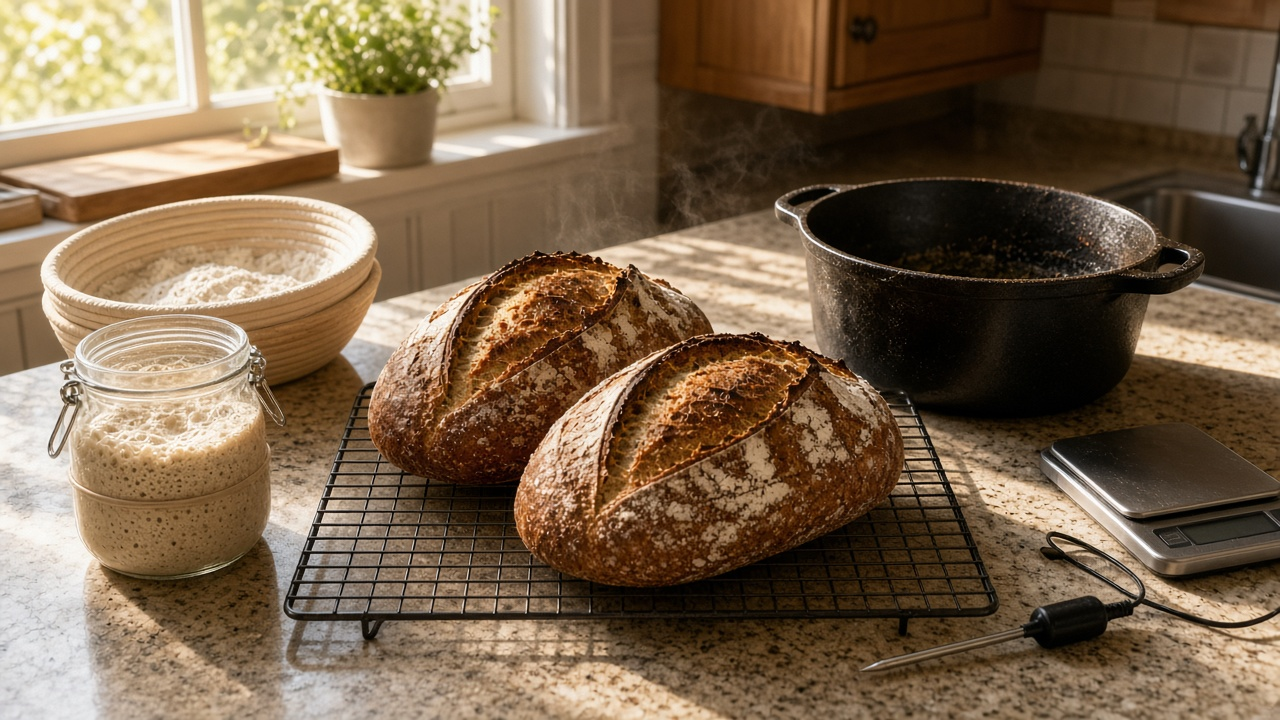
This image was generated using the prompt above.
Examples
Example Input
StarterStatus: 100 percent hydration starter, fed once a day at 1:1:1 with all purpose flour, doubles in about 6 hours on my counter, kept at room temperature
FormulaGoal: 2 loaves, mostly bread flour with some whole wheat, open but not wild crumb, about 74 to 75 percent total hydration
KitchenTemps: kitchen 70 F, flour 70 F; I can use the oven with only the light on as a warm spot
Schedule: free Saturday from 8 am, want to bake Sunday morning before brunch at 10
Equipment: home oven, one 5 quart Dutch oven, two oval bannetons, digital scale, probe thermometer
Format: checks, formula table, math, timeline, bake steps
Example Output
1. Starter readiness
Yours doubles in about 6 hours after a 1:1:1 feed, which is a good sign. On Friday, feed it in the morning and check that it rises, domes, and starts to fall the same way. If it is slow, give two feeds 12 hours apart before building the levain.

2. Levain build (Friday 9:00 pm)
Need 200 g levain plus extra: build 220 g.
20 g ripe starter + 100 g bread flour + 100 g water (1:5:5).
The higher ratio slows it so it peaks around Saturday morning at 70 F. Ready when doubled with a domed top.

3. Formula (2 loaves)
| Ingredient | Grams | Baker's % |
| Bread flour | 900 | 90 |
| Whole wheat flour | 100 | 10 |
| Water | 720 | 72 |
| Levain (100% hydration) | 200 | 20 |
| Salt | 20 | 2 |
Total flour: 1000 + 100 (in levain) = 1100 g
Total water: 720 + 100 (in levain) = 820 g
True total hydration: 820 / 1100 = 74.5 percent
Salt on total flour: 20 / 1100 = 1.8 percent
Dough weight: 1000 + 720 + 200 + 20 = 1940 g, so 970 g per loaf.

4. Water temperature (DDT 78 F)
Water = 78 x 4 minus (70 room + 70 flour + 72 levain + 2 friction for hand mixing)
= 312 minus 214 = 98 F.
Use 98 F water. If a calculation ever lands above 105 F, use 105 F and plan a warmer bulk spot instead.

5. Mixing (Saturday)
- 8:00 am: mix 1000 g flour with 700 g of the water. Rest 1 hour (autolyse).
- 9:00 am: add 200 g levain, pinch and fold until even.
- 9:15 am: add 20 g salt with the last 20 g water, squeeze through until the dough holds together again.

6. Bulk ferment (oven light on, target 76 to 78 F dough)
- Fill a small straight sided jar with a piece of dough, mark the level. This is the aliquot jar.
- Stretch and folds at 9:45, 10:15, 10:45, 11:15. Check dough temperature each time.
- Then rest covered. End bulk when the dough is domed, jiggly, has bubbles on the sides and top, and the jar shows about a 50 percent rise. Adjust that target on future bakes by how the crumb looks.
- Likely window at this temperature: early to mid afternoon. If the dough is not there, wait. The dough decides.

7. Shape and retard
- Divide into two 970 g pieces, pre shape into loose rounds, bench rest 30 minutes.
- Final shape into ovals, place seam up in floured bannetons, cover.
- Refrigerate at about 38 F until Sunday morning, roughly 14 to 18 hours depending on when bulk ended.

8. Bake (Sunday)
- 6:30 am: Dutch oven in the oven, preheat to 500 F for 45 minutes.
- 7:15 am: loaf 1 onto parchment, score one long cut at a shallow angle, into the pot.
- Lid on 20 minutes at 475 F, lid off 20 to 25 minutes at 450 F until deep brown. Internal 205 to 210 F.
- Reheat the pot 10 minutes and bake loaf 2 the same way from about 8:10, done about 8:55 am.
- Cool at least 1 hour on a rack before slicing, which still fits a 10 am brunch.

9. Timeline
Fri 9:00 pm levain | Sat 8:00 am autolyse | 9:00 levain in | 9:15 salt | 9:45 to 11:15 folds | afternoon end of bulk, shape, fridge | Sun 6:30 am preheat | 7:15 loaf 1 | 8:10 loaf 2 | 10:00 slice
Slow bulk: move to a warmer spot and wait. Fast bulk: shape early and add retard time.