How to Use the Restaurant Inspection Corrective Action Prompt to Fix Findings With Proof the Inspector Can Check
Answer a failed or marginal health inspection with a plan the inspector can verify: sort each finding by Food Code risk level, separate items corrected on site, name the real cause behind each violation, assign owners and dates before the reinspection, set up cold holding, cooling, and date marking logs, document staff retraining, and walk the kitchen with a reinspection checklist.
A tough health inspection is stressful, and the reinspection date arrives fast. The usual response is to throw out the food, move the bucket, and tell staff to be more careful. Then the same violation shows up again, because nothing about the process changed. The Restaurant Health Inspection Corrective Action Plan Writer: Priority, Priority Foundation, and Core Violation Triage, Root Cause per Finding, Temperature and Date Marking Logs, Staff Retraining Sign Off, and a Reinspection Walkthrough prompt turns your inspection report into a corrective action plan with a cause for every finding, an owner and a date for every fix, logs that prove the fix is working, and a walkthrough you can do the day before the inspector returns.
What the prompt produces
- A triage table that sorts findings by risk level, with Priority items first, then Priority foundation, then Core.
- A root cause for each finding: equipment, process, training, or layout.
- A corrective action per finding with an owner, a due date before the reinspection, and a way to verify it.
- Monitoring logs for cold and hot holding, cooling, and date marking, sized to the problems on your report.
- A retraining sign off sheet with a show me check, so staff demonstrate the rule rather than just hear it.
- A reinspection walkthrough checklist in the order an inspector usually moves through a kitchen.
- A short written response for health departments that ask for one.
How to fill the inputs
InspectionReport should be copied from the report itself, with each citation, its risk level, and the inspector's notes. The prompt does not change citations or levels.
CorrectedOnSite lists what was fixed during the visit. Discarding food corrects the item but not the cause, and the plan treats those differently.
Jurisdiction names your health department and the Food Code edition your state adopted, if you know it. The temperature and time values in the plan are FDA Food Code values and must be checked against your local version.
KitchenProfile describes the menu items involved, the equipment, the number of staff per shift, and anything unusual about your layout. This is where real root causes come from.
ReinspectionDate sets the deadline that every action is planned around.
Reading the example output
The example is a small taqueria with six findings, including a warm make line cooler, rice that cooled too slowly, missing date marks, and a blocked handwashing sink:
- The cooler finding is treated as an equipment problem, not a staff problem. The fix includes a service call, closed lids between orders, and five days of logged readings as proof.
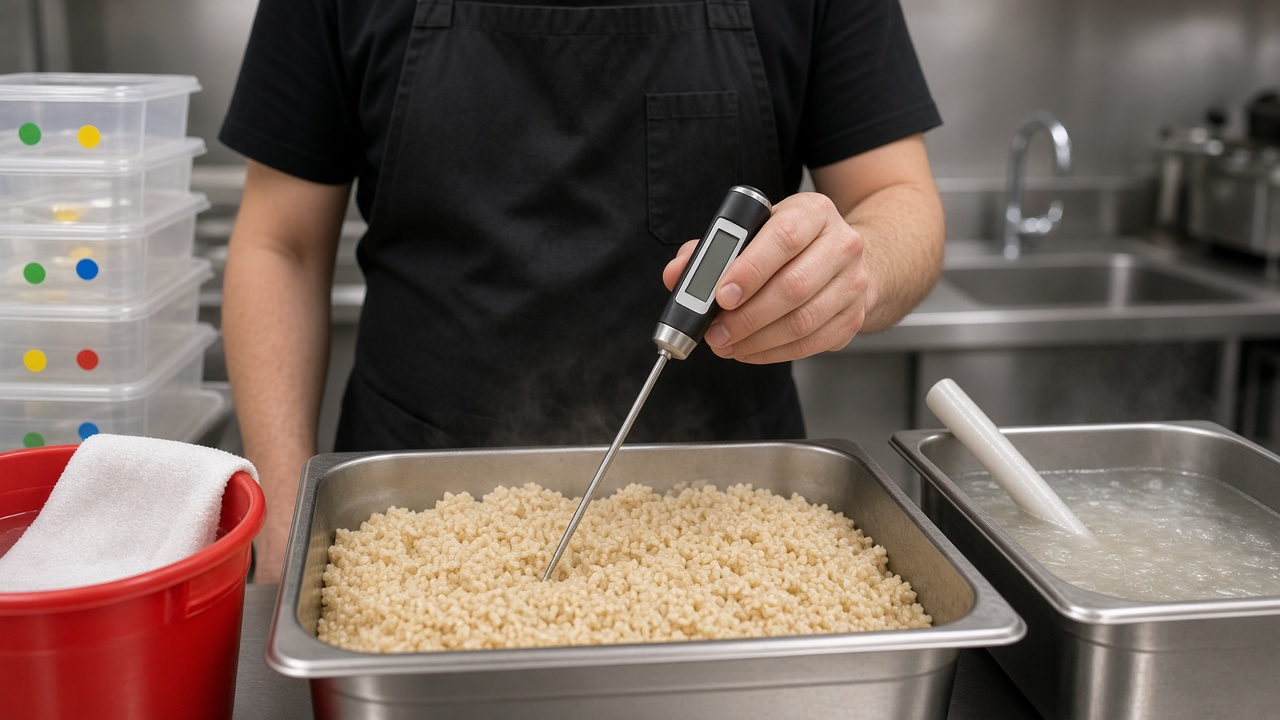
- The rice finding changes the method. Shallow uncovered pans, an ice wand, and a top shelf spot replace the deep covered pan, with a cooling log to show the two stage readings.
- Date marking gets a physical system: labels on a hook by the walk in door and a daily check at open.
- The blocked sink is a layout issue. The sink was the closest flat surface, so a tong rack goes on the wall beside the grill.
- Every action has an owner by role and a way to verify it, such as a photo, an invoice, or a log.
- The walkthrough ends with one folder holding the service invoice, logs, and the sign off sheet, ready for the inspector.
Tips for better results
- Start logs the same day as the inspection so you have a full record by reinspection.
- Use a calibrated probe thermometer and note the calibration check on the log.
- Keep the retraining short and practical. A cook spreading and probing a pan of rice teaches more than a lecture.
- Ask your inspector what they want to see on reinspection if the report does not say.
Mistakes to avoid
- Do not write "retrained staff" as the only fix for an equipment problem.
- Do not change the citations or argue the risk levels in the plan.
- Do not mix sanitizer by guesswork. Follow the product label and test with strips.
- Do not promise the health department a result. Show what you changed and how you check it.
Who it is for
Owners and managers of independent restaurants, kitchen managers preparing for a follow up visit, food truck operators, and consultants who help small operators respond to inspections.
Related PromptDig links
Open the Restaurant Health Inspection Corrective Action Plan Writer: Priority, Priority Foundation, and Core Violation Triage, Root Cause per Finding, Temperature and Date Marking Logs, Staff Retraining Sign Off, and a Reinspection Walkthrough prompt and paste your inspection findings to build your plan. For more small business operations prompts, Browse more prompts. If you have a prompt that helps run a kitchen, Share a prompt.