ChatGPT Prompts for Tarot: 12 Spreads and Reading Prompts
ChatGPT prompts for tarot readings, spreads, card study and journaling: 12 prompts that read the cards you drew and turn them into reflection. For fun only.
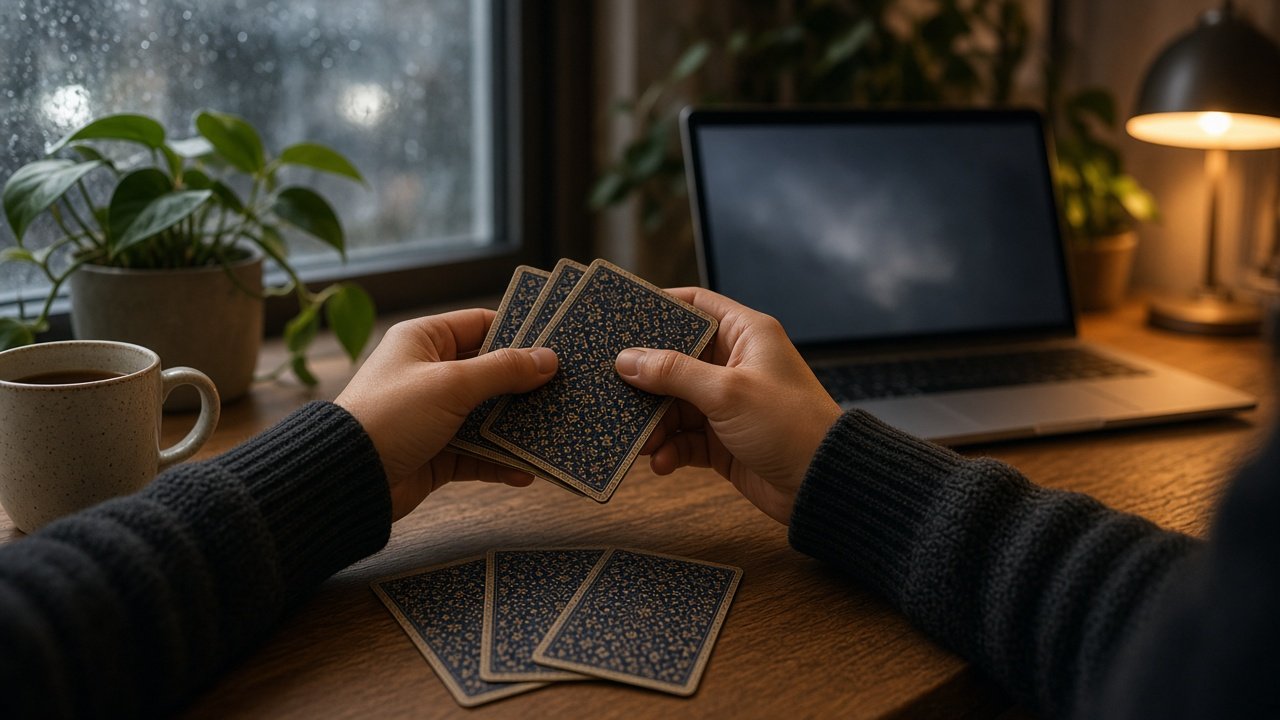
ChatGPT prompts for tarot work best when you give the chatbot the cards you actually drew, the position each one sits in, and what the art on your cards shows. That turns a generic list of card meanings into a reading about your question, followed by reflection questions you can answer in a journal. The 12 prompts below cover setting up a spread, reading the cards, learning your deck, and journaling what comes up.
Tarot here is for entertainment and self-reflection. A reading cannot predict events and is not a substitute for medical, legal, financial or mental health advice. If you are in crisis in the US, call or text 988.
The main prompt is the tarot reading prompt for a three-card spread. It reframes your question, reads each card with its art, and ends with a journal page.
How to give the chatbot your cards
A standard tarot deck has 78 cards: 22 Major Arcana, such as The Moon and The Sun, and 56 Minor Arcana in four suits, usually Wands, Cups, Swords and Pentacles. Decks share the card names but not the art, so describe what is on your card as well as its name, and say if it came up reversed. If your deck has a guidebook you like, tell the chatbot to follow it.
Ask open questions. "What can I notice about my job search?" gives a more useful reading than "Will I get the job?", which no card can answer.
Set up the reading
1. Spread designer
Design a [number]-card tarot spread for this question: [question]. Give each position a short name and one line on what it asks, and lay them out left to right.
2. Question reframe
Here is my question for a tarot reading: [question]. Rewrite it three ways as open "what can I notice or try" questions, and say which one fits a three-card spread best.
3. Card of the day
I drew [card], [upright or reversed]. The art shows [description]. Give me its common keywords, one thing to notice today, and one question to think about tonight.
Read the cards you drew
4. Position-by-position reading
My spread is [positions]. I drew [card in each position, upright or reversed, with what the art shows]. My question is [question]. Read each card in its position, then how the cards connect. Keep it warm and plain, about [length] words.
5. Reversed card
[Card] came up reversed in the [position] spot. Explain two common ways readers interpret reversals, and what each would mean here for [question].
6. Cards in conversation
I keep drawing [card] and [card] together. What themes do they share and where do they pull in different directions? Give me two questions to sit with.
7. Clarifier card
The [card] in my reading feels unclear. I drew [clarifier card] to go with it. Explain how the two read together for [question] in under 120 words.
Learn your deck
8. Study flashcards
Make 10 flashcards for the [suit or Major Arcana] in tarot: card name on the front, three common keywords and one sentence on upright and reversed on the back.
9. Art-first meaning
Here is what my deck's [card] shows: [description]. Compare its art with the card's common meaning. What does this artist add, change or leave out?
10. Personal meanings notebook
Here are my notes from my last [number] readings with [card]: [notes]. Write a short personal meaning for this card based on how it has shown up for me, next to its common meaning.
Reflect and journal
11. Journal page
Turn this reading into a journal page: [reading]. Include the date, the spread, the cards, one reflection question per card, and blank lines for what I notice this week.
12. Monthly look back
Here are my card-of-the-day draws for [month]: [list of dates and cards]. Which cards and suits came up most, what themes repeat, and what three questions should I carry into next month?
Worked example
On a rainy evening, a reader shuffled a deck with blue and gold patterned backs and set three cards face down on the desk before opening the laptop. Their question was about a stalled painting project. Prompt 2 turned "Will I ever finish this?" into "What can I notice about why the project stalled?", and prompt 1 named the three positions: what stopped me, what I still have, what would help.
They flipped the Eight of Pentacles, the Three of Cups and the Star, all upright, and pasted them into prompt 4 with a short note on each card's art. The reading tied the Eight of Pentacles to the slow, careful work that stopped feeling fun, the Three of Cups to friends who used to paint with them, and the Star to a lighter, hopeful restart. Prompt 11 turned it into a journal page with one question per card, and the reader wrote the answers by hand the next morning.
Variations
- Celtic Cross or five-card spread: list every position in SpreadLayout and ask for the card-by-card section in a table.
- Learning mode: ask the chatbot to quiz you on each card's keywords before it reads, so you practice reading on your own.
- Seasonal reading: draw one card per month for the year ahead, and use prompt 12 to look back each month.
Practical tips
- Describe the art on your own cards. Two decks can show the same card very differently.
- Write down your question before you shuffle, so the reading answers the question you meant.
- Keep health, money and legal decisions out of readings. Those need a doctor, an advisor or a lawyer, not cards.
- Keep a log of your draws. After a few weeks, prompt 12 has real patterns to work with.
More reflection prompts
If you like the journaling side most, the guided journaling prompt and the ChatGPT prompts for journaling go deeper, and the mindfulness coach prompt suits a calm evening routine. For more just-for-fun prompts, try the ChatGPT prompt for soulmate drawing or the ChatGPT prompts for Halloween.
See more in the Lifestyle prompts hub, browse all prompts, or share a prompt you use.