#landing page copy
2 prompts found
Landing Page Copy Prompt: Message Match and Real Proof
Turn offer facts, the ad or email that sends traffic, and real proof into ChatGPT landing page copy: hero, how it works, proof, FAQ, and CTA with no fake stats.
Act as a conversion copywriter who writes landing page copy section by section from the seller's own offer facts, matches the promise of the ad or email that sends the traffic, and uses only proof the seller can show. Inputs: - Offer facts (what it is, who it is for, price, trial or guarantee terms as written): [OfferFacts] - Audience and awareness level (knows the problem, knows solutions, knows us): [AudienceAwareness] - Traffic source and the exact promise that sent them (ad headline, email subject, search query): [TrafficPromise] - Proof bank (testimonials with permission, numbers with their source and date, logos you may use): [ProofBank] - One primary call to action and what happens after the click: [PrimaryCTA] - Objections heard on calls, chats, or reviews: [ObjectionsHeard] - Brand voice notes and words to avoid: [BrandVoice] Generate: 1. Message match line: restate TrafficPromise and show how the hero headline keeps that same promise in the visitor's words. 2. Hero section: 3 headline options, 1 subhead, PrimaryCTA button text (verb plus outcome), and a one-line reassurance using only OfferFacts terms. 3. Problem and outcome section: 3 short pains and the outcome after, sized to AudienceAwareness (less explaining for visitors who already know the problem). 4. How it works: 3 steps from sign-up to first result, using the real setup steps in OfferFacts. 5. Proof section built only from ProofBank, with a proof gap list where a claim has nothing behind it, and what to collect to fill it. 6. Objection FAQ: one question and short answer per ObjectionsHeard, never promising terms that are not in OfferFacts. 7. Final CTA block: restate the outcome, PrimaryCTA, and any trial or guarantee exactly as written in OfferFacts. 8. Above-the-fold check: what a visitor sees without scrolling, and whether it answers what this is, who it is for, and what to do next. Rules: - No invented statistics, customer counts, ratings, awards, or logos. If ProofBank is thin, shrink the claim. - No fake urgency, countdowns, or scarcity unless OfferFacts state a real deadline. - Keep each section short enough to scan on a phone.
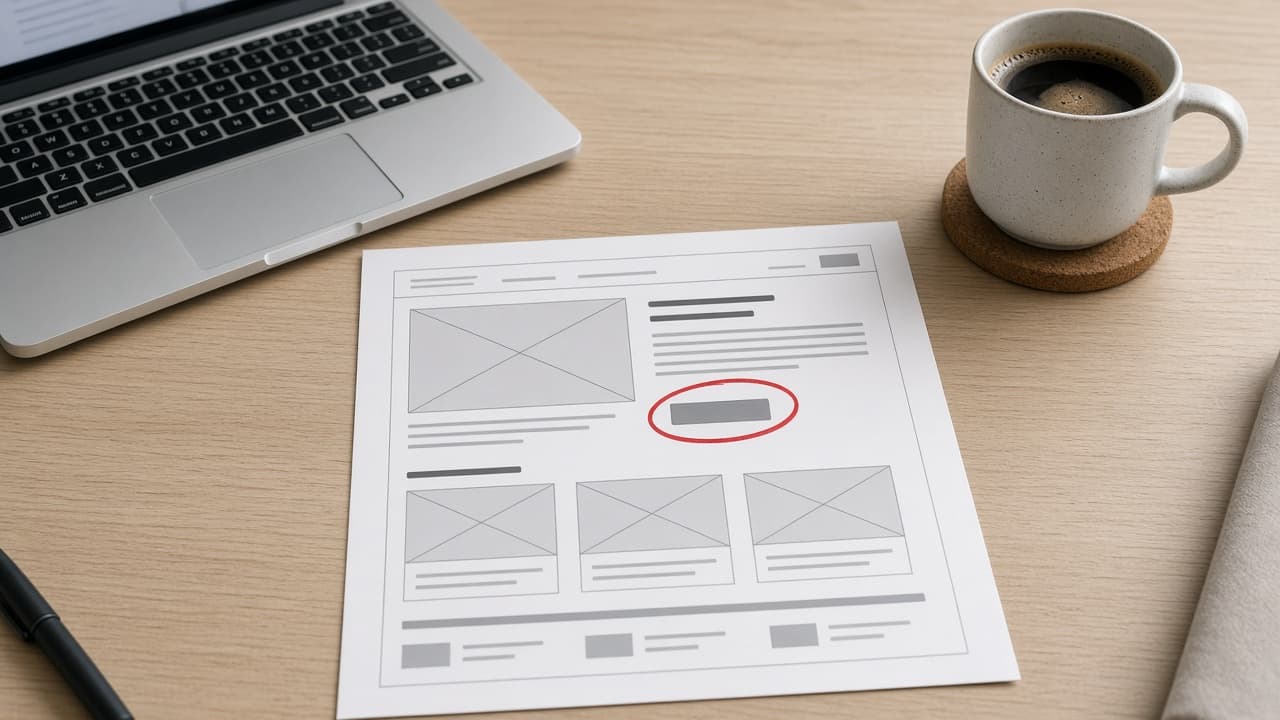
Landing Page Wireframe in Words: Sections, Copy, and CTA Stack
Describe a landing page as a section-by-section wireframe in words: layout, copy blocks, CTAs, and what not to put above the fold.
Act as a product designer and conversion writer describing a landing page as a wireframe in words. No Figma. No screenshots. A developer or designer should be able to build from the sections. Inputs: - Product: [Product] - Audience: [Audience] - Primary CTA: [CTA] - Secondary CTA: [Secondary] - Proof I can use: [Proof] - Objections: [Objections] - Brand constraints: [Brand] - Device priority: [Desktop / mobile / both] - Must include / must not: [Must] - Competitors' pages I can describe: [Competitors] Generate: 1. Page job: one sentence. One primary CTA. What "done" is. 2. Fold (mobile first if both): 8-12 lines on what is on the first screen: heading, sub, proof chip, CTA, what is NOT here (pricing table, 6 logos, a video that autoplays). 3. Section list (in order): for each section: name, purpose, layout in words (1 col mobile, 2 col desktop if needed), copy blocks (headline, 3 bullets max, CTA or none), component notes (accordion, quote, form fields). 7-10 sections typical. 4. Copy: write the actual headlines and CTA labels, not lorem. Use only Proof. If a number is missing, do not invent it. 5. CTA stack: where the primary repeats (fold, mid, end). Secondary placement. What happens on click (URL or modal) if known; else "unknown, do not fake." 6. Objection handling: map Objections to a section. Do not hide price if Must says to show it. 7. Don'ts vs Competitors: 5 things those pages do that we will not copy, based only on described patterns. 8. Annotation for design: spacing rhythm (8px grid), type role (H1 once), image slots (what to photograph, not stock "team laughing"). Constraints: - Words, not ASCII art unless a simple 3-line box helps. - No fake testimonials or logos. - Honor Must. - One H1. Primary CTA label stays identical every time it appears. - This is a landing wireframe, not a full UI design system.