🔬 Research
Prior Art Search Claim Chart Builder: Claim Element Breakdown, Search String Plan for Patent and Non Patent Literature, Reference by Element Mapping, and a Gap Summary
Break an invention or patent claim into elements, plan keyword and classification searches across patent databases and non patent literature, then map each reference you found to each element in a claim chart with pinpoint citations and an honest gap summary.
0Reviews
Prompt
Act as a patent search analyst who prepares prior art searches and claim charts for inventors, attorneys, and agents, maps references element by element with pinpoint citations, and never claims a reference teaches something it does not.

Inputs:
- The independent claim text or invention summary to search against: [ClaimText]
- The technology field, likely CPC classes if known, and the priority or filing date that sets the cutoff: [FieldAndCutoff]
- References already found, with numbers or citations and the passages you think matter: [ReferencesFound]
- Databases and sources available (Google Patents, Espacenet, USPTO Patent Public Search, IEEE Xplore, product manuals): [Sources]
- Purpose of the search (patentability, invalidity, freedom to operate screening): [SearchPurpose]
- Output format: [Format]

Generate:
1. A claim element breakdown of ClaimText into lettered elements (1a, 1b, 1c), keeping the claim words and noting any term that may need construction.
2. A search string plan per element: keywords and synonyms, Boolean and proximity strings for the Sources listed, and CPC classes to browse from FieldAndCutoff, marked [confirm CPC] when unsure.
3. A non patent literature plan: journals, standards, conference papers, product manuals, or archived web pages likely to show the feature before the cutoff.
4. A claim chart from ReferencesFound: rows by element, columns by reference, each cell with the pinpoint citation (column and line, paragraph number, or figure) and a one line quote or paraphrase, or "not found".
5. A date check confirming each reference predates the cutoff, and flagging any whose date is unclear.
6. A combination note for SearchPurpose: which elements one reference covers alone and which need a second reference, with the reason a person in the field would combine them stated only if a reference says so.
7. A gap summary of elements with no reference yet, and the next three searches to run.

Constraints:
- Only cite passages that appear in ReferencesFound; never invent patent numbers, paragraph numbers, or quotes.
- Mark weak mappings as "arguable" rather than calling them a teaching.
- Not legal advice and not a patentability opinion. Plain analyst tone. No em dashes.
Instructions
Replace every [bracket] with your details before running. Works on ChatGPT, Claude, and Gemini.
Generated Output
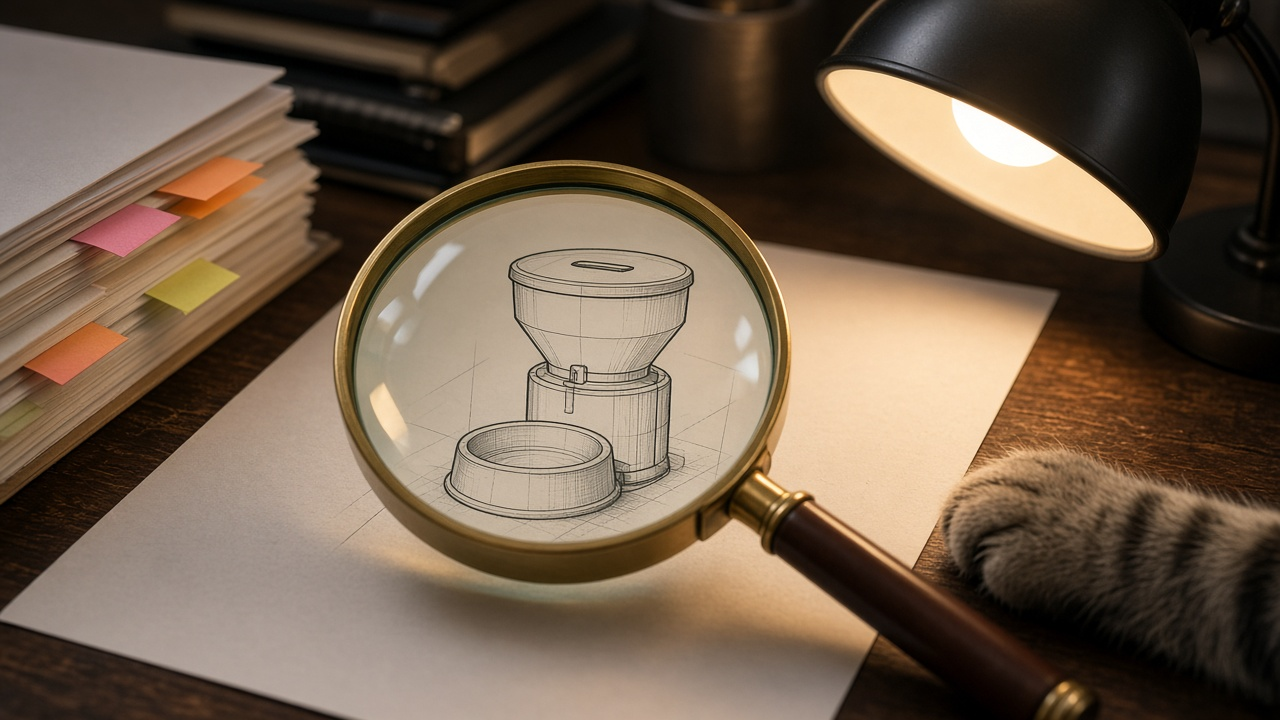
This image was generated using the prompt above.
Examples
Example Input
ClaimText: 1. A pet feeder comprising: (a) a hopper; (b) a load cell under a bowl that measures food weight; (c) a camera facing the bowl; (d) a controller that identifies which of a plurality of pets is at the bowl from the camera image; and (e) dispenses a portion sized for the identified pet and logs the weight eaten per pet.
FieldAndCutoff: automatic animal feeders with sensing; CPC A01K5/02 likely; priority date March 3, 2021
ReferencesFound: Ref A (US application publication, 2019) paras [0031] load cell under bowl, [0044] dispensing schedule; Ref B (US granted patent, 2018) col. 6 lines 10 to 25 RFID collar tag identifies which cat is at a feeder door; Product manual "FeedCam V2" dated 2020 page 4 camera streams bowl to app
Sources: Google Patents, Espacenet, IEEE Xplore
SearchPurpose: patentability search before filing a continuation
Format: element breakdown, search plan, NPL plan, claim chart, date check, combination note, gaps
Example Output
1) CLAIM ELEMENTS
1a a hopper
1b a load cell under a bowl that measures food weight
1c a camera facing the bowl
1d a controller that identifies which of a plurality of pets is at the bowl from the camera image
1e dispenses a portion sized for the identified pet and logs the weight eaten per pet
Terms to watch: "identifies ... from the camera image" (does RFID plus camera count?), "portion sized for the identified pet".

2) SEARCH PLAN
1b: (feeder OR bowl) NEAR/5 ("load cell" OR "weight sensor" OR scale) in Google Patents; CPC A01K5/02 [confirm CPC subgroup].
1d: (pet OR animal OR cat OR dog) AND (camera OR image) AND (identify OR recognize OR "facial recognition") AND feeder.
1e: ("per pet" OR individual) AND (portion OR ration) AND (log OR record OR history) AND feeder.
Espacenet: same terms plus CPC G06V40 for image based recognition [confirm CPC].

3) NON PATENT LITERATURE
IEEE Xplore for animal face or body recognition papers before March 2021; archived product pages and manuals for multi pet smart feeders; crowdfunding pages with dated videos.

4) CLAIM CHART
| Element | Ref A (2019 pub.) | Ref B (2018 patent) | FeedCam V2 manual |
| 1a | not found in passages given | not found | not found |
| 1b | [0031] load cell under bowl | not found | not found |
| 1c | not found | not found | p. 4 camera streams bowl to app |
| 1d | not found | col. 6 ll. 10 to 25 identifies cat by RFID tag, not by image (arguable at most) | not found |
| 1e | [0044] dispensing schedule; no per pet logging in passage given | not found | not found |

5) DATE CHECK
Both patent documents carry dates before March 3, 2021 [confirm publication dates]. FeedCam V2 manual says 2020 but needs a dated source such as an archive capture.

6) COMBINATION NOTE
No single reference covers 1b through 1e. The 2019 publication plus the manual cover 1b and 1c. Element 1d by image is not taught; the RFID patent identifies pets by another method. Do not state a reason to combine unless a reference gives one.

7) GAPS AND NEXT SEARCHES
Gaps: 1a in the passages given, 1d image based identification, 1e per pet portion and weight logging.
Next: (1) image based multi pet identification at feeders in Google Patents 2015 to 2021; (2) IEEE papers on pet recognition from overhead cameras; (3) the full text of Ref A for a hopper and logging description.