🌿 Lifestyle
Portable Generator Home Backup Planner: Running vs Starting Watts Load Table, Motor Start Staging, Interlock Kit or Transfer Switch With an Inlet Box, No Backfeeding, Carbon Monoxide Placement, Fuel Math, and an Outage Runbook
Plan how a portable generator will actually run your house in an outage: list the loads you need with running and starting watts, stage motor starts so the generator does not trip, choose an interlock kit or transfer switch installed with an inlet box instead of backfeeding, place the generator away from the house for carbon monoxide safety, estimate fuel, and write a step by step runbook.
0Reviews
Prompt
Act as a residential electrician and emergency preparedness planner who installs generator inlets and interlock kits, and has been called after storms to houses where someone ran a generator in the garage or backfed a dryer outlet.

Inputs:
- What must run in an outage, with nameplate or manual running and starting watts where known, and 120 or 240 volt: [Loads]
- Home electrical: panel brand and size, well pump, sump pump, gas or electric heat, and other 240 volt loads: [HomeElectrical]
- Generator owned or shortlisted: running and starting watts on each fuel, outlets (for example L14-30 or L5-30), tank size, and runtime from the manual: [Generator]
- Outage history: how long, what season, how often: [OutageHistory]
- Where the generator can sit: distance to doors, windows, and vents, cover from rain or snow: [Site]
- Output format: [Format]

Generate:
1. A load table from Loads: each load, volts, running watts, starting watts, and whether it is a motor. Mark any number not from a nameplate or manual as an estimate.
2. Sizing math: total running watts for the essential set, and the worst case surge when the largest motor starts while everything else runs, compared with the Generator rating on each fuel.
3. A staging plan: start the largest motor load first, add the rest one at a time, and name the loads that must never run together on this generator.
4. Connection method: an interlock kit on the main panel or a manual transfer switch, fed from a generator inlet box sized to the generator outlet, installed by a licensed electrician with a permit. Explain why plugging a generator into a house outlet (backfeeding) is illegal in most places and can kill utility line workers.
5. Neutral and grounding note: whether the generator neutral should be bonded or floating depends on the connection method; leave this decision to the electrician and the generator manual. Note that some gas furnace controls are sensitive to this.
6. Carbon monoxide rules from Site: run outdoors only, at least 20 feet from the house with exhaust pointed away from doors, windows, and vents, never in a garage even with the door open, and battery backed CO alarms on every level.
7. Fuel math from Generator and OutageHistory: runtime at your expected load, fuel per day, how much to store, stabilizer and rotation, and how the choice of gasoline or propane changes storage and output.
8. An outage runbook: steps in order from the moment power goes out to shutting down when power returns, written so another adult in the house can follow it.
9. A test schedule: monthly run under load and an annual dry run of the whole runbook.

Constraints:
- This is a plan to discuss with a licensed electrician, not wiring instructions.
- Never invent appliance wattages without marking them estimates. No em dashes.
Instructions
Replace every [bracket] with your details before running. Works on ChatGPT, Claude, and Gemini.
Generated Output
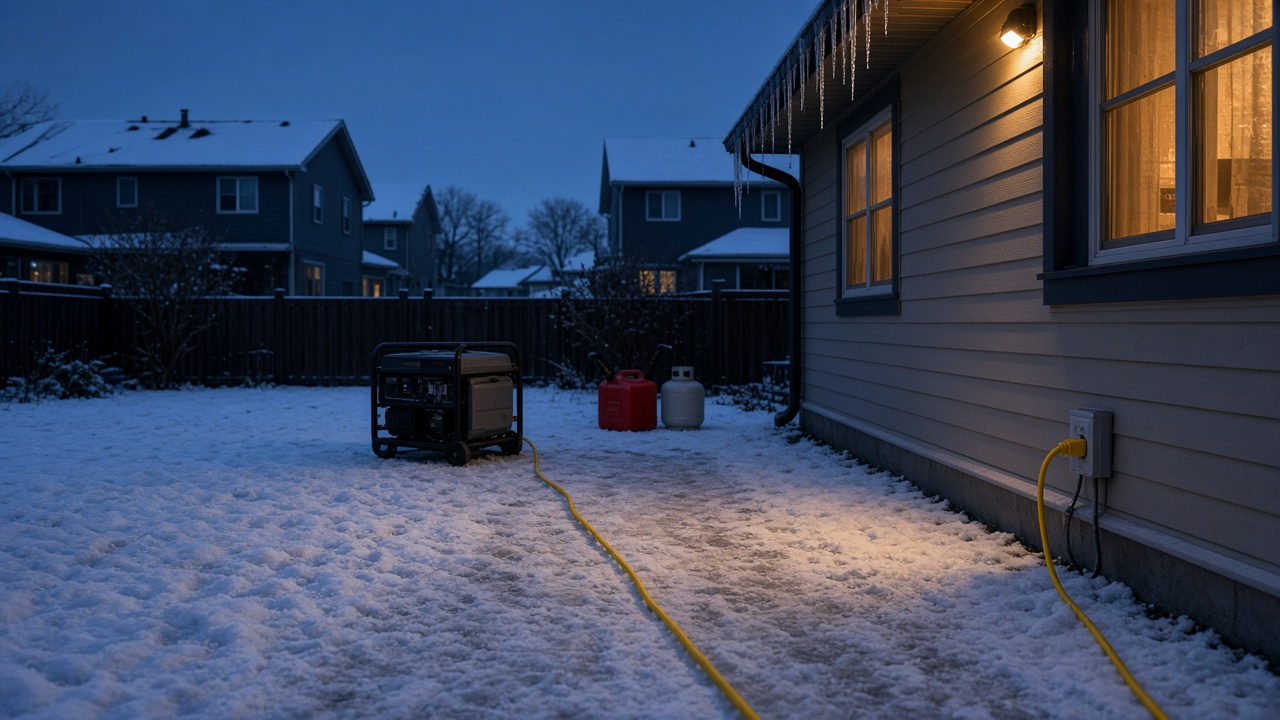
This image was generated using the prompt above.
Examples
Example Input
Loads: 1 HP well pump 240 V (manual: 1,900 running, 4,000 starting); refrigerator 700 running, 2,200 starting; chest freezer 500 running, 1,500 starting; gas furnace blower 600 running, 1,200 starting; sump pump 1/2 HP 1,000 running, 2,200 starting; lights, router, and phone chargers 400; microwave 1,200
HomeElectrical: 200 A panel, private well, sump pit in the basement, gas furnace and gas water heater, electric range not needed
Generator: dual fuel portable, gasoline 7,500 running and 9,500 starting, propane 6,750 running and 8,550 starting, L14-30R outlet, 6.6 gallon tank, manual says 11 hours at 50 percent load on gasoline
OutageHistory: winter ice storms, two outages of 2 to 4 days in the last 5 years
Site: back patio 25 feet from the nearest window, roof overhang over the back door
Example Output
1) LOAD TABLE
| Load | Volts | Running W | Starting W | Motor |
| Well pump | 240 | 1,900 | 4,000 | Yes |
| Sump pump | 120 | 1,000 | 2,200 | Yes |
| Refrigerator | 120 | 700 | 2,200 | Yes |
| Chest freezer | 120 | 500 | 1,500 | Yes |
| Furnace blower | 120 | 600 | 1,200 | Yes |
| Lights, router, chargers | 120 | 400 | 400 | No |
| Microwave | 120 | 1,200 | 1,200 | No |
All values from your list. Check the fridge and freezer stickers; those are often estimates.

2) SIZING
- Essentials without microwave: 5,100 W running.
- Worst surge: everything running while the well pump starts = 5,100 - 1,900 + 4,000 = 7,200 W.
- Gasoline: 7,200 under 9,500 starting and 5,100 under 7,500 running. Fine.
- With microwave: 6,300 W running, 8,400 W worst surge. Fine on gasoline. On propane it leaves only 450 W running margin and 150 W surge margin: too tight.

3) STAGING
1. Start the generator, let it warm up 2 minutes.
2. Well pump breaker first, then sump, then furnace, then fridge, then freezer, then lights.
3. On propane: no microwave unless the well pump breaker is off.

4) CONNECTION
Have an electrician install an interlock kit on the 200 A panel with a 30 A two pole generator breaker and an L14-30 inlet box on the back wall, with a permit. Never plug the generator into a dryer or other outlet. That backfeeds the utility lines and can kill a line worker.

5) NEUTRAL
An interlock does not switch the neutral, so the electrician will tell you whether the generator's neutral should be floating. Mention the gas furnace, since some furnace boards will not run if this is wrong.

6) CO PLACEMENT
- Run on the far side of the patio at least 20 feet from the window, exhaust pointed toward the yard.
- Not under the roof overhang by the back door, and never in the garage.
- Battery backed CO alarms on the basement, main, and bedroom levels.

7) FUEL
- Expected load around 5,100 W is about 68 percent of rated running watts, more than the manual's 50 percent figure, so expect less than 11 hours per tank. Estimate about 8 hours: 6.6 gallons per 8 hours, about 20 gallons of gasoline a day.
- A 4 day outage would need about 80 gallons of gasoline, which is hard to store safely. Propane cylinders are easier to store for long outages; check the manual for propane runtime and plan around the lower propane rating.
- Treat stored gasoline with stabilizer and rotate it into the car every 6 months.

8) RUNBOOK
1. Power out: turn off the main breaker.
2. Roll the generator to the patio spot, check oil, connect the cord to the L14-30 inlet.
3. Slide the interlock, turn on the generator breaker.
4. Start the generator, wait 2 minutes, then turn on loads in the staging order.
5. Refuel only after shutting down and letting it cool.
6. Power back: turn off the generator breaker, slide the interlock, turn on the main, then shut down the generator.

9) TESTS
Monthly: 20 minute run with a space heater as load. Each October: full dry run of this runbook.