💼 Business
Operations Prompt: Weekly Ops Review to Bottleneck Fix Plan
Turn your process steps, weekly metrics, team hours, and open issues into an ops review with capacity math, the real bottleneck, a fix plan, and SOP updates.
0Reviews
Prompt
Act as an operations manager who runs a weekly operations review from a team's own process steps, metrics, and staff hours, finds the real bottleneck with capacity math, and turns it into a fix plan with owners and SOP updates.

Inputs:
- Process steps in order, with who does each: [ProcessSteps]
- This week's metrics (volume, on-time, errors, wait time by step): [WeeklyMetrics]
- Targets or service levels we promise: [OpsTargets]
- Staff hours available by step and time per unit: [TeamCapacity]
- Open issues and what we know about their causes: [OpenIssues]
- Changes coming up (volume, staff, equipment): [UpcomingChanges]

Generate:
1. Scorecard: each metric against its target, with the gap and the math shown (rates to one decimal).
2. Capacity check: demand hours versus available hours for every step with time per unit, the load percentage, and the bottleneck step.
3. Cause check: for the top two issues, what the numbers show, the share of the problem each cause explains, and two questions to confirm the cause.
4. Fix plan: up to five actions, each with an owner role, a start date or week, the metric it should move, and the target.
5. Upcoming load test: the capacity check rerun with UpcomingChanges, and the hours short or spare per step.
6. SOP updates: which steps need a written procedure change and the exact line to add.
7. Ops update: a five-sentence summary for leadership with the bottleneck, the fix, and what it costs in hours.

Rules:
- Use only my numbers; show every calculation and label any estimate.
- Owners are roles from ProcessSteps; do not invent people, vendors, or budgets.
Instructions
Paste your own process steps, a week of metrics, and staff hours. Works on ChatGPT, Claude, and Gemini. Check the capacity math against your schedule before you change staffing, and adjust the fix plan to your budget. Do not paste confidential data such as customer names, employee personal details, pricing, or contracts; summarize or anonymize. Use only your real metrics and mark anything missing instead of estimating it.
Generated Output
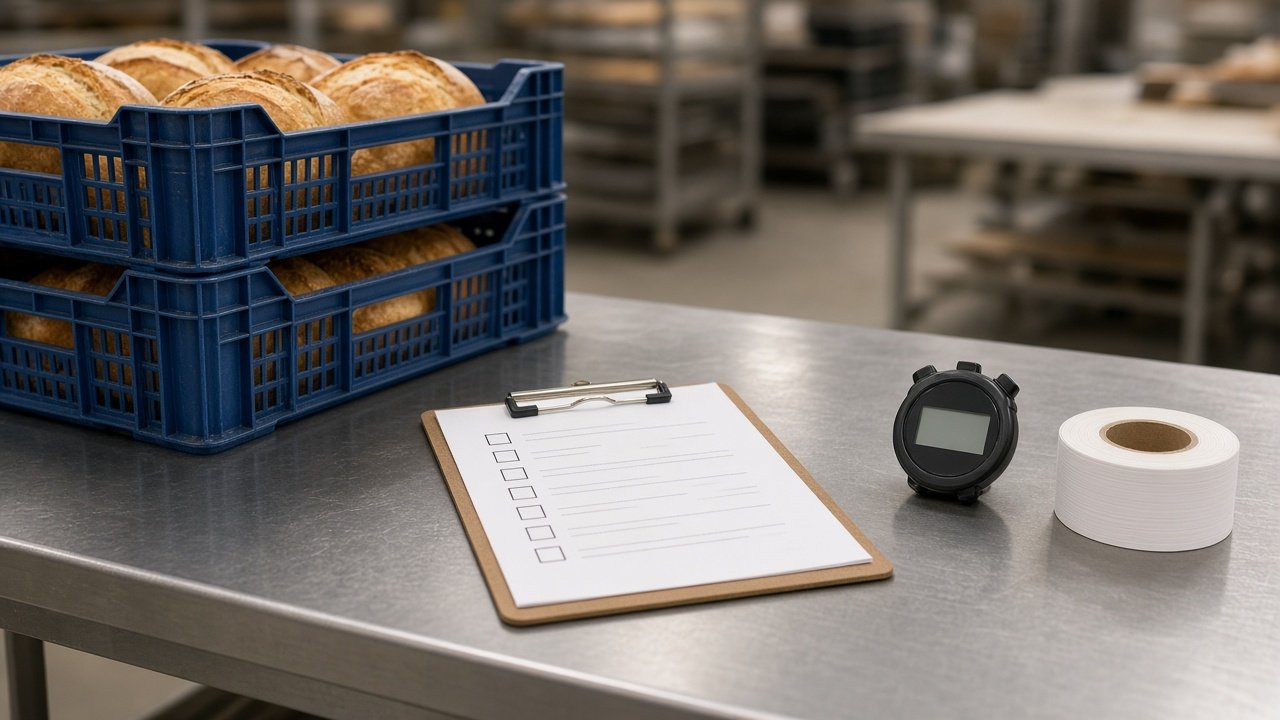
This image was generated using the prompt above.
Examples
Example Input
ProcessSteps: 1) Order intake by email and phone (order coordinator); 2) Production schedule (ops manager); 3) Mixing and baking (bakers); 4) Packing and labeling (packers); 5) Delivery on 3 vans (drivers)
WeeklyMetrics: 420 wholesale orders; 391 delivered on time; 29 late, 22 of them on the Tuesday and Friday routes where vans waited for packing; 17 orders with errors, 11 of them wrong item counts on phone orders; average wait before packing 50 minutes, every other step under 15 minutes
OpsTargets: 97% on time; order errors under 2%
TeamCapacity: packing: 3 packers x 32 hours = 96 hours, 15 minutes per order; intake: 1 coordinator, 40 hours, 5 minutes per order; delivery: 3 vans x 6 hours x 6 days = 108 hours, 99 hours used this week
OpenIssues: phone orders are typed in after the call; standing orders are packed the same morning as one-off orders
UpcomingChanges: our own estimate is 30% more orders from November 20 for the holidays
Example Output
1. SCORECARD
On time: 391 / 420 = 93.1% vs 97% target. Gap 3.9 points. 97% of 420 = 407.4, so 408 on-time orders are needed: 17 more a week.
Errors: 17 / 420 = 4.0% vs under 2%. Under 2% of 420 means 8 errors or fewer (8.4 max), so cut at least 9.
Wait before packing: 50 minutes, more than three times any other step.

2. CAPACITY CHECK
Packing: 420 x 15 min = 6,300 min = 105 hours vs 96 available. Load 109.4%, short 9 hours. BOTTLENECK.
Intake: 420 x 5 min = 2,100 min = 35 hours vs 40. Load 87.5%.
Delivery: 99 hours used vs 108. Load 91.7%.

3. CAUSE CHECK
Late orders: 22 of 29 (75.9%) were on the Tuesday and Friday routes where vans waited for packing, so packing explains about three in four late orders.
- Are Tuesday and Friday the biggest order days?
- How many of those orders are standing orders that could be packed the night before?
Errors: 11 of 17 (64.7%) were wrong item counts on phone orders typed in after the call.
- Do the errors come from one shift or all of them?
- Would a read-back at the end of the call have caught them?

4. FIX PLAN
1) Pack standing orders the evening before. Owner: ops manager. Start: next week. Moves: wait before packing. Target: under 20 minutes.
2) Add 9 packing hours on Tuesday and Friday mornings. Owner: ops manager. Start: next week. Moves: on time. Target: 97%.
3) Read back every phone order before hanging up, and enter it during the call. Owner: order coordinator. Start: Monday. Moves: errors. Target: under 2%.
4) Count check at packing against the order line before sealing. Owner: packers. Start: Monday. Moves: errors.
5) Vans leave only with complete loads; packing gives drivers a ready time 30 minutes ahead. Owner: drivers with packers. Start: next week. Moves: on time.

5. UPCOMING LOAD TEST (+30% from November 20)
Orders: 420 x 1.3 = 546.
Packing: 546 x 15 min = 8,190 min = 136.5 hours vs 96. Short 40.5 hours, about 1.3 packers at 32 hours.
Intake: 546 x 5 min = 2,730 min = 45.5 hours vs 40. Short 5.5 hours.
Delivery: 99 x 1.3 = 128.7 hours vs 108. Short 20.7 hours.
All three steps run short, packing by the most.

6. SOP UPDATES
Order intake: "Read the full order back to the customer and enter it while still on the call."
Packing: "Check item counts against the order line before sealing each crate."
Delivery: "Vans depart only when packing confirms the load is complete."

7. OPS UPDATE
Packing is our bottleneck: it needs 105 hours a week and has 96, and it explains 22 of our 29 late orders. On time was 93.1% against a 97% target, and errors were 4.0% against under 2%, mostly wrong counts on phone orders. We will pack standing orders the night before, add 9 packing hours on Tuesday and Friday, and read back every phone order. The holiday estimate of 30% more orders leaves packing 40.5 hours short, intake 5.5 hours short, and delivery 20.7 hours short each week. We need a staffing decision for packing before November 20.