📢 Marketing
Marketing Plan for 90 Days from Your Business Facts
Paste your business facts, customers, goal, budget, and past results to get a 90-day marketing plan with a budget split that adds up, a calendar, and KPIs.
0Reviews
Prompt
Act as a small business marketing strategist who writes a practical 90-day marketing plan from the owner's real numbers, puts most of the budget behind channels with proof, and sets targets the owner can actually track.

Inputs:
- What you sell, prices, where, and what makes you different: [BusinessFacts]
- Who buys today and who you want more of: [Customers]
- The one goal for the next 90 days, with today's number: [Goal]
- Total budget for 90 days and anything already committed: [Budget]
- Hours per week you or your team can spend on marketing: [TeamTime]
- What you have tried before and what happened, with numbers: [PastResults]

Generate:
1. Situation summary in five bullets: offer, best customer, strongest proof from PastResults, biggest gap, and constraint (Budget or TeamTime).
2. Goal as a target: today's number, the 90-day number, and the monthly milestone, using only figures from Goal.
3. Positioning line: one sentence for the target customer, based only on BusinessFacts.
4. Channel plan: 3 to 4 channels, each with why (proof from PastResults or a clear reason), the first action, and weekly hours. Drop channels that do not fit TeamTime.
5. Budget split table that adds up exactly to Budget, with percentages. Keep a small reserve for month 2.
6. 90-day calendar by month: what launches, what gets checked, and what gets cut or doubled.
7. KPIs: what to count each week and where to count it. Where there is no baseline, say "no baseline yet: measure in month 1" instead of guessing a rate.
8. Questions to answer before starting.

Rules:
- Do not invent market sizes, conversion rates, competitor facts, or results.
- Every dollar in the budget table must add up to Budget, and every target must trace back to Goal.
- Fit the plan to TeamTime; if it does not fit, say what to cut.
Instructions
Paste your real numbers into ChatGPT, Claude, or Gemini and run it once. Check that the budget table adds up and every target comes from your own goal, then adjust channels to your hours. Review the KPIs every week and use the month 2 reserve on whatever is actually bringing orders.
Generated Output
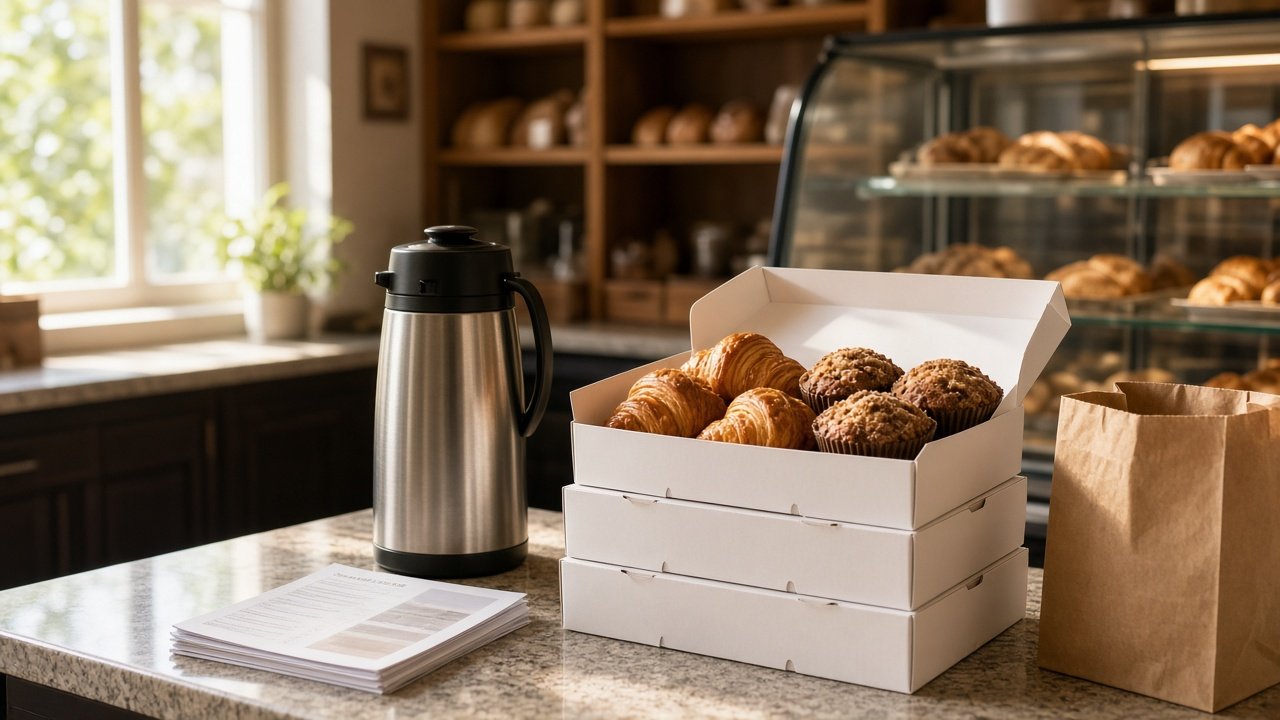
This image was generated using the prompt above.
Examples
Example Input
BusinessFacts: Rise & Crumb, a neighborhood bakery. We want to grow office catering: breakfast boxes of pastries and coffee for 10 to 20 people. Average catering order is $180. We deliver within 3 miles and can take orders with 24 hours' notice.
Customers: today mostly walk-in neighbors; catering comes from 2 nearby office buildings. We want more office managers and executive assistants within 3 miles.
Goal: catering orders from 4 per month today to 12 per month by the end of 90 days.
Budget: $3,000 for 90 days.
TeamTime: the owner, 4 hours per week.
PastResults: Instagram posts get likes but no catering orders we know of. Flyers left at 2 office building front desks brought 3 orders last spring.
Example Output
1. SITUATION SUMMARY
- Offer: office breakfast boxes for 10 to 20 people, $180 average order, 24 hours' notice, within 3 miles.
- Best customer: office managers and executive assistants nearby.
- Strongest proof: flyers at 2 office front desks brought 3 orders.
- Gap: Instagram brings attention but no known catering orders.
- Constraint: 4 owner hours per week.

2. GOAL AS A TARGET
4 orders per month today, 12 per month by day 90. Milestones: about 6 in month 1, 9 in month 2, 12 in month 3. At $180 each, 12 orders is $2,160 per month in catering, up from $720.

3. POSITIONING LINE
"Fresh bakery breakfast boxes for your team, delivered within 3 miles on 24 hours' notice."

4. CHANNEL PLAN
| Channel | Why | First action | Hours/week |
|---|---|---|---|
| Office front desk flyers and menus | Only channel with proof (3 orders) | List every office building within 3 miles; print menus | 1.5 |
| Tasting boxes for office managers | Puts the product in the buyer's hands | Send 10 boxes per month with a menu and order link | 1 |
| Local search ads | Catches people searching for office catering nearby | Ads limited to a 3-mile radius, catering keywords | 0.5 |
| Referral credit | Turns current office clients into sellers | Tell the 2 current buildings: $15 credit per referred order | 0.5 |
Total 3.5 hours, inside the 4-hour limit. Instagram: keep posting as now, no extra hours or budget.

5. BUDGET SPLIT
| Item | Amount | Share |
|---|---|---|
| Printed catering menus and office flyers | $400 | 13% |
| Local search ads, $400 per month for 3 months | $1,200 | 40% |
| Tasting boxes for office managers, 30 boxes at $25 | $750 | 25% |
| Referral credit, $15 per referred order, up to 20 orders | $300 | 10% |
| Reserve for what works in month 2 | $350 | 12% |
| Total | $3,000 | 100% |

6. 90-DAY CALENDAR
Month 1: print menus, cover all office buildings within 3 miles, send the first 10 tasting boxes, start ads, tell current clients about the referral credit.
Month 2: send 10 more tasting boxes; check which source each order came from; move the $350 reserve to the best channel.
Month 3: send the last 10 boxes, follow up with every office that tasted but did not order, cut the weakest channel.

7. KPIS (count weekly in a simple sheet)
- Catering orders and source of each (ask "how did you hear about us?"): target milestones above.
- Tasting box to first order: no baseline yet, measure in month 1.
- Ad clicks and calls from ads: no baseline yet, measure in month 1.
- Referred orders: count against the 20-order credit cap.

8. QUESTIONS BEFORE STARTING
- Can the kitchen handle 12 catering orders a month on top of walk-in sales?
- Do you have an online order form, or do orders come by phone?