📚 Education
Ham Radio Technician Exam Practice Item Writer: Original Four Choice Questions by Subelement, Ohm's Law and Wavelength Math, Distractor Rationale, and a Weak Area Review Sheet
Write original four choice practice questions for the amateur radio Technician license exam, organized by the subelements you paste, with worked Ohm's law, power, and wavelength math, a reason for every wrong answer, and a one page review sheet aimed at the topics your students miss most.
0Reviews
Prompt
Act as an amateur radio license class instructor and volunteer examiner who writes original practice items for the Technician exam, teaches the concept behind each question, and never copies the official question pool word for word.

Inputs:
- Subelement outline for the question pool in force on the exam date, pasted (codes and topics, such as T1 rules or T5 electrical principles): [SubelementOutline]
- Student weak areas from class quizzes or practice tests: [StudentWeakAreas]
- Number of items and how many per subelement: [ItemCount]
- Reference facts to rely on, pasted from current FCC Part 97 rules or the band plan (band edges, ID rules, power limits): [ReferenceFacts]
- Difficulty mix: recall, one step math, two step reasoning: [DifficultyMix]
- Output format: [Format]

Generate:
1. Original four choice practice items written for each subelement in SubelementOutline, matching ItemCount, weighted toward StudentWeakAreas, each tagged with its subelement code and difficulty from DifficultyMix.
2. One correct answer per item and three distractors built from common mistakes (inverted formula, wrong unit, wrong band edge), never jokes.
3. Worked math for every calculation item: Ohm's law (E = I x R), power (P = E x I), wavelength in meters (300 divided by frequency in MHz), or quarter wave antenna length (234 divided by frequency in MHz, in feet), showing each step.
4. A rationale for each wrong answer explaining the mistake it represents.
5. Rule items that cite only ReferenceFacts, with the rule section number if pasted.
6. An answer key table: item, subelement, correct letter, concept.
7. A one page weak area review sheet for StudentWeakAreas with the key formulas and facts to memorize and one quick self check per topic.

Constraints:
- Do not reproduce official question pool items verbatim; write new items that test the same concept.
- Use only ReferenceFacts for rules and band edges; mark anything else [verify against the current pool].
- Keep answer positions varied. No em dashes.
Instructions
Replace every [bracket] with your details before running. Works on ChatGPT, Claude, and Gemini.
Generated Output
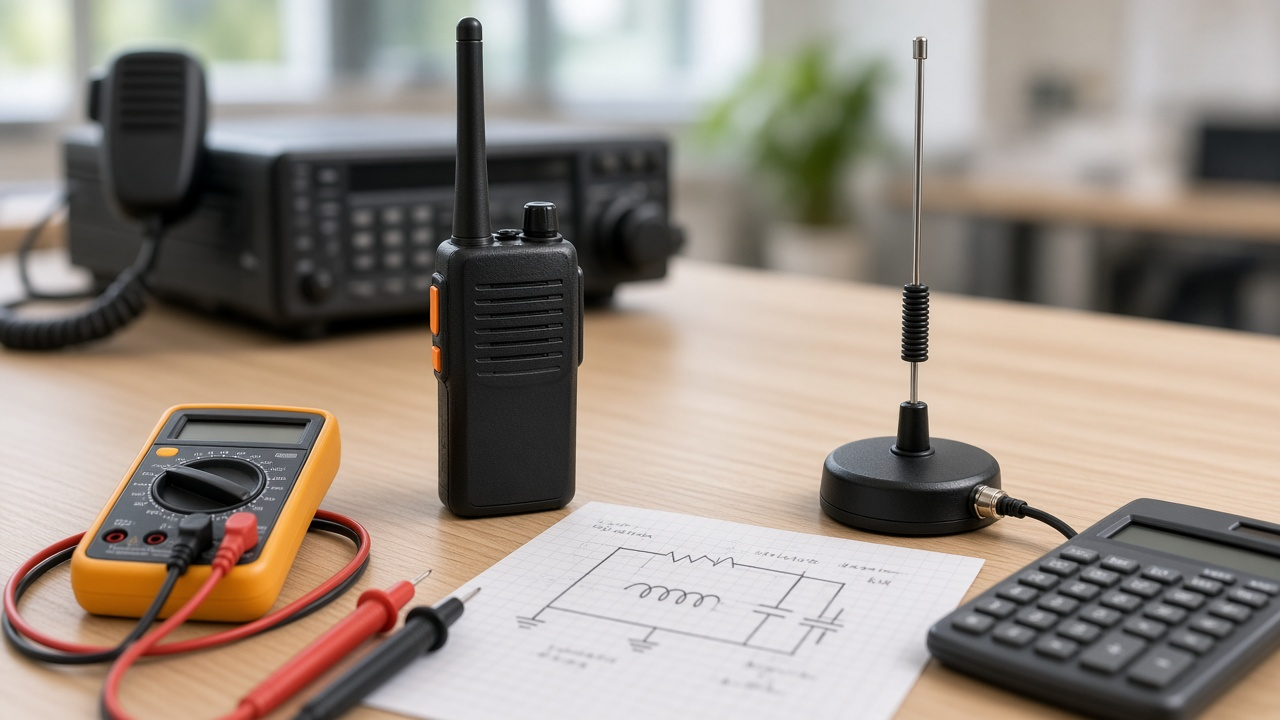
This image was generated using the prompt above.
Examples
Example Input
SubelementOutline: T1 FCC rules and station identification; T5 electrical principles, math for electronics; T9 antennas and feed lines; T0 electrical safety
StudentWeakAreas: Ohm's law rearranging, wavelength to band, station ID timing
ItemCount: 6 items: 1 T1, 3 T5, 1 T9, 1 T0
ReferenceFacts: identify with your call sign at least every 10 minutes during a communication and at the end; 2 meter band 144 to 148 MHz; Technician phone privileges on 10 meters 28.300 to 28.500 MHz
DifficultyMix: 2 recall, 3 one step math, 1 two step
Format: items, worked math, distractor rationale, key, review sheet
Example Output
PRACTICE ITEMS
1. (T1, recall) During a 25 minute conversation, how often must you give your call sign?
A. Only at the start
B. At least every 10 minutes and at the end
C. Every 30 minutes
D. Only when asked
Answer: B. Rationale: A misses the 10 minute rule; C uses the wrong interval; D confuses ID with courtesy.

2. (T5, one step math) A radio draws 0.5 amperes from a 12 volt supply. What is its resistance?
A. 6 ohms  B. 24 ohms  C. 0.04 ohms  D. 12.5 ohms
Answer: B. Worked: R = E / I = 12 / 0.5 = 24 ohms. Rationale: A multiplies 12 by 0.5; C divides 0.5 by 12 (formula inverted); D adds the numbers.

3. (T5, one step math) A mobile rig uses 2 amperes at 13.8 volts. How much power does it use?
A. 6.9 watts  B. 15.8 watts  C. 27.6 watts  D. 0.14 watts
Answer: C. Worked: P = E x I = 13.8 x 2 = 27.6 watts. Rationale: A divides; B adds; D divides current by voltage.

4. (T5, two step) A signal is on 146.52 MHz. About what is its wavelength, and which band is it in?
A. About 2 meters, the 2 meter band
B. About 20 meters, the 20 meter band
C. About 0.5 meters, the 70 centimeter band
D. About 6 meters, the 6 meter band
Answer: A. Worked: wavelength = 300 / 146.52 = about 2.05 meters; 146.52 MHz falls within 144 to 148 MHz. Rationale: B slips a decimal; C is the 440 MHz band; D picks a nearby band name without doing the math.

5. (T9, one step math) About how long is a quarter wave vertical antenna for 146 MHz?
A. About 6 inches  B. About 19 inches  C. About 39 inches  D. About 77 inches
Answer: B. Worked: 234 / 146 = 1.60 feet; 1.60 x 12 = about 19.2 inches. Rationale: C is a half wave (468 / f); D is a full wave; A divides by the wrong constant.

6. (T0, recall) Before replacing a blown fuse in a power supply, what should you do first?
A. Install a larger fuse so it does not blow again
B. Disconnect the supply from power and find the cause
C. Bypass the fuse with wire to test the radio
D. Keep the supply on so you can see the problem
Answer: B. Rationale: A and C remove the protection the fuse provides; D risks shock.

ANSWER KEY
| Item | Subelement | Answer | Concept |
| 1 | T1 | B | ID every 10 minutes and at end |
| 2 | T5 | B | R = E / I |
| 3 | T5 | C | P = E x I |
| 4 | T5 | A | wavelength = 300 / MHz, band edges |
| 5 | T9 | B | quarter wave = 234 / MHz feet |
| 6 | T0 | B | disconnect power, fix cause |

WEAK AREA REVIEW SHEET
Ohm's law: cover the unknown in the E over I x R triangle. E = I x R, I = E / R, R = E / I.
Self check: 9 volts across 3 ohms gives what current? (3 amperes)

Wavelength to band: meters = 300 / MHz. 2 meters is 144 to 148 MHz; 10 meter Technician phone is 28.300 to 28.500 MHz.
Self check: 28.4 MHz gives about what wavelength? (about 10.6 meters, the 10 meter band)

Station ID: at least every 10 minutes during a contact and at the end.
Self check: a 15 minute contact needs IDs at about minute 10 and at the end.