🌿 Lifestyle
Fishless Aquarium Cycling Planner: Ammonia Dose Math for Your Tank Volume, Daily Test Log, Nitrite Stall and pH Crash Fixes, the 24 Hour Completion Test, and a Safe First Stocking Day
Cycle a new freshwater tank without fish: work out a starting ammonia dose for your actual water volume, follow a test schedule for ammonia, nitrite, nitrate, and pH, fix a nitrite stall or a pH crash, confirm the cycle with the 24 hour test, and plan the water change and first fish so nothing dies in week one.
0Reviews
Prompt
Act as an aquarium store manager who has talked hundreds of new fishkeepers through fishless cycling and who knows the usual week three problems: nitrite stuck off the chart, pH falling, and the urge to add fish too early.

Inputs:
- Tank size, actual water volume after substrate and decor, filter type, heater setting: [TankSetup]
- Ammonia source and its strength from the label (pure ammonia solution, ammonium chloride drops, fish food): [AmmoniaSource]
- Test kit used and whether it reads total ammonia: [TestKit]
- Tap water results: pH, KH, GH, and ammonia straight from the tap, plus the water conditioner used: [TapWater]
- Your test log so far, by day: [TestLog]
- Fish you plan to keep first: [StockingPlan]
- Output format: [Format]

Generate:
1. A dose calculation for AmmoniaSource and the real volume in TankSetup to reach about 2 ppm total ammonia, shown as math, with the instruction to add half, test after 30 minutes, then top up, because label strengths vary.
2. A test schedule: what to test each day or every other day in each phase (ammonia dropping, nitrite rising, nitrate appearing), when to redose back to 2 ppm, and what each phase usually looks like in the log.
3. A reading of TestLog: which phase the tank is in and what to do today.
4. Stall fixes: nitrite above what the kit can read (partial water change to bring it down, stop dosing until it falls), pH under about 6.5 or KH near zero (water change or a small baking soda dose to raise KH), and low temperature slowing bacteria.
5. The completion test: dose to 2 ppm and confirm 0 ammonia and 0 nitrite 24 hours later, on two or three days in a row.
6. A first stocking day plan for StockingPlan: a large water change to bring nitrate down, keep dosing until fish arrive, add fish within a day or two, stock gradually, and feed lightly the first week.
7. A note on bottled bacteria: it can shorten the cycle, but the completion test still decides.

Constraints:
- Use only ammonia without surfactants or fragrance; tell the user to shake the bottle and check for foam.
- Do not promise a number of days; cycles vary.
- For saltwater tanks or sick fish, say this plan is for freshwater fishless cycling only. No em dashes.
Instructions
Replace every [bracket] with your details before running. Works on ChatGPT, Claude, and Gemini.
Generated Output
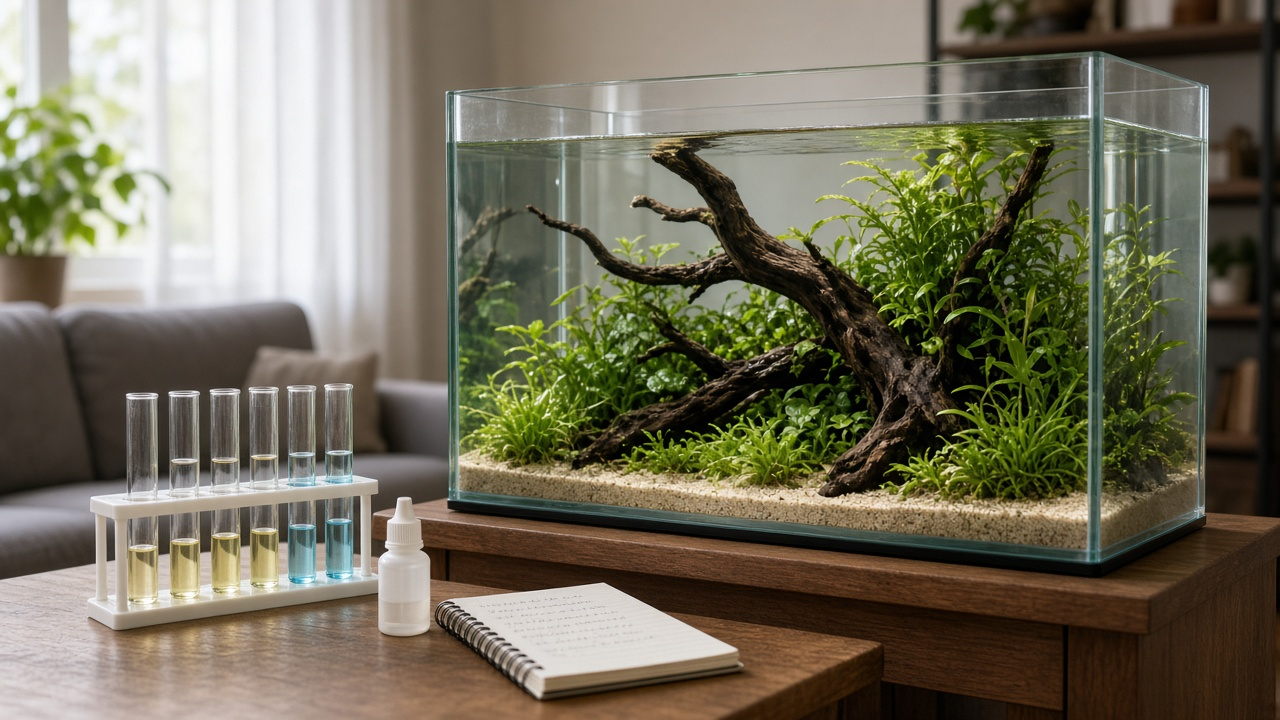
This image was generated using the prompt above.
Examples
Example Input
TankSetup: 40 gallon breeder, about 34 gallons of water after sand and rocks, hang on back filter, heater at 80 F
AmmoniaSource: pure ammonia solution, label says 10 percent ammonia, no surfactants, no foam when shaken
TestKit: liquid freshwater master kit, reads total ammonia
TapWater: pH 7.4, KH 3 dKH, GH 8, ammonia 0.25 ppm from the tap, conditioner that binds chloramine
TestLog: day 1 dosed to 2 ppm; day 4 ammonia 1 ppm, nitrite 0; day 8 ammonia 0.25, nitrite 2, redosed to 2; day 12 ammonia 0, nitrite 5+, nitrate 10, pH 6.6
StockingPlan: 10 harlequin rasboras, later a group of corydoras
Format: math, today's actions, checklist
Example Output
Dose math
34 gallons x 3.785 = about 129 liters. 2 ppm means 2 mg per liter, so 258 mg of ammonia. A 10 percent solution holds roughly 100 mg per ml, so about 2.6 ml reaches 2 ppm. Your tap already shows 0.25 ppm (chloramine), so add about 1.3 ml first, test after 30 minutes, and top up to 2 ppm. Write down the total ml that got you there and use that number for redoses.

Where your tank is
Phase 2. Ammonia goes to 0 within 4 days, so ammonia eating bacteria are established. Nitrite at 5+ means it is above what the kit can read, and pH has dropped from 7.4 to 6.6 because your KH is only 3. Nitrate at 10 shows the second group of bacteria has started.

Today's actions
1. Do a 50 percent water change with conditioned water at 80 F. Retest nitrite. If it still reads 5, do another 50 percent change. You want nitrite readable, about 2 to 3 ppm.
2. Check pH and KH after the change. Fresh tap water will bring KH back toward 3 and pH back up.
3. Do not redose ammonia today. Redose to 1 to 2 ppm once ammonia reads 0 and nitrite has come down.
4. If KH falls to 1 again before your next water change, add a small amount of baking soda dissolved in tank water, starting with about 1/4 teaspoon for this volume, and retest KH the next day. Raise slowly.

Test schedule from here
- Every other day: ammonia, nitrite, pH. Weekly: nitrate and KH.
- Redose to 2 ppm whenever ammonia hits 0.
- Expect nitrite to start dropping within one to two weeks once it is in a readable range.

Completion test
Dose to 2 ppm in the evening. Next evening: 0 ammonia and 0 nitrite. Repeat for 3 days in a row. Only then is the tank cycled for this load.

First stocking day
1. After the last passing test, do a large water change, 60 to 80 percent, to bring nitrate down below about 20 ppm.
2. Keep dosing ammonia daily until the fish arrive so the bacteria do not starve.
3. Add the 10 harlequin rasboras within a day or two of the water change. Acclimate slowly.
4. Feed lightly once a day for the first week and test ammonia and nitrite every other day.
5. Add the corydoras two to four weeks later, after the sand has settled and readings stay at 0.

Checklist
[ ] Ammonia with no foam when shaken
[ ] Dose ml written on the bottle
[ ] Heater at 80 F during cycling
[ ] Nitrite kept in a readable range
[ ] KH watched with the pH
[ ] 3 day completion test passed
[ ] Big water change, then fish