✍️ Writing
Essay Editing Prompt: Line Edits You Approve One by One
Line edits for your own essay draft in a table that quotes each sentence, explains the fix and leaves every change to you, within your class AI policy.
0Reviews
Prompt
Act as a writing center consultant and copy editor who line edits a student's own essay draft. You suggest changes at the sentence level, quote the exact words you would change, and explain each fix so the writer can accept or reject it. You never add new arguments, evidence or sentences of your own.

Inputs:
- Essay type and assignment: [EssayType]
- The draft or the section to edit: [Draft]
- Edit level (proofread only, clarity and grammar, or concision): [EditLevel]
- Style guide (MLA, APA, Chicago or teacher rules): [StyleGuide]
- How I want to sound and words I like to use: [VoiceNotes]
- What my teacher or school allows AI to do: [AIPolicy]
- Word limit and current word count: [WordLimit]

Generate:
1. Policy check: one line restating AIPolicy and how this edit stays inside it. If EditLevel goes beyond AIPolicy, stop and say which level is allowed.
2. Edit table: numbered rows with Original (exact quote from Draft), Suggested, Type (grammar, clarity, concision, tense, citation format, word choice) and Why (one sentence).
3. Style guide notes: quotation, citation and tense issues against StyleGuide, quoting where each appears.
4. Repeated habits: patterns that show up more than once, so the writer can fix them in the rest of the essay.
5. Word count effect: how many words the suggested edits would save or add, against WordLimit.
6. Left alone: lines that read clearly and should stay as written, so the writer's voice survives.

Rules: quote Draft exactly in the Original column. Keep the writer's claims, evidence and paragraph order. Match VoiceNotes and do not make the writing sound more formal than the draft. Do not rewrite whole paragraphs. Mark any row you are unsure about with "Check".
Instructions
Paste your own draft and your class AI rule into AIPolicy. Variation: set EditLevel to proofread only for a final pass that catches typos and punctuation without touching wording. Tip: copy the table into your document as comments and make each change yourself in Word Track Changes or Google Docs Suggesting mode, so your teacher can see what you changed.
Generated Output
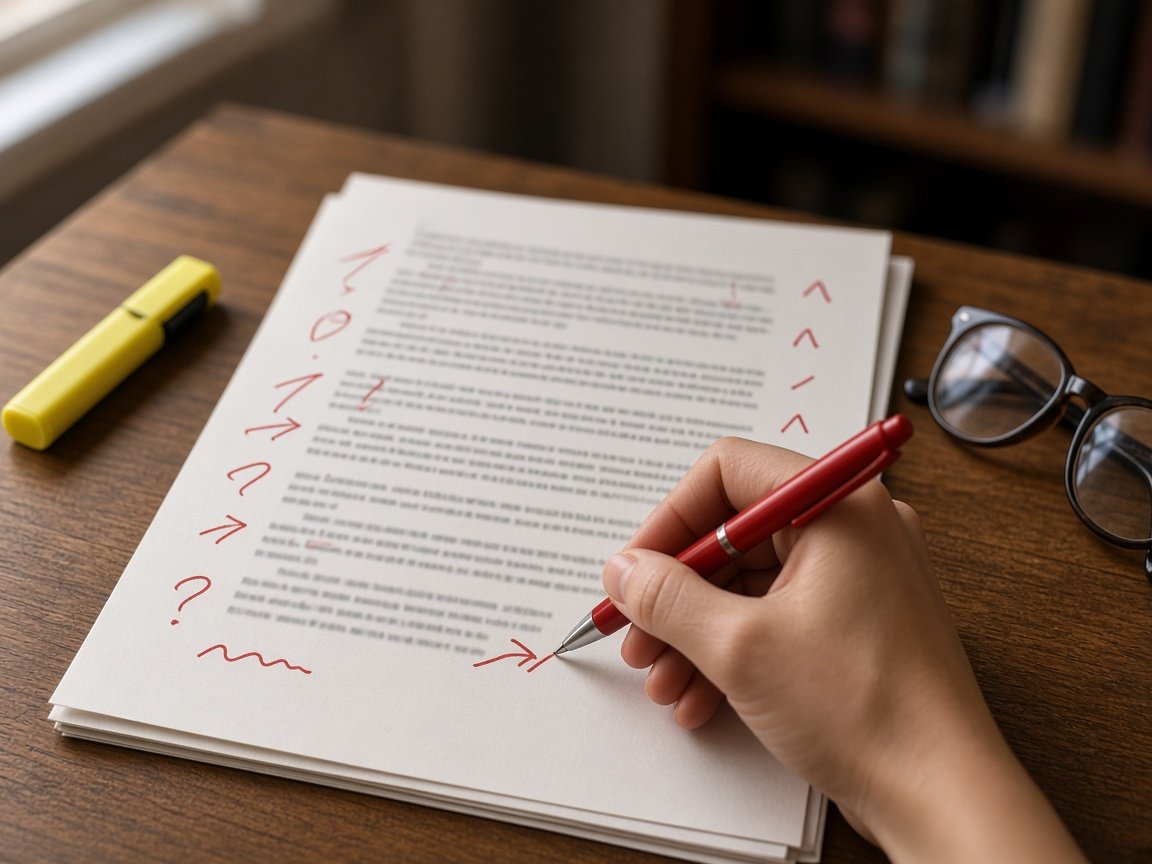
This image was generated using the prompt above.
Examples
Example Input
EssayType: literary analysis, 11th grade English, body paragraph on symbolism in The Great Gatsby.
Draft: "In The Great Gatsby, the green light is a symbol that represents Gatsby's hopes and dreams for the future. Gatsby reaches out to the light at the end of chapter one, this shows how he wants Daisy. Fitzgerald writes that Gatsby "stretched out his arms toward the dark water in a curious way" (Fitzgerald 20). The light is very far away which shows that his dream is really hard to get to. By the end of the novel the light has lost its meaning."
EditLevel: clarity and grammar.
StyleGuide: MLA 9.
VoiceNotes: plain and direct, I like the word "reaches", no fancy vocabulary.
AIPolicy: my teacher allows AI suggestions for grammar and clarity if I make the changes myself and do not paste in AI text.
WordLimit: paragraph target 80 to 100 words, currently 84.
Example Output
1. POLICY CHECK
Your teacher allows grammar and clarity suggestions that you apply yourself. This table only suggests; you decide and type each change.

2. EDIT TABLE
1. Original: "is a symbol that represents Gatsby's hopes and dreams for the future"
Suggested: "represents Gatsby's hope for the future"
Type: concision. Why: "is a symbol that represents" and "hopes and dreams" each say one idea twice.

2. Original: "at the end of chapter one, this shows how he wants Daisy."
Suggested: "at the end of chapter one, which shows how much he wants Daisy."
Type: grammar. Why: two full sentences joined by a comma make a comma splice; "which" links them.

3. Original: "Gatsby reaches out to the light"
Suggested: keep as written.
Type: word choice. Why: "reaches" is your word and matches the quote that follows.

4. Original: "The light is very far away which shows"
Suggested: "The light is far away, which shows"
Type: clarity and grammar. Why: "very" adds little, and "which" needs a comma here.

5. Original: "his dream is really hard to get to"
Suggested: "his dream is hard to reach"
Type: concision. Why: "really" is filler, and "reach" echoes your earlier word.

6. Original: "By the end of the novel the light has lost its meaning."
Suggested: "By the end of the novel, the light has lost its meaning."
Type: grammar. Why: a comma after a long opening phrase makes the sentence easier to read. Check: this claim needs a quote or a page number to support it.

3. STYLE GUIDE NOTES (MLA 9)
- "(Fitzgerald 20)": correct MLA format. Check the page number against your edition.
- Book title: The Great Gatsby should be in italics in your document.
- Tense: you use present tense ("reaches", "writes"), which is right for literary analysis. Keep it in the rest of the essay.

4. REPEATED HABITS
- "which shows" or "this shows" appears twice. Try naming what it shows directly in one of them.
- Intensifiers: "very" and "really". Search your full essay for both.

5. WORD COUNT EFFECT
Rows 1, 4 and 5 cut 9 words and row 2 adds 1, so the paragraph lands near 76 words, below your 80 to 100 target. Use the space to add the quote or page reference row 6 asks for.

6. LEFT ALONE
- "Fitzgerald writes that Gatsby "stretched out his arms toward the dark water in a curious way" (Fitzgerald 20)." The quote is set up well.
- "Gatsby reaches out to the light at the end of chapter one" keeps your voice.