📚 Education
EPA Section 608 Technician Certification Practice Item Writer: Core, Type I, Type II, and Type III Questions with Rule Based Answer Keys, Distractor Logic, and a Weak Area Drill Plan
Write original multiple choice practice items for the EPA Section 608 refrigerant technician exam sections, each tied to a rule or concept from your course materials, with an answer key that explains why every distractor is wrong and a drill plan for the areas students miss most.
0Reviews
Prompt
Act as an HVAC trade school instructor and item writer who prepares students for the EPA Section 608 technician certification, writes original multiple choice items from the course's own rule summaries, and never copies questions from proctored exams.

Inputs:
- Exam sections to cover (Core, Type I small appliances, Type II high pressure, Type III low pressure) and how many items each: [SectionsAndCounts]
- Rule summaries or textbook pages the items must be based on, pasted or summarized: [CourseRules]
- Topics students missed most on the last practice round: [WeakAreas]
- Student level (first year apprentice, career changer, experienced tech renewing knowledge): [StudentLevel]
- Exam format notes from your certifying organization (items per section, passing score, open or closed book): [ExamFormatNotes]
- Output format: [Format]

Generate:
1. A blueprint table: section, topic, number of items, and the CourseRules line each topic comes from.
2. Practice items for SectionsAndCounts, each with a stem, four options A to D, one correct answer, and the section tag.
3. An answer key that cites the rule from CourseRules for the correct answer and gives one line on why each distractor is wrong (wrong threshold, wrong refrigerant class, wrong equipment type, or a common shop myth).
4. Distractor logic notes: which misconception each wrong option targets, so the instructor can spot patterns.
5. Extra items weighted toward WeakAreas, at least two per weak topic.
6. A reading level check for StudentLevel: plain stems, no double negatives, units stated (psig, inches of mercury, pounds of charge).
7. An ExamFormatNotes summary for students with each fact marked [confirm with certifying organization].
8. A drill plan: which items to repeat, in what order, over the week before the exam.

Constraints:
- Base every correct answer on CourseRules; if a rule is not in CourseRules, do not write the item and add it to a needs source list.
- Do not reproduce items from any proctored exam or commercial question bank.
- Plain instructor tone. No em dashes.
Instructions
Replace every [bracket] with your details before running. Works on ChatGPT, Claude, and Gemini.
Generated Output
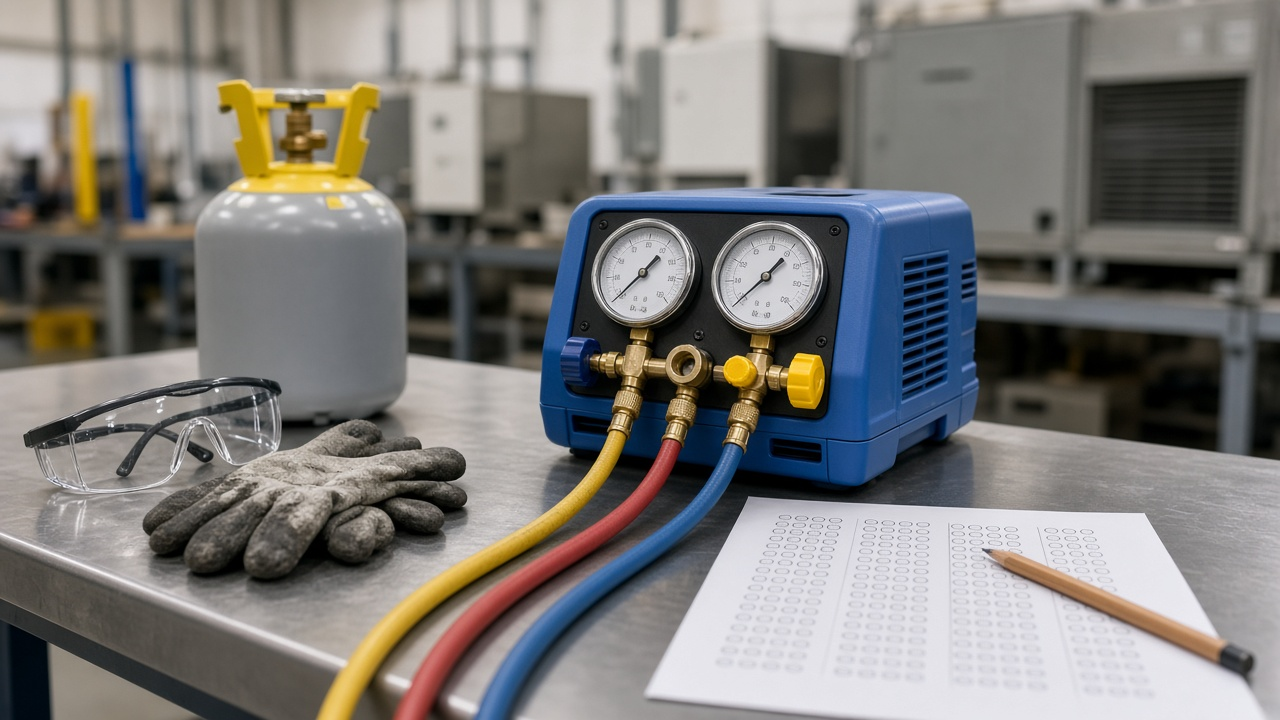
This image was generated using the prompt above.
Examples
Example Input
SectionsAndCounts: Core 4 items, Type I 3 items
CourseRules: venting of CFC and HCFC refrigerants during service is prohibited, de minimis releases during good faith recovery are allowed; HFCs have zero ozone depletion potential but are still covered by the venting ban; CFCs have higher ozone depletion potential than HCFCs; recovery cylinders must not be filled above 80 percent of capacity by volume; small appliance means factory charged, hermetically sealed, 5 pounds of refrigerant or less; Type I recovery equipment made after November 15, 1993 must recover 90 percent of the refrigerant when the compressor works, or 80 percent when it does not; evacuation removes air and moisture before charging
WeakAreas: Type I recovery percentages; cylinder fill limits
StudentLevel: first year apprentices in a 12 week HVAC certificate
ExamFormatNotes: our proctor says 25 items per section, closed book, Core is required with any Type
Format: blueprint, items, key, distractor logic, weak area extras, reading check, format summary, drill plan
Example Output
1) BLUEPRINT
| Section | Topic | Items | CourseRules line |
| Core | Venting ban and de minimis | 1 | venting prohibited, de minimis allowed |
| Core | Ozone depletion potential | 1 | CFC higher than HCFC; HFC zero |
| Core | Cylinder fill limit | 1 | 80 percent by volume |
| Core | Evacuation purpose | 1 | removes air and moisture |
| Type I | Small appliance definition | 1 | 5 lb or less, hermetically sealed |
| Type I | Recovery percentages | 2 | 90 percent or 80 percent |

2) ITEMS
C1 (Core) A technician releases a small amount of HCFC-22 while connecting recovery hoses during a good faith recovery. This release is:
A. A violation in every case  B. A de minimis release  C. Allowed only for HFCs  D. Allowed if under 1 pound
C2 (Core) Which refrigerant has the highest ozone depletion potential?
A. HFC-134a  B. HCFC-22  C. CFC-12  D. HFC-410A
C3 (Core) A recovery cylinder should be filled to no more than what share of its capacity by volume?
A. 60 percent  B. 80 percent  C. 90 percent  D. 100 percent
C4 (Core) The main purpose of evacuating a system before charging is to remove:
A. Oil  B. Old refrigerant labels  C. Air and moisture  D. Ozone
T1 (Type I) Which of these is a small appliance?
A. A household refrigerator factory sealed with 6 ounces of refrigerant  B. A 10 ton rooftop unit  C. A centrifugal chiller  D. A walk in cooler with 20 pounds of charge
T2 (Type I) Recovery equipment made after November 15, 1993 is used on a small appliance with a working compressor. It must recover:
A. 70 percent  B. 80 percent  C. 90 percent  D. 100 percent
T3 (Type I) The same equipment is used on a small appliance whose compressor does not run. It must recover:
A. 50 percent  B. 80 percent  C. 90 percent  D. 95 percent

3) ANSWER KEY
C1 B. De minimis releases during good faith recovery are allowed. A ignores the de minimis rule; C reverses the rule, HFCs are covered too; D invents a weight limit.
C2 C. CFCs have higher ODP than HCFCs. A and D are HFCs with zero ODP; B is an HCFC, lower than a CFC.
C3 B. 80 percent by volume. A is too cautious and not the rule; C and D leave no room for expansion.
C4 C. Evacuation removes air and moisture. A, B, and D are not what a vacuum pump removes.
T1 A. Factory sealed with 5 pounds or less. B, C, and D are field charged or over 5 pounds.
T2 C. 90 percent with a working compressor. B is the non working figure.
T3 B. 80 percent when the compressor does not run. C is the working figure.

4) DISTRACTOR LOGIC
T2 and T3 swap 80 and 90 on purpose, since that swap is the WeakArea. C2 tests the myth that newer refrigerants are always worse for ozone.

5) WEAK AREA EXTRAS
W1 A tech recovers from a window unit with a dead compressor using 1995 equipment. Which target applies? (80 percent)
W2 A 50 pound recovery cylinder: about how many pounds of liquid by the 80 percent rule? (rule given by volume; teach the cylinder's stamped capacity, not a guess)

6) READING CHECK
Short stems, no "NOT" questions, units stated in every item.

7) FORMAT SUMMARY
25 items per section, closed book, Core plus one Type [confirm with certifying organization]. Passing score [confirm with certifying organization].

8) DRILL PLAN
Day 1 all items cold. Day 3 repeat T2, T3, C3, W1, W2. Day 5 mixed order. Day 6 only missed items.