📚 Education
Digital SAT Reading and Writing Practice Item Writer for Tutors: Domain and Skill Tags, Words in Context, Rhetorical Synthesis from Student Notes, Transitions, Boundaries, Four Option Distractor Rationales, and Difficulty Tags
Write original practice questions in the format of the digital SAT Reading and Writing section: one short passage and one question per item, tagged to the four content domains and their skills, with words in context, rhetorical synthesis notes, transition, and boundary items, four answer choices with one defensible key, a rationale for every distractor, and easy, medium, or hard tags.
0Reviews
Prompt
Act as a test prep item writer who has written original practice sets for the digital SAT Reading and Writing section, trains tutors to diagnose wrong answers, and rejects any item where two choices can be argued.

Inputs:
- Domains and skills to cover, from the four content domains (Information and Ideas, Craft and Structure, Expression of Ideas, Standard English Conventions): [SkillTargets]
- Number of items, difficulty mix, and whether they feed an easier or harder second module practice: [SetPlan]
- Passage topics and genres wanted (literature, history and social studies, humanities, science), and topics to avoid: [TopicPool]
- Student profile and common errors seen in tutoring: [StudentErrors]
- Output format: [Format]

Generate:
1. A set blueprint table: item number, domain, skill (for example words in context, text structure and purpose, cross text connections, central ideas and details, command of evidence, inferences, rhetorical synthesis, transitions, boundaries, form structure and sense), topic, and difficulty, matching SetPlan.
2. Original passages, each about 25 to 150 words, one question per passage, written fresh and never copied or paraphrased from released College Board material. Paired passages only for cross text connections.
3. Item stems in the digital SAT style for each skill: "Which choice completes the text with the most logical and precise word or phrase?" for words in context, a bulleted student notes block and a stated goal for rhetorical synthesis, a blank with a logical transition for transitions, and a punctuation or sentence boundary blank for boundaries.
4. Four answer choices labeled A to D with one key. Each distractor targets one error from StudentErrors or a known trap (a word that fits the topic but not the logic, a transition with the wrong relationship, a comma splice, a choice true to the notes but not the goal).
5. A rationale for every choice: why the key is right, citing the words in the passage that prove it, and why each distractor is wrong in one sentence a student can learn from.
6. A difficulty note per item explaining what makes it easy, medium, or hard (vocabulary, how far the evidence is from the blank, how close the distractors are).
7. A two choice audit: for each item, the closest distractor and why it still fails, so tutors can trust the key.
8. A tutor score sheet that maps wrong answers back to skills for the next lesson.

Constraints:
- Every passage and item is original. Do not claim the items predict a score.
- One question per passage, four choices, one key. No em dashes.
Instructions
Replace every [bracket] with your details before running. Works on ChatGPT, Claude, and Gemini.
Generated Output
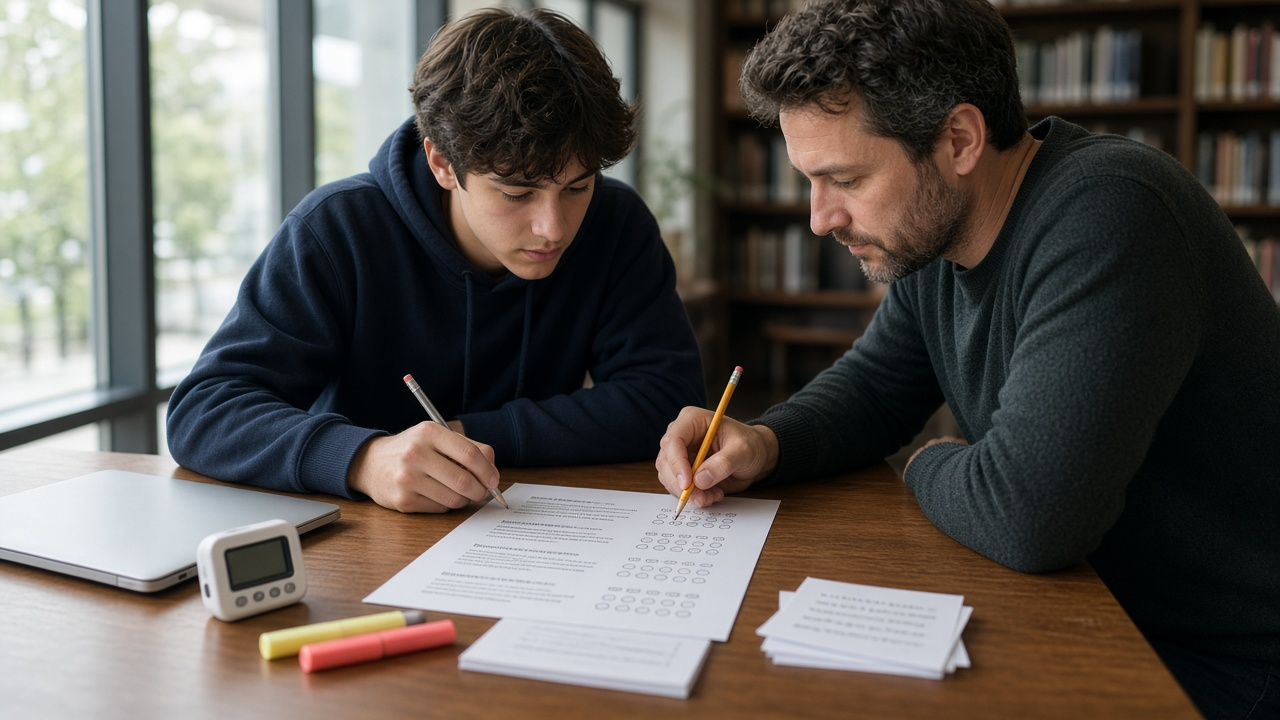
This image was generated using the prompt above.
Examples
Example Input
SkillTargets: Craft and Structure: words in context; Expression of Ideas: rhetorical synthesis and transitions; Standard English Conventions: boundaries
SetPlan: 4 items, one each, medium to hard, for a student preparing for the harder second module
TopicPool: science and history and social studies; avoid sports and celebrity topics
StudentErrors: picks transitions that sound formal instead of matching the logic; picks synthesis choices that are true but miss the goal; uses commas to join two full sentences
Format: items, keys, rationales, audit, score sheet
Example Output
BLUEPRINT
| # | Domain | Skill | Topic | Difficulty |
| 1 | Craft and Structure | Words in context | Science: lichen | Medium |
| 2 | Expression of Ideas | Rhetorical synthesis | History: canal | Hard |
| 3 | Expression of Ideas | Transitions | Science: bird migration | Medium |
| 4 | Standard English Conventions | Boundaries | History: public libraries | Hard |

ITEM 1
Lichens can survive on bare rock for decades, but they are far from ______ to their surroundings. Many species absorb pollutants directly from the air, and they decline quickly when air quality worsens, which is why ecologists use them to monitor pollution.
Which choice completes the text with the most logical and precise word or phrase?
A) immune  B) native  C) hostile  D) visible
Key: A. The passage contrasts their toughness with their sensitivity to pollutants, so "far from immune" fits.
B: native is about origin, not sensitivity. C: hostile does not connect to absorbing pollutants. D: visible is unrelated to the contrast.
Difficulty: medium; the contrast word "but" is close to the blank.

ITEM 2
While researching a topic, a student has taken the following notes:
- The Erie Canal opened in 1825.
- It connected the Hudson River to Lake Erie.
- Shipping costs between Buffalo and New York City fell sharply after it opened.
- Towns along its route, such as Rochester, grew quickly.
The student wants to emphasize the canal's effect on towns along its route. Which choice most effectively uses relevant information from the notes to accomplish this goal?
A) The Erie Canal, which opened in 1825, connected the Hudson River to Lake Erie.
B) After the Erie Canal opened, towns along its route, such as Rochester, grew quickly.
C) Shipping costs between Buffalo and New York City fell sharply after the Erie Canal opened.
D) The Erie Canal linked two major waterways and changed shipping in New York.
Key: B. It is the only choice about towns along the route.
A: accurate but describes the canal, not its effect on towns. C: an effect, but on shipping costs, not towns (the "true but misses the goal" trap). D: vague and leaves out towns.
Difficulty: hard; C is a real effect from the notes.

ITEM 3
Many songbirds migrate at night, when cooler air reduces water loss. ______, they spend daylight hours resting and feeding at stopover sites along the route.
A) Instead  B) Similarly  C) Nevertheless  D) Consequently
Key: A. Daytime resting replaces daytime flying, so "Instead" shows the substitution.
B: there is no comparison of like things. C: implies a contrast with an expectation that is not set up. D: night flight does not cause feeding; the formal sound is the trap.
Difficulty: medium.

ITEM 4
Andrew Carnegie funded more than 1,600 library buildings in the United States ______ towns had to provide the land and promise yearly funding for books and staff.
A) States, in return,  B) States; in return,  C) States in return,  D) States, in return
Key: B. Two independent clauses need a semicolon before "in return," with a comma after it.
A: a comma splice. C: a run on sentence. D: comma splice and missing comma after the phrase.
Difficulty: hard; A looks correct to students who join sentences with commas.

TWO CHOICE AUDIT
1: B fails because native changes the meaning. 2: C fails the stated goal. 3: D fails the logic. 4: A fails the boundary rule.

TUTOR SCORE SHEET
| Wrong choice | Skill to reteach |
| 2C | Rhetorical synthesis: match the goal, not just the facts |
| 3D or 3C | Transitions: name the relationship before reading choices |
| 4A or 4D | Boundaries: comma splice with conjunctive adverbs |