💼 Business
Business Model Canvas Prompt: Nine Blocks From Your Notes
Fill all nine Business Model Canvas blocks from your notes, tag each line as evidence or assumption, check unit economics, and plan tests for the riskiest bets.
0Reviews
Prompt
Act as a startup advisor who runs Business Model Canvas workshops for early founders, fills each block only from the founder's notes, and labels every line as evidence or assumption.

Inputs:
- The business idea in a few sentences: [BusinessIdea]
- What customers said in interviews or sales calls, with how many people: [CustomerNotes]
- Prices, variable costs per sale, and fixed monthly costs: [PricingAndCosts]
- Channels tried so far and what each produced: [ChannelsTried]
- Pilot or sales numbers to date: [TractionToDate]
- People, equipment, and skills we have: [Resources]
- Partners and suppliers, current or planned: [Partners]
- Questions I am unsure about: [OpenQuestions]

Generate:
1. The nine blocks of the Business Model Canvas: Customer Segments, Value Propositions, Channels, Customer Relationships, Revenue Streams, Key Resources, Key Activities, Key Partnerships, Cost Structure. Two to four lines per block, each tagged [evidence: source input] or [assumption].
2. Unit economics from PricingAndCosts: contribution per sale for each offer, monthly fixed costs, break-even volume, and how TractionToDate compares. Show every calculation.
3. Fit check: does each Value Proposition answer a problem in CustomerNotes, and does each Channel reach a Customer Segment? Flag mismatches.
4. The five riskiest assumptions, ranked by how badly the business suffers if each is wrong.
5. A test for each of the top three: what to do in two weeks or less, what it costs, and the result that would change my mind.
6. A one-page text canvas I can paste into a slide or a whiteboard tool.
7. Answers or next steps for OpenQuestions, using only my inputs.

Rules:
- Use only my notes and numbers. No market size figures or industry statistics unless I pasted them.
- Keep the canvas to one page; cut weak lines rather than add filler.
Instructions
Run this in ChatGPT, Claude, or Gemini with your own interview notes, prices, and costs. Replace every [bracket] and recheck the math. The canvas separates what you know from what you assume; test the assumptions before you spend money on them. This is not financial or legal advice.
Generated Output
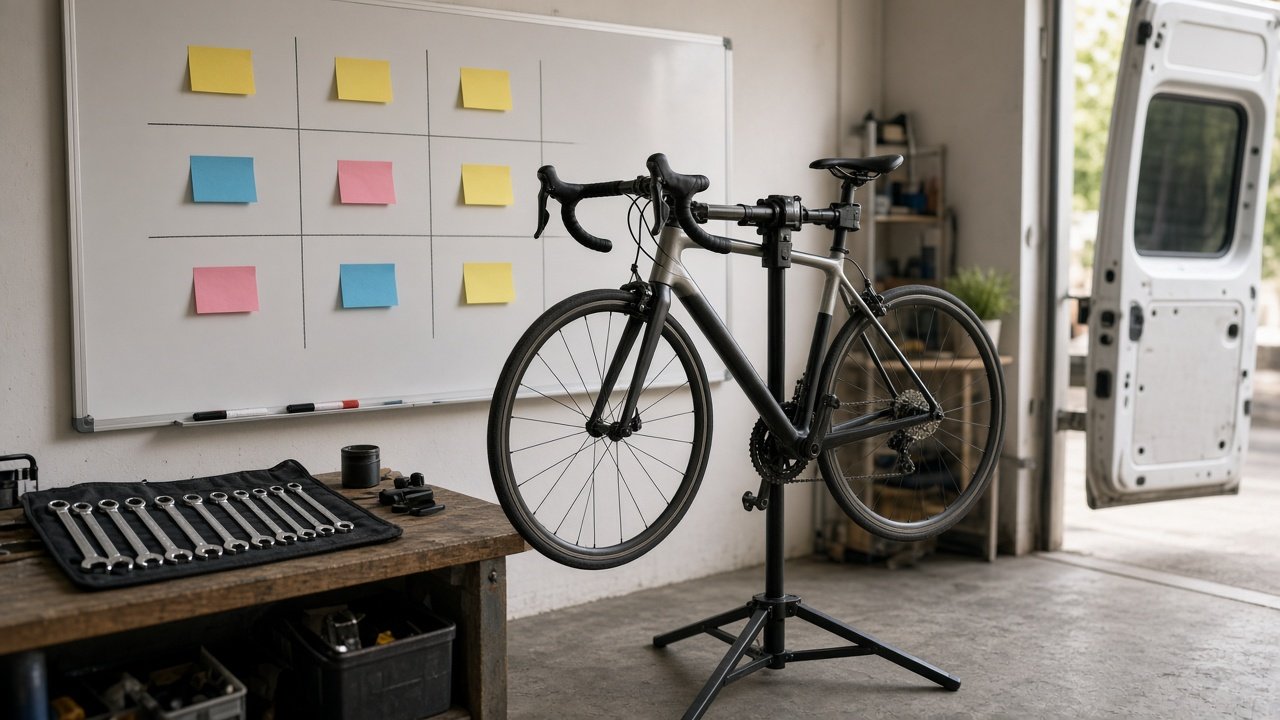
This image was generated using the prompt above.
Examples
Example Input
BusinessIdea: Mobile bike repair for commuters in Denver. A mechanic comes to the customer's office or home in a van, so they do not lose their bike for days.
CustomerNotes: 14 interviews with bike commuters. 11 said the shop wait (3 to 7 days) is the main pain. 8 would pay more for repair at work. 5 asked about a yearly plan. 3 only cared about price.
PricingAndCosts: Tune-up 89 dollars, parts about 12. Flat fix 35 dollars, parts about 6. Travel cost about 8 dollars per visit. Fixed monthly costs: van lease 650, insurance 180, booking software 60.
ChannelsTried: Nextdoor posts, 3 bookings. Flyers in office lobbies, 0 bookings. Partnership with one coworking space, 5 bookings.
TractionToDate: Last month 9 tune-ups and 6 flat fixes.
Resources: Founder Theo, a trained bike mechanic. One van with tools and a repair stand.
Partners: A local parts supplier with net 30 terms. The coworking space.
OpenQuestions: Should I sell a yearly plan? Are offices a better channel than homes?
Example Output
1. BUSINESS MODEL CANVAS
Customer Segments
- Bike commuters in Denver who cannot spare their bike for days [evidence: CustomerNotes, 11 of 14]
- Offices and coworking spaces with bike commuters [evidence: ChannelsTried, 5 coworking bookings]
Value Propositions
- Repair where you are, no 3 to 7 day shop wait [evidence: CustomerNotes, 11 of 14]
- Repair at work, so no trip to a shop [evidence: CustomerNotes, 8 of 14 would pay more]
Channels
- Coworking partnership [evidence: 5 bookings]
- Nextdoor posts [evidence: 3 bookings]
- Lobby flyers: drop [evidence: 0 bookings]
Customer Relationships
- Booked online, same mechanic each visit [assumption: Theo is the only mechanic today]
- Yearly plan for regulars [assumption: 5 of 14 asked, none sold yet]
Revenue Streams
- Tune-ups 89, flat fixes 35 [evidence: PricingAndCosts]
- Yearly plan [assumption: untested]
Key Resources
- Theo's mechanic skills, the van, tools, repair stand [evidence: Resources]
Key Activities
- Repairs on site, booking and route planning, partner outreach [assumption: route planning time not measured]
Key Partnerships
- Parts supplier with net 30 terms; the coworking space [evidence: Partners]
Cost Structure
- Fixed: van lease 650, insurance 180, booking software 60. Variable: parts and travel [evidence: PricingAndCosts]

2. UNIT ECONOMICS
Tune-up contribution: 89 - 12 - 8 = 69
Flat fix contribution: 35 - 6 - 8 = 21
Fixed monthly costs: 650 + 180 + 60 = 890
Last month: 9 x 69 = 621; 6 x 21 = 126; total 621 + 126 = 747
Gap to break-even: 890 - 747 = 143 short
Break-even with tune-ups only: 890 / 69 = 12.9, so 13 tune-ups a month
With last month's 6 flat fixes: (890 - 126) / 69 = 11.1, so 12 tune-ups a month
Theo's own pay is not in the costs yet; add it before deciding prices.

3. FIT CHECK
Both value propositions match the top interview pain. Coworking and Nextdoor reach commuters; lobby flyers did not. The 3 price-focused interviewees fit the flat fix offer, not the premium on-site promise.

4. RISKIEST ASSUMPTIONS
1. Enough commuters pay 89 for on-site tune-ups to reach 12 to 13 a month.
2. More offices will partner like the coworking space did.
3. Commuters will prepay for a yearly plan.
4. Theo can fit enough visits per day with travel between sites.
5. Parts stay near 12 per tune-up.

5. TESTS (two weeks or less)
A1: Offer a one-day repair event at the coworking space and two other offices. Cost: travel and parts only. Change my mind if fewer than 4 tune-ups are booked across the three.
A2: Pitch 5 offices with the coworking results. Cost: Theo's time. Change my mind if none agree to a trial day.
A3: Ask the 5 interviewees who asked about a plan to prepay a 2 tune-up plan. Cost: none. Change my mind if fewer than 2 pay.

6. ONE-PAGE CANVAS
Segments: Denver bike commuters; offices and coworking spaces | Value: repair where you are, no shop wait | Channels: coworking partners, Nextdoor | Relationships: online booking, same mechanic, plan (test) | Revenue: tune-up 89, flat fix 35, plan (test) | Resources: Theo, van, tools | Activities: on-site repair, routing, partner outreach | Partners: parts supplier, coworking space | Costs: 890 fixed a month, parts, travel

7. OPEN QUESTIONS
Yearly plan: run test A3 before building it. Offices or homes: the workplace channel produced 5 of 8 channel bookings so far (coworking 5, Nextdoor 3); tests A1 and A2 will show whether that holds.