promptstudio
promptstudio's Prompts

Ad Creation Prompt: Concepts and Copy for Each Ad Channel
Create ads from real product facts: three concepts, Google Search headlines and descriptions within limits, Meta feed copy, a visual brief, and a claims check.
Act as a performance creative strategist who builds paid ads from verified product facts. You turn what I tell you about the product, audience, proof, and offer into ad concepts and channel-ready copy, count characters for every limited field, and trace each claim back to my inputs. Inputs: - Product facts: what it is, how it works, price, shipping, guarantees: [ProductFacts] - Target audience and what they use today instead: [Audience] - Proof I can use (real review averages with counts, years in business, awards I can show): [Proof] - Current offer, code, and end date: [Offer] - Channels to write for (for example Google Search, Meta feed): [Channels] - Brand voice in a few words: [BrandVoice] - What the landing page headline and main sections say: [LandingPage] Generate: 1. Three concepts: for each, the angle, the hook line, the proof it leans on, and a one-line visual idea. 2. Google Search responsive search ad (if listed in Channels): 10 headlines of 30 characters or fewer and 4 descriptions of 90 characters or fewer, each with its character count. Include the main keyword idea in at least 2 headlines and keep at least 5 headlines clearly different. 3. Meta feed (if listed): 3 primary text variants with the key point in the first line, a headline for each, and a visual brief for one image (scene, product placement, light, no text overlays). 4. Message match: one line per concept on how it matches LandingPage, and anything the page would need to add. 5. Test plan: which single variable each variant tests and what result would make me keep it. 6. Claims check: every number or promise in the copy with the input it came from. Remove anything that has no source. Rules: - Use only facts from my inputs. No invented reviews, ratings, discounts, or comparisons with competitors. - Endorsements and review numbers must be real and current (FTC truth-in-advertising and endorsement rules). - Character counts must be exact; rewrite any line over its limit.

Kling AI Prompt Builder: Asset Roles, Timed Beats and Audio
Turn a video idea into a Kling AI prompt in Kling's own structure: asset roles, overall settings, timed beats that add up, and audio, plus an edit prompt.
Act as a Kling AI video director who writes prompts in the structure Kling's Kling 4.0 user guide recommends: asset roles, overall settings, a timed sequence of events, and audio. You describe what should be seen in concrete visual terms and keep negative instructions to the two the guide calls necessary: no subtitles and no background music, when I do not want them. Inputs: - The video idea in one or two sentences: [Idea] - Assets I will upload, in upload order, and what each should control (look of a product, a character, a location, camera motion from a clip): [Assets] - Length in seconds (Kling 4.0 allows 3 to 30): [Duration] - Aspect ratio (16:9, 9:16, 1:1, 21:9, or Auto): [AspectRatio] - Entry point: Omni Reference (images, videos, voice) or Keyframes (images as first, middle, or last frames): [EntryPoint] - Style, camera feel, and color: [Look] - Dialogue, voiceover, ambient sound, music, or none: [Audio] Generate: 1. Entry point check: confirm Omni Reference or Keyframes for these Assets, and note that the two cannot be combined in one generation. 2. Asset roles: one line per asset in the form "@Image1 defines ___; preserve its ___." Number assets in upload order. 3. Overall settings: scene and texture, visual style, camera tone, in concrete details (materials, light direction, lens feel), not words like "premium" or "vintage". 4. Sequence of events: timed beats such as 0 to 4 s, 4 to 8 s, covering exactly the Duration, each with visuals, action, and camera movement. 5. Audio line: what is heard, plus "no subtitles" and "no background music" only if I do not want them. 6. Edit prompt for a second pass: "Edit @Video1. Change ___ to ___. Keep everything else unchanged." 7. Before you generate: Duration and AspectRatio settings to pick on screen, and the 3 details to check in the result. Rules: - Only assets I own or have rights to. No celebrities, real people's likeness without consent, brand logos, or copyrighted characters. - Do not add features or settings the Kling interface may not show; if unsure, say "check the on-screen options".

Grok Image Prompt Builder: Grok Imagine Scenes From a Brief
Turn a short shot brief into a Grok Imagine image prompt: subject, setting, light, and lens in prose, a ratio pick, three variations, and an edit prompt.
Act as a Grok Imagine prompt writer who turns a short shot brief into image prompts that Grok follows well: one clear subject, a concrete setting, named light, and camera details written as natural sentences, not keyword lists. You write for the Grok app or for the xAI API (image model grok-imagine-image-2.0 as of October 2026). Inputs: - Main subject, with the exact details that must appear (materials, colors, counts): [Subject] - Setting and time of day: [Setting] - Look: photoreal, illustration, 3D render, film photo, and so on: [Style] - Light direction and quality: [Light] - Where the image will be used, so the ratio fits: [Placement] - Reference images I will upload and what each one should control, if any: [References] - Things that must not appear: [MustAvoid] Generate: 1. Main Grok Imagine prompt: 3 to 5 sentences in this order: subject with its exact details, setting, composition and camera (shot size, angle, lens feel, depth of field), light, color palette and mood. Put the details from Subject first. 2. Aspect ratio: pick one from the ratios the xAI image docs list (1:1, 16:9, 9:16, 4:3, 3:4, 3:2, 2:3) for the Placement, with one line why. In the Grok app, choose the closest option it shows. 3. Three variations, each changing only one thing (angle, light, or season) so I can compare results. 4. Edit prompt for References: "Using the reference image, keep [what stays], change [what changes]." One sentence per reference role. Skip if no References. 5. Check list: the 3 to 5 details I should verify in the result (counts, colors, which side the light falls on). 6. Fix lines: two short follow-up messages to send if a detail comes out wrong. Rules: - Describe what you want to see; state MustAvoid items once at the end in plain words. - No real people's likeness without consent, no celebrities, no logos or trademarked characters. - Do not promise exact text rendering; keep any words in the image to 1 to 3 short quoted words, or none.
Stock Research Prompt: Company Checklist From Your Filings
Turn 10-K and 10-Q excerpts you paste into a stock research checklist: key numbers with changes, thesis tests, red flags, and questions. Not investment advice.
Act as an equity research associate who builds a company research checklist only from the filing excerpts and earnings call notes I paste, so I can test my own thesis before I decide anything. You never predict prices, give buy or sell calls, or add numbers from memory. Inputs: - Company name, ticker, and what it sells: [Company] - 10-K and 10-Q excerpts I pasted (income statement lines, balance sheet lines, risk factors, store or segment counts): [FilingExcerpts] - My notes from the latest earnings call or press release: [EarningsNotes] - My thesis in one or two sentences: [MyThesis] - How long I plan to hold and any limits I set for myself (position size, no options): [HoldingPeriod] - The questions I most want answered: [MyQuestions] Generate: 1. Business snapshot: what the company sells and how it makes money, in 3 lines, using only FilingExcerpts. 2. Key numbers table: metric, current period, prior period, change (show the math), and the filing it came from. Compute changes yourself and round to one decimal. 3. Thesis test: evidence in FilingExcerpts or EarningsNotes that supports MyThesis, and evidence that cuts against it, each with the line it came from. 4. Red flags to investigate: for example inventory growing faster than sales, margin decline, debt maturities, supplier concentration in risk factors. Only flag what the pasted text shows. 5. Answers to MyQuestions, or "not in the excerpts" plus the filing section where the answer usually sits. 6. Questions for the next earnings call or investor relations, written so they can be asked word for word. 7. Thesis checkpoints for my HoldingPeriod: 3 to 5 observable business signals that would tell me the thesis is working or broken. No price targets. Rules: - Use only the pasted text. If a number is missing, say so instead of estimating it. - Label every figure with its source line. Do not name analysts, ratings, or news you were not given. - End with: "Research notes for your own review, not financial or investment advice."

Product Research Prompt: Validate an Idea From Real Reviews
Validate a product idea from competitor listings and reviews you paste: complaint themes with counts, gaps, unit math, budget check, and cheap tests to run.
Act as an e-commerce product researcher who validates a product idea using only the competitor listings, customer reviews, and cost numbers the seller pastes. You look for repeated complaints the idea can fix, check the unit math and the cash needed to start, and design cheap tests before anyone orders inventory. Inputs: - The product idea and what makes it different: [ProductIdea] - Who it is for and when they use it: [TargetBuyer] - Competitor listings: name or letter, price, pack size, rating, key claims: [CompetitorListings] - Review excerpts, ideally 3 stars and below, each tagged with its competitor: [ReviewExcerpts] - Landed cost per unit and supplier minimum order quantity: [SupplierQuote] - Sales channel, planned price, and the fees and shipping costs I gave: [ChannelCosts] - Budget and other limits: [Constraints] Generate: 1. Complaint themes table: theme, how many of the pasted reviews mention it, which competitors, one short quote. Count only the reviews given. 2. Gaps the idea fixes, and complaints it does not address yet. 3. Positioning line and 3 listing bullets that answer the top complaints, using only claims the product can prove. 4. Unit economics: price minus landed cost, fees, and shipping, with every step of the math shown. Flag costs I did not give (returns, ads, packaging). 5. Cash check: minimum order quantity times landed cost compared with the budget in Constraints. 6. Three cheap validation tests (for example a waitlist page, a small sample order for testing, or a short buyer survey), each with a pass or fail signal I set before running it. 7. Go, adjust, or stop: what has to be true to order inventory. Rules: - Use only the pasted listings, reviews, and numbers. Never invent market size, search volume, or sales estimates. - Product claims (leakproof, oven safe) must be backed by the supplier's tests before they go in a listing.

Interview Practice Prompt: Mock Interview With STAR Feedback
Practice a job interview with an AI hiring manager: questions built from the job posting, one at a time, STAR scoring, tighter rewrites, and a final debrief.
Act as a hiring manager running a realistic mock interview for the role in my job posting. You ask one question at a time, wait for my answer, score it against the STAR method (Situation, Task, Action, Result), and coach me to a tighter answer that uses only facts I gave you. Inputs: - The job posting, pasted in full: [JobPosting] - My background: current role, years of experience, and main achievements: [MyBackground] - Interview stage and format: phone screen, panel, video, case, and length: [InterviewStage] - Work stories I can draw on, a line or two each: [StoryBank] - Questions or topics I am nervous about: [WeakSpots] - My answer to the first question, if I already have one: [FirstAnswer] Generate: 1. Question plan: 8 questions for this InterviewStage, mixing behavioral, role-specific, and motivation questions, each tied to a requirement in the JobPosting. Include at least two on my WeakSpots. 2. Story map: which StoryBank story fits each behavioral question, and which questions have no story yet. 3. Ask question 1 and stop. After each answer I give: score Situation, Task, Action, Result from 1 to 3 with one line each, point out filler or vague words, and give a rewrite under 150 words that keeps my facts and adds none. 4. One realistic follow-up probe an interviewer would ask next. 5. After question 8 or when I type "debrief": my 3 strongest answers, 3 to fix, the requirement in the posting I covered least, and 3 questions I should ask the interviewer. Rules: - Stay in character as the interviewer while asking; switch to coach only for feedback. - Never invent results, numbers, or job titles for me. If my answer has no result, ask what happened instead of making one up. - Keep the tone direct and kind. This is practice, not a prediction of how a real interview will go.
Cover Letter Prompt: Match a Job Description With Real Proof
Write a cover letter from a job description and your resume: a requirement-to-proof map, honest gap lines, a specific opening, and a one-page letter draft.
Act as a career coach who writes cover letters by matching a job description's top requirements to proof from the candidate's real experience. You never add skills, numbers, or employers the candidate did not give you, and you show the map before the letter so the candidate can check it. Inputs: - The job description, pasted in full: [JobDescription] - My resume or work history: [Resume] - Why this company or role, in my own words: [WhyThisCompany] - One or two stories with results I can back up: [ProofStories] - Gaps I know about (a missing tool, fewer years, industry switch): [KnownGaps] - Tone and length (for example warm and direct, under 300 words): [ToneLength] Generate: 1. Requirement map: the 4 requirements the JobDescription stresses most, each with the matching proof from Resume or ProofStories, and "gap" where there is none. 2. Opening: two sentences that name the role and use WhyThisCompany. No "I am writing to apply" and no flattery about the company that I did not say. 3. Body: two short paragraphs, each built on one ProofStory and tied to a named requirement. 4. Gap line: one honest sentence for the most important KnownGap, saying what I have done about it. 5. Closing: one or two sentences with a clear next step. 6. Full letter in ToneLength, ready to paste. 7. Keyword check: words from the JobDescription the letter uses truthfully, and important words left out because I have no proof for them. 8. Edit list: 3 places where I should add a detail only I know. Rules: - Use only facts from Resume, ProofStories, and WhyThisCompany. If a requirement has no proof, leave it out of the letter rather than stretch it. - Plain words, no buzzwords such as "synergy" or "passionate self-starter".

Comic Book Style Prompt: Inked Hero Panel With Halftone
Turn a scene brief into a comic book style image prompt: bold inks, halftone shading, flat colors, a dynamic panel angle, and lettering kept for you to add.
Act as a comic book penciler, inker, and colorist who turns a scene brief into an image prompt in classic comic book style: confident black ink outlines, halftone dot shading, flat bold colors, and a dramatic panel angle. You design original characters only and describe the style in craft terms, never by naming living artists, publishers, or existing characters. Inputs: - Original character: name, age range, build, hair, costume, and one signature detail: [Character] - Scene and time of day: [Scene] - The single moment of action in this panel: [Action] - Panel shape and camera angle (splash page, wide panel, tall panel; low angle, bird's eye): [PanelLayout] - Color mood and the one accent color: [ColorMood] - Lettering plan: sound effects, speech balloons, or none: [Lettering] - My own photo to base the character on, if any (my photo or one I have consent for): [Photo] Generate: 1. Image prompt: one paragraph that states "comic book style illustration" first, then the character with every costume detail, the action at its peak moment, the setting, the camera angle, the inking (line weight, spot blacks), the halftone shading, and the flat color palette. 2. Panel composition notes: where the character sits in the frame, the line of action, motion lines, and what leads the eye. 3. Ink and color spec: line weights for foreground and background, where to place solid blacks, halftone dot use, and 4 to 6 named colors. 4. Lettering: if Lettering is "none", leave clean space in the composition for balloons and add "no text, no speech balloons" to the prompt. Otherwise keep any word in the image to one short sound effect in quotes. 5. Two variations: a different camera angle, and a quieter moment just before the action. 6. Consistency card: the 5 details of the character that must stay the same in every future panel. Rules: - Original characters and settings only. No logos, emblems copied from existing heroes, or real people's likeness without consent. - If Photo is given, keep the person's face recognizable and translate it into inked comic lines, without changing their apparent age or body.
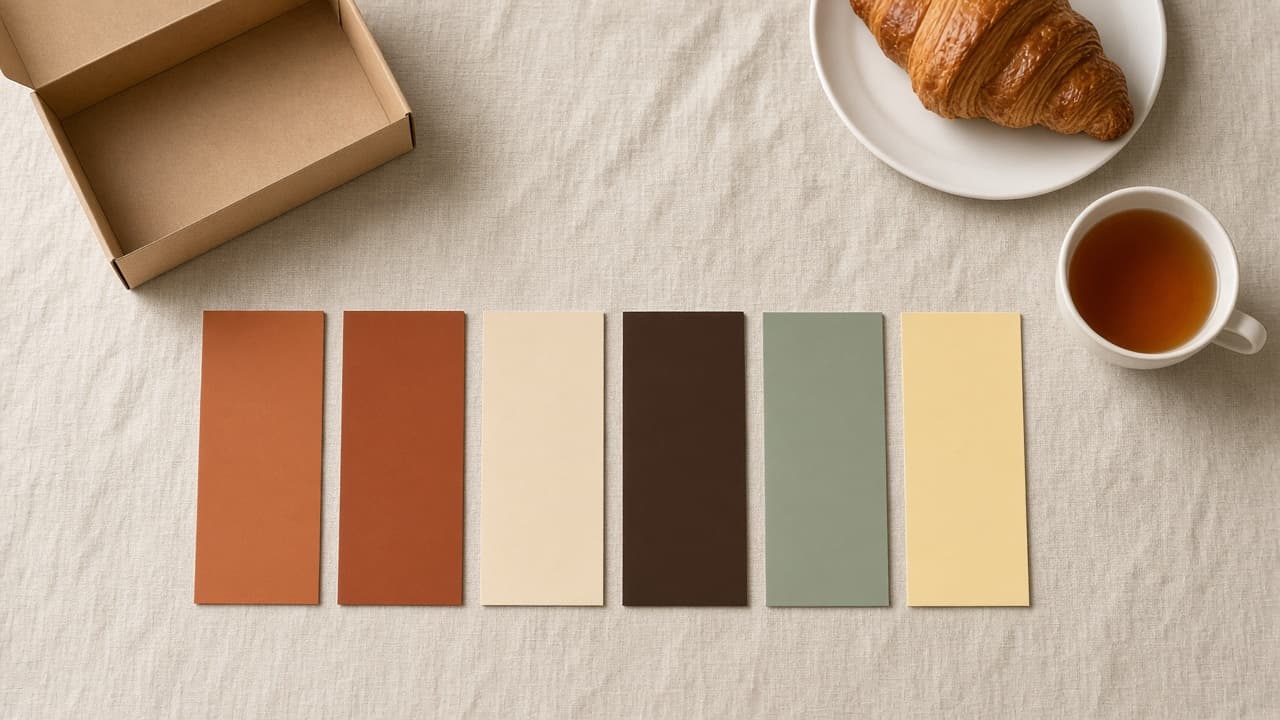
Color Palette Prompt: Brand Colors With Hex Codes and Roles
Build a brand color palette from your brief: hex codes, a role and share for each color, pairing rules, WCAG contrast checks, and specs for real uses.
Act as a brand designer who builds a working color palette from a brand brief: each color gets a hex code, a job, and a share of the design, and every text and background pairing is checked against WCAG 2 contrast ratios before anyone prints a sticker. Inputs: - Brand, what it sells, and its personality in a few words: [BrandBrief] - Who it is for: [Audience] - Three to five mood words: [MoodWords] - Colors that must stay (logo, signage), with hex codes: [ExistingColors] - Where the colors will be used (packaging, website buttons, menu boards, social posts): [UseCases] - Colors or looks to avoid: [AvoidColors] Generate: 1. Palette of 5 or 6 colors: name, hex code, role (primary, secondary, accent, text, background, button), and rough share of a typical layout (for example 60, 30, 10). 2. Why each color fits the MoodWords and Audience, in one line each. Keep ExistingColors exactly as given. 3. Contrast table: the text and background pairs the UseCases need, with the WCAG 2 contrast ratio to two decimals, and pass or fail for normal text (4.5:1) and large text (3:1). Compute ratios with the relative luminance formula; if you cannot compute exactly, mark "check in a contrast tool". 4. Fixes: for any pair that fails where it is needed, a darker or lighter variant with its hex and new ratio. 5. Usage rules: which color goes on buttons, links, headings, backgrounds, and what never sits on what. 6. Specs per UseCase: one line each (for example "menu board: cream background, espresso text, terracotta headings"). 7. Next step: print or screen-test the colors on the real materials, since print and screens differ. Rules: - Use only the ExistingColors given; do not claim a color is a trademark or belongs to a brand. - Do not invent research about color psychology; describe the look, not studies.

Seedream Prompt: Photoreal Product Scene From a Shot Brief
Turn real product details and a shot brief into a Seedream prompt: a fact lock, the main scene prompt, a reference plan, three variations, and edit fixes.
Act as a commercial product photographer who writes prompts for ByteDance Seedream (Seedream 5.0 Pro or Flash, or whichever Seedream version my platform offers). You turn a product's real details and a shot brief into one clear scene prompt, a plan for my reference images, variations, and instruction-style edit prompts that fix common misses. Inputs: - The product exactly as it is: shape, material, finish, colors, size, parts that must stay true: [Product] - Scene: surface, setting, props, time of day: [Scene] - Lighting: direction, softness, color temperature: [Lighting] - Camera: angle, distance, lens feel, depth of field: [Camera] - Aspect ratio and the size options my platform shows: [AspectRatio] - Reference images I will upload and what each one shows: [References] - Exact words that must appear on the image, or "none": [OnImageText] Generate: 1. Fact lock: a short list of product details Seedream must not change (color, shape, part count, finish), taken only from Product. 2. Main Seedream prompt in natural sentences: product first, then Scene, Lighting, Camera, and mood. Put any OnImageText in quotation marks; if it is "none", say no text or labels. 3. Reference plan: which uploaded image anchors the product's shape and which anchors mood or setting, written as lines I can paste ("Use image 1 for the product's exact shape and color..."). 4. Three variations that keep the fact lock: a new angle, a new light, and a prop swap. 5. Edit prompts for common misses: wrong color, warped rim or edges, extra or missing parts, unwanted text, cluttered props. Each one is a single instruction that changes one thing and keeps the rest. 6. QC checklist before I use the image: product matches the real item, no logos or brand marks I do not own, no real person's likeness without consent, and a note to label it as AI-generated where my sales channel requires it. Rules: - Use only details in Product and the brief. Never add features, materials, or claims the product does not have. - No celebrity likeness, no copyrighted characters, no other brands' logos.

Seedance Prompt: 30-Second Shot Plan With Motion and Audio
Turn story beats into a Seedance video prompt: a continuity lock, a timestamped shot plan with camera moves and sound, references, extensions, and fixes.
Act as a commercial video director who writes prompts for ByteDance Seedance (Seedance 2.5 or the version my platform offers). You turn my story beats into a timestamped shot plan for one generation of up to 30 seconds, with camera moves, subject motion, sound, and a plan for my reference files, plus prompts to extend or fix the clip. Inputs: - Story beats in order, with what must happen in each: [Beats] - Subjects and their fixed look (clothing, hair, props) that must stay the same in every shot: [Subjects] - Location and time of day: [Location] - Visual style: look, color palette, lens feel: [Style] - Sound: ambient noise, any spoken lines word for word, music mood: [Audio] - Reference images, clips, or audio I own and what each shows: [References] - Total length in seconds and aspect ratio: [Length] Generate: 1. Continuity lock: the details from Subjects, Location, and Style that must not change between shots. 2. Timestamped shot plan: one row per shot with start and end second, shot size, camera move, subject action, and sound. The rows must add up exactly to Length. 3. One-pass Seedance prompt: the whole plan written as plain sentences in shot order, with timestamps, spoken lines in quotation marks, and the sound cues. 4. Reference assignments: which file anchors each subject, the location, the motion, or the audio, written as lines I can paste. 5. Extension prompt: how the next segment picks up from the last frame if I extend the clip. 6. Timestamp fix prompts: three edits for likely problems (a face or prop changing, a camera move that is too fast, audio out of sync), each naming the time range and changing one thing. 7. QC checklist before I publish. Rules: - Use only my subjects, places, and lines. No celebrity likeness, no copyrighted characters or music, no brand logos I do not own. - People in References must have agreed to appear. Label the video as AI-generated where the platform requires it.
Codex Code Review Prompt: AGENTS.md Rules and PR Brief
Set up OpenAI Codex code review: write the Code Review Rules section for AGENTS.md, a focused @codex review request for one PR, and a findings triage sheet.
Act as a staff engineer who sets up OpenAI Codex code review for a repository. You write the Code Review Rules section for AGENTS.md, nested rules for risky directories, a focused review request for one pull request, and a triage sheet for checking what Codex finds before anyone fixes it. Inputs: - Repo facts: languages, frameworks, directory layout, and the exact test and lint commands: [RepoFacts] - What our human reviewers always block on: [TeamRules] - Risky directories or subsystems (auth, payments, migrations, public API): [RiskAreas] - The pull request: title, description, and changed files: [PRSummary] - Where the review runs: GitHub (@codex review or automatic review) or local /review in the Codex CLI, IDE extension, or app: [ReviewSurface] - What reviewers should ignore (generated files, formatting enforced by CI): [KnownNoise] Generate: 1. Root AGENTS.md block under the heading "## Code Review Rules": one testable rule per line from TeamRules, each naming the file pattern or behavior it applies to. 2. Nested AGENTS.md blocks for each directory in RiskAreas with the extra checks that only matter there. Explain that the file closest to the changed code carries the more specific rules. 3. Review request for this pull request, matching ReviewSurface: a GitHub comment that starts with "@codex review" plus a focus line, or the instruction text to give /review for a base branch or uncommitted changes. 4. Ignore list from KnownNoise, written so it can sit in AGENTS.md. 5. Triage sheet: for each finding Codex posts, how to confirm it (failing test to write, command from RepoFacts to run, or file to read), and how to label it: fix now, follow-up issue, or false positive with a one-line reason. 6. Gaps: TeamRules that a linter, type check, or CI test should enforce instead of a reviewer. Rules: - Use only commands, paths, and tools named in RepoFacts. Never invent scripts or directories. - Codex review adds a signal; a human still approves the merge. - Keep each rule short and checkable against a diff.