How to Use the Pool Opening and Water Chemistry Prompt to Get Clear Water Without Guesswork
Open a residential pool after winter with a plan instead of guesses: gallons from the pool's real dimensions, cover removal and equipment startup in order, test results read against target ranges, chlorine dosing math for the liquid chlorine you buy, a step by step plan to clear green water, chemical safety rules, and a weekly testing routine for the season.
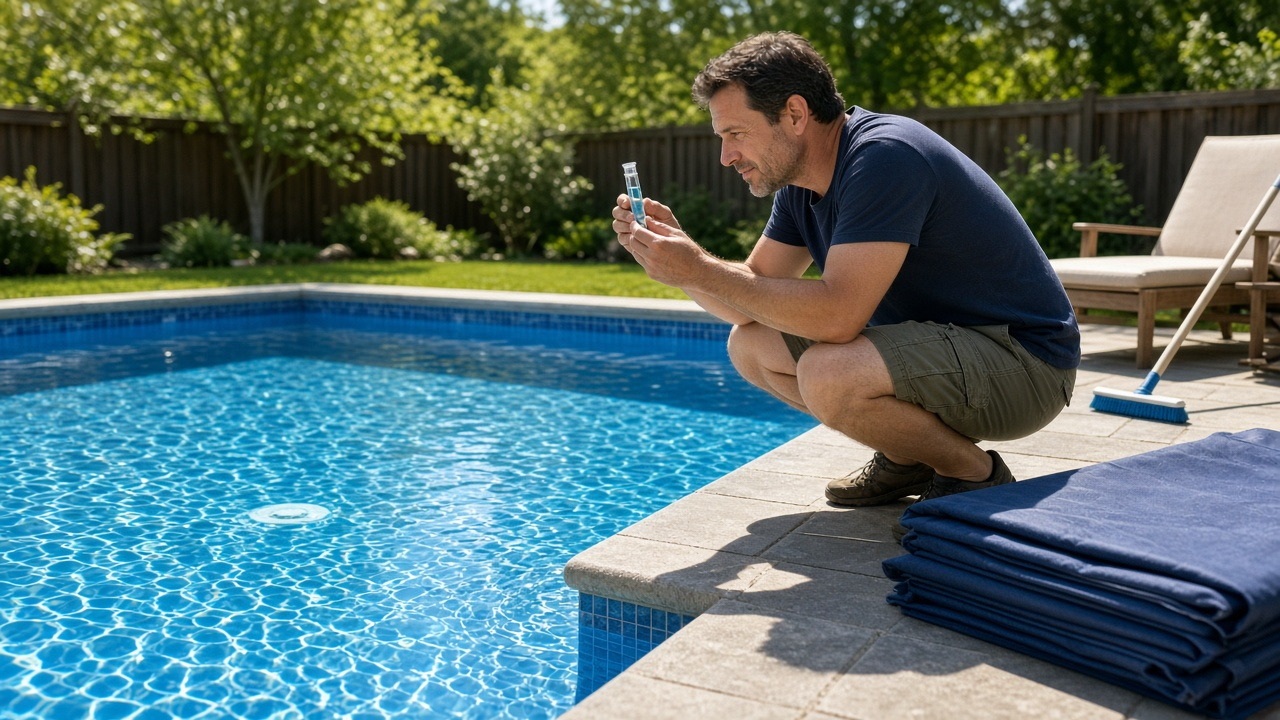
Opening a backyard pool can feel like a chemistry exam with a deadline. The cover comes off, the water is often cloudy or green, and the store suggests a cart full of products. Most of what a pool needs comes down to a few numbers: the pool's real volume, the free chlorine level relative to stabilizer, pH, and alkalinity. When those are tested accurately and dosed by math, the water clears and stays clear. The Backyard Swimming Pool Opening and Water Chemistry Planner for Homeowners: Volume Math, Spring Startup Steps, Free Chlorine to CYA Ratio, pH and Total Alkalinity Targets, Liquid Chlorine Dosing, Green Pool SLAM Plan, and a Weekly Test Log prompt builds an opening plan from your pool's dimensions and test results, with dosing math, a step by step plan for green water, safety rules, and a weekly log.
What the prompt produces
- Volume in gallons from your pool's dimensions, with the arithmetic shown.
- An opening sequence from cover removal to equipment startup and leak checks.
- A test results table comparing each reading to its target range and listing the action needed.
- Dose math for liquid chlorine based on your product strength and volume, plus a calculator method for pH and alkalinity.
- A plan for green or cloudy water that holds chlorine at shock level until clear criteria are met.
- Filter care by filter type during cleanup.
- Safety rules for handling and storing chemicals.
- A weekly log template for the season.
How to fill the inputs
PoolSpecs gives the shape, length, width, shallow and deep depths, surface, and cover type. Volume drives every dose, so measure rather than guess.
Equipment lists the pump, filter type, heater, and chlorinator. Filter type changes how you clean it during recovery.
WaterTest is your test results and what the water looks like. A drop based kit gives more reliable chlorine and stabilizer readings than strips.
ChemicalsOnHand includes the strength printed on each label, such as the liquid chlorine percentage and acid strength.
SeasonPlan gives your opening date, how often you can test, and who will swim.
Reading the example output
The example is a 16 by 32 foot plaster pool with light green water, no chlorine, high pH, and stabilizer at 40.
- The volume works out to about 21,000 gallons from the average depth.
- The test table uses the stabilizer level to set targets, with a normal range and a shock level from the chart the owner follows.
- Chlorine math scales a simple rule to this pool, so the owner knows roughly how many gallons to add to reach shock level.
- Acid goes in first, in portions, with retesting, and chlorine is added separately.
- The cleanup plan has clear finish criteria: low overnight chlorine loss, low combined chlorine, and a visible main drain.
- Kids and the dog stay out until chlorine returns to the normal range.
Tips for better results
- Measure depth at both ends and use the average.
- Test stabilizer at opening, since it carries over from last season.
- Run the pump continuously while clearing green water.
- Brush every day during cleanup to help chlorine reach algae.
- Keep a log. Patterns make problems easier to spot.
Mistakes to avoid
- Never mix chlorine and acid, even in a bucket.
- Do not add chemicals with the pump off.
- Do not stop shocking as soon as the water looks better. Use the clear criteria.
- Do not trust numbers that are not on your product label or test kit.
Who it is for
New pool owners opening for the first time, homeowners who want to stop overspending at the pool store, families preparing for summer, and anyone who has inherited a pool with a home purchase.
Related PromptDig links
Open the Backyard Swimming Pool Opening and Water Chemistry Planner for Homeowners: Volume Math, Spring Startup Steps, Free Chlorine to CYA Ratio, pH and Total Alkalinity Targets, Liquid Chlorine Dosing, Green Pool SLAM Plan, and a Weekly Test Log prompt and enter your pool size and test results to plan your opening. For more home and lifestyle prompts, Browse more prompts. If you have a home maintenance prompt that saves you time or money, Share a prompt.