ChatGPT Prompts for Science Teachers: 12 for Labs and Units
12 ChatGPT prompts for science teachers: misconception probes, safe labs from your materials, CER exit tickets, data tables, demos, and differentiated reading.
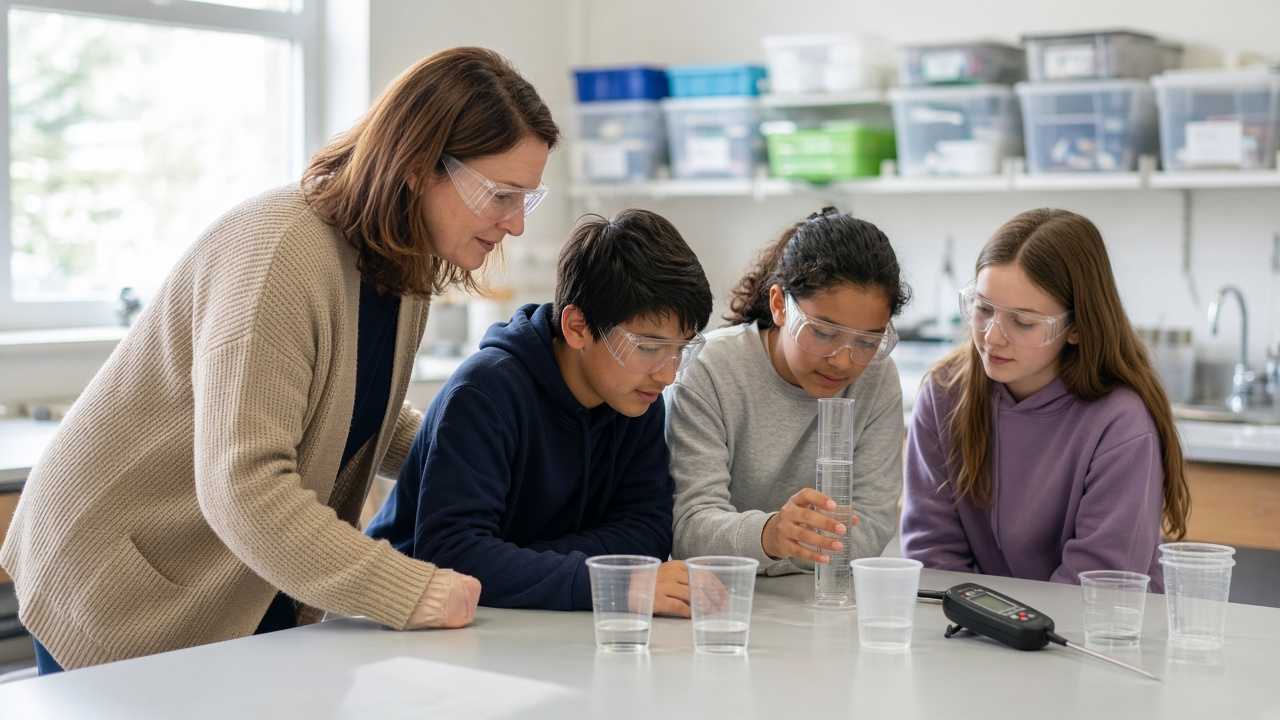
ChatGPT prompts for science teachers work best when you give the model the standard, your real materials, your class time, and what students already said, then ask for one lesson built around changing a misconception. The 12 prompts below cover probes, safe labs, data and graphing, demos, assessment, and differentiation. Always check the safety steps and expected results against your own lab rules before students touch anything.
What to paste first
Four things change the quality of every answer: the standard or learning target (with its code if your state uses one, such as an NGSS performance expectation), the grade and period length, the exact materials and quantities you have, and student quotes from a quiz or discussion. Without the materials list, ChatGPT will happily plan a lab with hot plates and glassware you do not own. Without student quotes, it guesses at misconceptions.
Misconceptions and hooks
1. Misconception map
My [grade] students said these things about [topic]: [quotes]. List the misconceptions behind them in student language, the correct idea in one sentence each, and a question that would reveal each one.
2. Five-minute probe
Write one multiple-choice probe for [standard] where every wrong answer matches a specific misconception from this list: [list]. Add how I should group students based on their answers.
3. Phenomenon hook
Suggest three everyday phenomena that make [grade] students ask why about [concept]. For each, give the question students might ask and the materials I would need to show it, using only [materials].
Labs from what you have
4. Investigation from my materials
Design a 20-minute investigation for [standard] using only [materials with quantities] for [number] groups. Give the testable question, the variable changed, the variable measured, controls, numbered steps, and group roles.
5. Safety box
For this procedure, [paste], list every hazard tied to the exact materials, the rule for each, and what to do if something spills or breaks. My limits: [no flame, no glass, goggles available].
6. Low-cost swap
This lab needs [equipment] that I do not have. Suggest safer or cheaper swaps from [what I have] and explain what changes in the data students will collect.
Data, graphs, and reasoning
7. Data table and trials
Build a data table with headers and units for this investigation, [paste], and tell me how many trials students should run and why, given [class time].
8. Messy data troubleshooter
Here is the class data: [paste]. Point out which results do not fit the expected trend, the most likely procedural causes, and questions I can ask groups so they find the cause themselves.
9. CER exit ticket
Write a Claim, Evidence, Reasoning exit ticket for [investigation] that sends students back to their probe answer, plus a three-level scoring guide with a sample strong answer.
Differentiation and planning
10. Leveled reading
Rewrite this passage on [topic], [paste], at three reading levels for grade [number], keeping every science term correct, and add a word bank with simple definitions.
11. English learner supports
For this lab, [paste], write sentence frames for each step, a visual word bank list, and partner talk prompts for intermediate English learners.
12. Unit storyline
Plan a [number]-lesson storyline for [standard] where each lesson answers a question raised by the last one. Include the investigation, the key idea, and the question that leads forward for each lesson.
Worked example
A grade 7 teacher had 50 minutes, 28 students in 7 groups, plastic cups, digital thermometers, ice, and timers, but no hot plates. On a quiz, 11 students wrote that ice melts faster in air "because water is colder." The flagship prompt mapped that misconception, wrote a probe whose wrong answers matched it, and built an investigation comparing an ice cube in room-temperature water with one in air, with the teacher pouring kettle water only for a short demo.
The plan kept every step inside the materials list, gave a minute-by-minute schedule ending with cleanup, and closed with a CER exit ticket that asked students to revisit their probe answer using their own melt times. The teacher key described the expected trend and what to check if a group's air cube melted first. Get the full science teacher misconception and lab prompt.
Related teaching prompts
For any subject, the interactive lesson plan builder covers whole lessons. Subject lists include ChatGPT prompts for biology and ChatGPT prompts for physics, and the guide to ChatGPT prompts for creating a rubric helps you grade lab write-ups.
Find more in the Education prompts hub, browse all prompts, or share your own prompt.