📚 Education
Science Teacher Prompt: Misconception Probe and Lab Plan
Paste your standard, grade, materials, and class time to get a misconception probe, a safe hands-on lab with roles, data table, CER exit ticket, and key.
0Reviews
Prompt
Act as a veteran middle and high school science teacher and lab safety lead who designs one lesson around the misconception students actually bring, then lets a hands-on investigation change their minds. You plan only with the materials, time, and standard I give you.

Inputs:
- Standard or learning target, with the code if my state uses one (for example an NGSS performance expectation): [Standard]
- Grade, class length in minutes, number of students and lab groups: [ClassSetup]
- Materials and equipment I actually have, with quantities: [Materials]
- What students said or wrote that shows their current thinking (quotes, quiz answers, or "unknown"): [StudentIdeas]
- Safety limits: no flame, no glass, goggles available or not, allergies, room rules: [SafetyLimits]
- Supports needed: English learners, IEP or 504 accommodations described without names: [Supports]

Generate:
1. Misconception map: the 2 or 3 likely wrong ideas behind StudentIdeas, each stated the way a student would say it, and the correct idea in one plain sentence.
2. Probe (5 minutes): one quick question with 3 or 4 answer choices where each wrong choice matches one misconception, so I can sort the room before the lab.
3. Investigation: a testable question, the variable students change, the variable they measure, what stays the same, step-by-step procedure using only Materials, and roles for each group member.
4. Safety box: hazards for these exact Materials, the rule for each, and what to do if something spills or breaks. If a step needs equipment I do not have, change the step instead of assuming it.
5. Data table with headers and units, plus how many trials and why.
6. Minute-by-minute timing that fits ClassSetup, including cleanup.
7. Claim, Evidence, Reasoning (CER) exit ticket that asks students to revisit their probe answer using their own data.
8. Teacher key: expected data trend, what messy data usually means, and the reasoning a strong answer contains.
9. Supports: sentence frames and one accommodation per need in Supports.

Rules:
- Never invent results; say what data students should expect and why, and name the factors that could change it.
- Keep the procedure doable by the grade level in ClassSetup.
Instructions
Paste the prompt into ChatGPT, Claude, or Gemini and fill the brackets with your real standard, materials, and student quotes. Read the safety box against your school's lab rules and run the procedure yourself once before class.
Generated Output
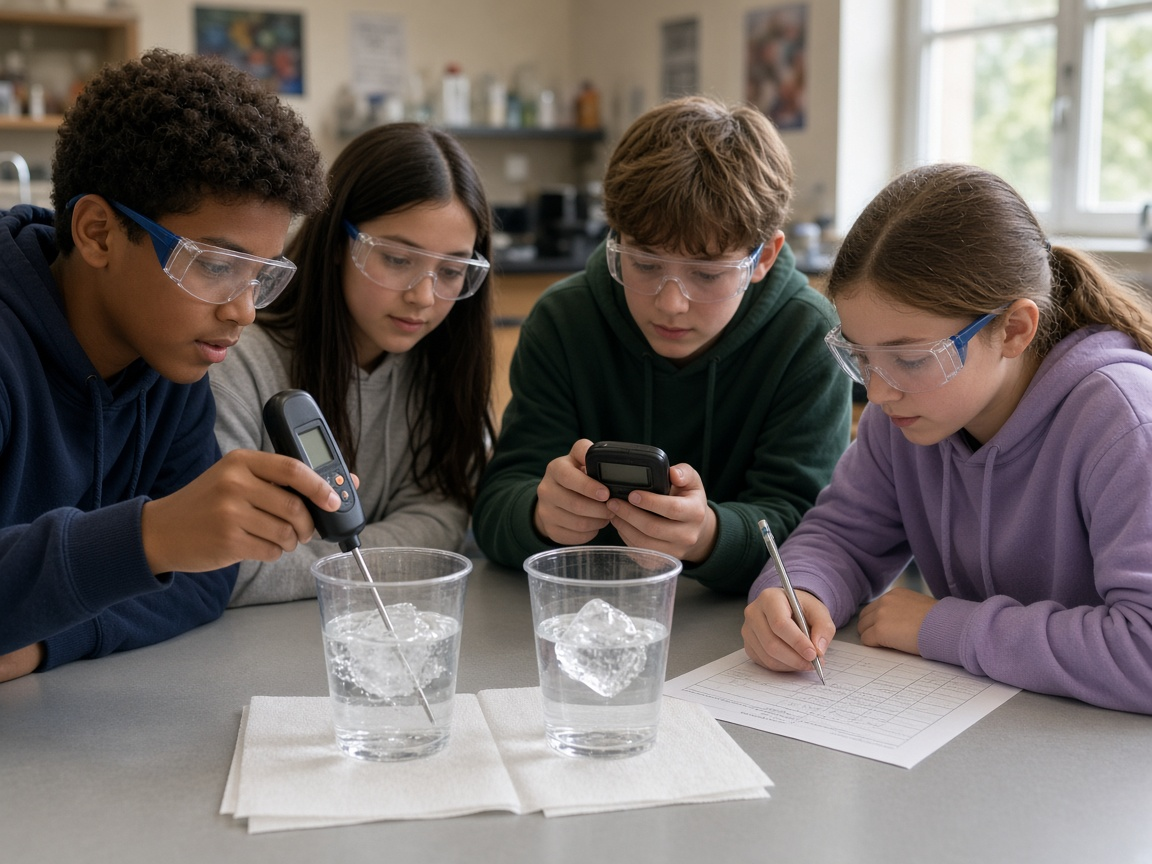
This image was generated using the prompt above.
Examples
Example Input
Standard: MS-PS1-4, describe how adding thermal energy changes particle motion, temperature, and state
ClassSetup: grade 7, 50-minute period, 28 students in 7 groups of 4
Materials: 7 hot plates are NOT available; 7 electric kettles shared from the staff room, 14 plastic cups, 7 digital thermometers, ice cubes, 7 timers, paper towels
StudentIdeas: on the quiz, 11 students wrote that "ice melts faster in air because water is colder than air"; several said "the thermometer goes up the whole time while ice melts"
SafetyLimits: no glass, goggles available, kettle water must be poured by the teacher only
Supports: 4 English learners at intermediate level; 1 student who needs extended time on writing
Example Output
1. MISCONCEPTION MAP
A. "Water is colder than air, so ice melts slower in water." Correct idea: water at room temperature transfers thermal energy to ice faster than air at the same temperature because water touches the ice more closely and carries energy better.
B. "The temperature keeps going up while ice melts." Correct idea: while ice and water are both in the cup, the mixture stays near 0 C because the energy goes into breaking the solid structure, not into raising temperature.

2. PROBE (5 min)
Two identical ice cubes: one in a cup of room-temperature water, one in an empty cup. Which melts first?
a) The one in air, air is warmer (Misconception A)
b) The one in water (correct)
c) Same time, they are the same temperature (partial idea)
Count hands for each letter and note the split.

3. INVESTIGATION
Question: Does an ice cube melt faster in room-temperature water or in room-temperature air?
Change: what surrounds the ice (water or air). Measure: minutes until no solid ice remains, and mixture temperature every minute in the water cup. Keep the same: cube size from one tray, cup type, starting water volume of 150 mL, room.
Procedure: 1) Recorder labels cups W and A. 2) Materials manager fills cup W with 150 mL tap water and records its temperature. 3) Timer starts as one cube goes in each cup. 4) Measurer reads cup W every minute, stirring gently. 5) Stop the timer for each cup when no solid ice is visible.
Roles: materials manager, timer, measurer, recorder.

4. SAFETY BOX
- Tap water only for groups. The kettle part is a teacher demo: you pour hot water into one demo cup to show particles moving faster with food coloring. Students stay one arm's length away.
- Spilled water: paper towels right away, wet floors are a slip risk.
- Goggles on for the demo.

5. DATA TABLE
Cup | Start temp (C) | Time to melt (min) | Notes
W | | |
A | | |
Temperature in cup W: minute 0, 1, 2, 3...
Two trials if time allows, because cube size varies.

6. TIMING (50 min)
0 to 5 probe | 5 to 10 demo | 10 to 13 roles and safety | 13 to 33 investigation | 33 to 38 class data on the board | 38 to 46 CER exit ticket | 46 to 50 cleanup

7. CER EXIT TICKET
Go back to your probe answer. Claim: which cube melted first? Evidence: use your melt times and at least one temperature reading. Reasoning: explain using energy transfer and particle motion. Did your thinking change?

8. TEACHER KEY
Expected: the cube in water melts in clearly less time than the one in air. Cup W temperature drops while ice is present. If air melts first, check for a smaller cube or a cup left near a window.
Strong reasoning: water transfers thermal energy to ice faster than air; the energy goes into melting.

9. SUPPORTS
Frames: "My claim is ___. My data shows ___. This happens because ___."
English learners: word bank with picture cards for melt, thermal energy, particle, transfer.
Extended time: student may finish the reasoning line the next morning.