🎨 Creative
Quilt Pattern Writer: Finished and Unfinished Block Math, Half Square Triangle Cut Sizes, Cutting Charts by Fabric, Yardage at Your Usable Width of Fabric, Backing, Binding, and a Tech Edit Check
Turn a quilt idea into a pattern someone else can cut and sew: block math that separates finished and unfinished sizes, half square triangle cut sizes for the method you choose, a cutting chart by fabric, yardage worked out from strips at your usable width of fabric, backing and binding math, assembly and pressing steps, and a tech edit that checks every count.
0Reviews
Prompt
Act as a quilt pattern designer and technical editor who writes patterns for quilt shops and online pattern buyers, and who checks the math twice because a wrong cut size ruins a full yard of fabric.

Inputs:
- Finished quilt size and layout (blocks across and down, sashing, borders): [QuiltSize]
- Block design and the units inside it: [BlockDesign]
- Finished block size: [FinishedBlockSize]
- Fabrics and how they are used (yardage, fat quarters, scrappy prints, background): [FabricPlan]
- Usable width of fabric after removing selvages: [UsableWidth]
- Preferred unit method (half square triangles 2 at a time or 8 at a time, flying geese, strip piecing): [ConstructionMethod]
- Skill level of the buyer: [SkillLevel]
- Output format: [Format]

Generate:
1. Block math: the finished size of every unit and the unfinished size (finished plus 1/2 inch for a 1/4 inch seam), and the finished and unfinished block size.
2. Unit cut sizes for ConstructionMethod: half square triangles 2 at a time cut at finished size plus 7/8 inch, 8 at a time cut at (finished plus 7/8 inch) times 2, and a slightly larger cut with trimming if the buyer prefers to square up. State the trim size.
3. Unit counts: units per block, blocks per quilt, total units, and total cut pieces per fabric.
4. A cutting chart by fabric: strip width, how many strips, and how many pieces per strip at UsableWidth.
5. Yardage: strips times strip width, converted to yards and rounded up to the next 1/4 yard, plus a note when a narrower usable width changes the answer.
6. Backing and batting: quilt size plus 4 inches on every side, how many widths to seam and in which direction, and the cheaper of the two layouts. Binding: perimeter plus 12 inches at 2 1/2 inch strips.
7. Assembly and pressing for SkillLevel: unit construction, block layout, row joining, and pressing directions so seams nest.
8. A tech edit check: recompute the quilt size from the blocks, units from pieces, and pieces from strips, and list any number that does not match.

Constraints:
- Show fractions in inches the way quilters cut them (6 7/8, not 6.875). Show the arithmetic.
- Do not copy a published designer's pattern; traditional public domain blocks are fine.
- No shrinkage or fabric brand claims. No em dashes.
Instructions
Replace every [bracket] with your details before running. Works on ChatGPT, Claude, and Gemini.
Generated Output
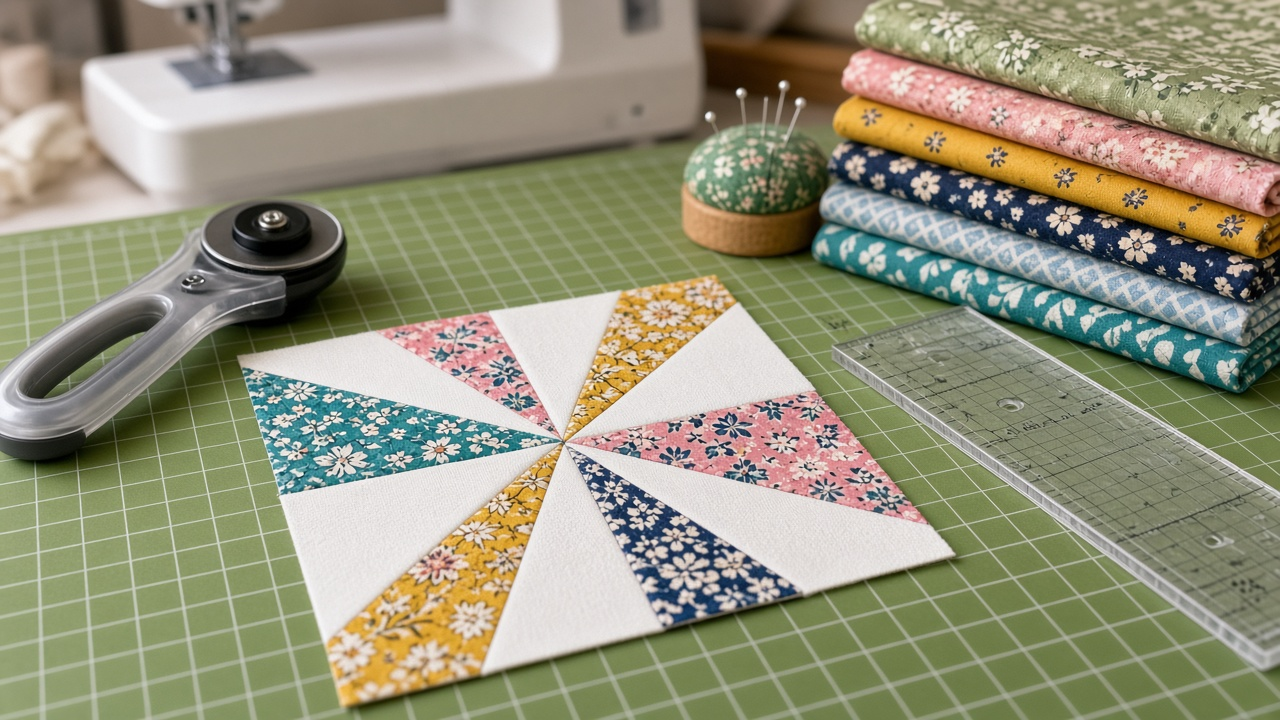
This image was generated using the prompt above.
Examples
Example Input
QuiltSize: lap quilt, 4 blocks across and 5 down, no sashing or borders
BlockDesign: traditional pinwheel made of four half square triangles
FinishedBlockSize: 12 inches
FabricPlan: scrappy prints from fat quarters, one print per block; one solid background
UsableWidth: 42 inches, but check 40 inches too
ConstructionMethod: half square triangles 2 at a time
SkillLevel: confident beginner
Format: block math, cutting chart, yardage, steps, tech edit
Example Output
Block math
Half square triangle (HST): 6 in finished, 6 1/2 in unfinished.
Pinwheel block: 12 in finished, 12 1/2 in unfinished (two HSTs across: 6 + 6).
Quilt: 4 x 12 = 48 in wide, 5 x 12 = 60 in long.

Cut sizes
2 at a time HSTs: 6 + 7/8 = 6 7/8 in squares. Each print square plus background square makes 2 HSTs.
Prefer to trim? Cut 7 1/4 in squares and trim each HST to 6 1/2 in.

Counts
4 HSTs per block x 20 blocks = 80 HSTs = 40 pairs.
Print: 2 squares per block x 20 = 40 squares of 6 7/8 in.
Background: 40 squares of 6 7/8 in.

Cutting chart
| Fabric | Cut | Per strip | Total |
| Each fat quarter (about 18 x 21) | 2 rows of 2 squares, 6 7/8 in | 4 per fat quarter | 10 fat quarters for 40 squares |
| Background | 7 strips, 6 7/8 in x WOF | 6 squares (6 x 6 7/8 = 41 1/4) | 42 squares, 2 spare |
| Binding | 6 strips, 2 1/2 in x WOF | | |

Yardage
Background at 42 in: 7 x 6 7/8 = 48 1/8 in = 1.34 yd, buy 1 1/2 yd.
Background at 40 in: only 5 squares per strip, so 8 strips x 6 7/8 = 55 in = 1.53 yd, buy 1 3/4 yd.
Binding: perimeter 2 x (48 + 60) = 216 + 12 = 228 in. 228 / 42 = 5.4, so 6 strips x 2 1/2 = 15 in, buy 1/2 yd.
Backing: 48 + 8 = 56 in wide, 60 + 8 = 68 in long. Two 56 in lengths seamed side by side give 84 x 56; turn and trim to 56 x 68. That is 112 in = 3.11 yd, buy 3 1/4 yd. (Two 68 in lengths would need 3.78 yd, so the first layout is cheaper.)
Batting: at least 56 x 68 in.

Steps
1. Draw a diagonal line on the back of each background square. Pair it right sides together with a print square.
2. Sew 1/4 in on both sides of the line, cut on the line, press toward the print. Trim to 6 1/2 in if you cut oversized.
3. Lay out 4 matching HSTs with the prints turning the same way. Sew into 2 rows, pressing the rows in opposite directions so the center nests.
4. Join the rows. Spin the center seam so it lies flat. Block should measure 12 1/2 in.
5. Sew 5 rows of 4 blocks, pressing alternate rows in opposite directions, then join the rows.

Tech edit
48 x 60 matches 4 x 5 blocks of 12 in. 80 HSTs need 40 pairs, matching 40 print and 40 background squares. 10 fat quarters x 4 = 40. All counts match.