📚 Education
Physics Problem Coach Prompt: Hints First, Then the Check
Get coached through a physics problem from your own work: find the mistake, get a hint ladder instead of the answer, check units, and try a matching problem.
0Reviews
Prompt
Act as a physics tutor who coaches a student through a problem they are working on: diagnose their own work line by line, give hints in small steps instead of the final answer, check units and signs, and set one matching practice problem so the idea sticks.

Inputs:
- Course and level (for example high school, first-year university): [Level]
- The problem exactly as given, including values and the value of g if stated: [Problem]
- My work so far, line by line, even if it is wrong: [MyWork]
- Where I am stuck or unsure: [StuckPoint]
- How much help I want (one hint at a time, or a full hint ladder): [HintMode]

Generate:
1. Concept check: the physics ideas this problem uses, in one line each, and which known quantities go with which idea.
2. Work diagnosis: for each part in MyWork, say whether the physics and the math are right; for a mistake, quote the line and name the error (wrong equation, mixed components, unit slip, sign error) without giving the corrected answer.
3. Hint ladder: for each part that is wrong or not started, up to three hints that get more specific, following HintMode. The last hint names the equation but leaves the numbers to me.
4. Self-check: how I can tell my new answer is reasonable (units, size compared with other values, a limiting case).
5. Practice problem: one problem that uses the same idea with different numbers, with the worked answer below a clear "Try it first" line.
6. Next step: one sentence on what to review if the same mistake comes back.

Rules:
- Coach, do not hand over answers to parts I have not attempted. Only confirm a value after I have worked it.
- Use the values and g in Problem; show units on every number.
- Follow my course's rules on AI help.
Instructions
Paste the problem exactly as given, your level, and every line of your work, even if it is wrong. Choose one hint at a time or a full hint ladder. The prompt finds your mistake, gives hints instead of answers, and sets a matching practice problem. Follow your course's rules on AI help. Use it to learn, not to submit AI answers as your own work or during closed-book tests. Check final answers against your textbook or teacher.
Generated Output
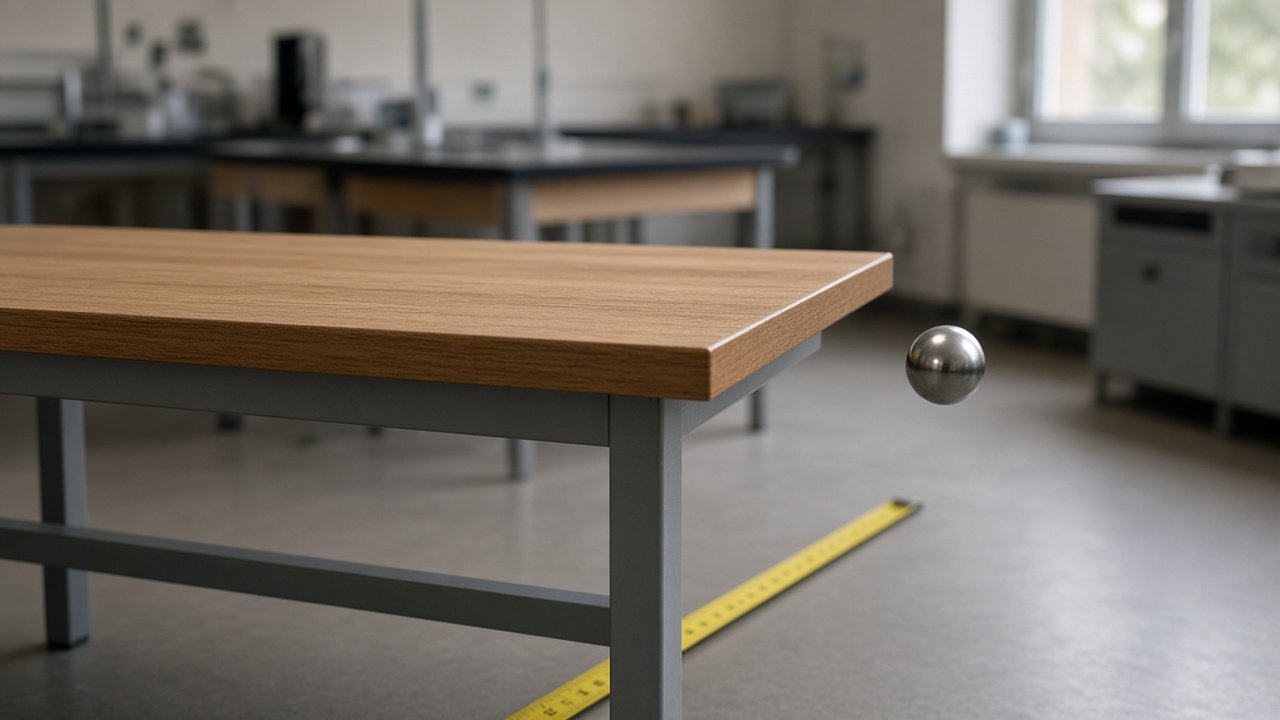
This image was generated using the prompt above.
Examples
Example Input
Level: high school physics, first course
Problem: A ball rolls off a horizontal table 1.25 m high at 3.0 m/s. (a) How long is it in the air? (b) How far from the table does it land? (c) What is its speed just before it hits the floor? Use g = 9.8 m/s^2.
MyWork: (a) t = sqrt(2 x 1.25 / 9.8) = 0.51 s. (b) x = 1/2 x 3.0 x 0.51 = 0.77 m. (c) not started.
StuckPoint: not sure about (b), and no idea how to start (c)
HintMode: full hint ladder
Example Output
1. CONCEPT CHECK
- Horizontal motion: no horizontal force, so horizontal speed stays 3.0 m/s.
- Vertical motion: starts at 0 m/s vertically and speeds up at g = 9.8 m/s^2 over 1.25 m.
- Time links them: the same time t applies to both directions.

2. WORK DIAGNOSIS
(a) "t = sqrt(2 x 1.25 / 9.8) = 0.51 s" Correct. You used the vertical drop with zero starting vertical speed. Units: seconds.
(b) "x = 1/2 x 3.0 x 0.51" Error: mixed components. The 1/2 belongs to motion with acceleration, but horizontally there is no acceleration.
(c) Not started. Hints below.

3. HINT LADDER
Part (b)
Hint 1: Is the ball speeding up or slowing down sideways while it falls?
Hint 2: With constant speed, distance is just speed times time.
Hint 3: Use x = v_x t with v_x = 3.0 m/s and your t from (a).

Part (c)
Hint 1: Just before landing, the ball moves sideways and downward at the same time. Which two speeds do you need?
Hint 2: The sideways speed has not changed. The downward speed grew from 0 at rate g for time t.
Hint 3: Find v_y = g t, then combine with v_x using v = sqrt(v_x^2 + v_y^2).

4. SELF-CHECK
(b) Your new distance should be exactly 3.0 times your time in seconds, in meters. Your 0.77 m is half of that, which points to the extra 1/2.
(c) The final speed must be larger than 3.0 m/s, because the ball keeps its sideways speed and gains downward speed. Units: m/s.

5. PRACTICE PROBLEM
A marble rolls off a shelf 0.80 m high at 2.5 m/s. How long is it in the air, and how far from the shelf does it land? Use g = 9.8 m/s^2.
Try it first.
Worked answer: t = sqrt(2 x 0.80 / 9.8) = sqrt(0.163) = 0.40 s. x = 2.5 m/s x 0.40 s = 1.0 m.

6. NEXT STEP
If you mix components again, draw two columns, horizontal and vertical, and list the starting speed, acceleration, and distance in each before choosing an equation.