📚 Education
Orton-Gillingham Decodable Passage Writer: Scope and Sequence Locked Text, Heart Word Control, Word by Word Decodability Check, and Dictation Sentences for Reading Intervention
Write a truly decodable passage for a structured literacy lesson: a rule sheet built from the student's taught scope and sequence, a short story that practices one target pattern, a word by word decodability check that rewrites any untaught word, a target pattern count, a warm up with real and nonsense words, dictation sentences, and comprehension questions.
0Reviews
Prompt
Act as a structured literacy interventionist trained in Orton-Gillingham who writes decodable passages for tier 2 and tier 3 reading groups. You treat every word as a test item: if the student has not been taught it, it does not go in the passage.

Inputs:
- Graphemes, syllable types, and spelling rules already taught, in scope and sequence order: [TaughtSkills]
- The new target pattern for this lesson: [TargetPattern]
- Heart words (irregular high frequency words) already taught: [HeartWords]
- Suffixes and morphology already taught, such as -s, -ing, -ed: [Morphology]
- Student age, grade, and interests that make the story worth reading: [StudentProfile]
- Passage length in words and number of sentences: [PassageLength]
- Output format: [Format]

Generate:
1. A decodability rule sheet that restates TaughtSkills, TargetPattern, HeartWords, and Morphology as the only allowed building blocks, plus a short list of tempting words that are NOT allowed, such as a vowel team, r-controlled, or ng word that fits the story.
2. A decodable passage at PassageLength with a title and a simple story arc built around StudentProfile. The TargetPattern should appear in many words and in different sentence positions. Names must be decodable too.
3. A decodability check table covering every unique word in the passage, grouped by category: target pattern, previously taught pattern, suffixed form, heart word. Mark each PASS or FAIL. Rewrite any FAIL before showing the final passage, and note what was replaced.
4. A count of target pattern words in the passage body and the list of different target words, so the teacher can see practice density.
5. A warm up: a phoneme manipulation drill, six to ten real words, and four nonsense words that use TargetPattern.
6. Three dictation sentences using only allowed words, and three comprehension questions (literal, sequence, inference). The teacher reads the questions aloud, so only the passage and dictation must be decodable.

Constraints:
- No word in the passage, title, or dictation may fall outside the rule sheet.
- Do not assign Lexile measures, grade level scores, or reading level labels.
- Keep sentences natural. No word salad to force pattern density. No em dashes.
Instructions
Replace every [bracket] with your details before running. Works on ChatGPT, Claude, and Gemini.
Generated Output
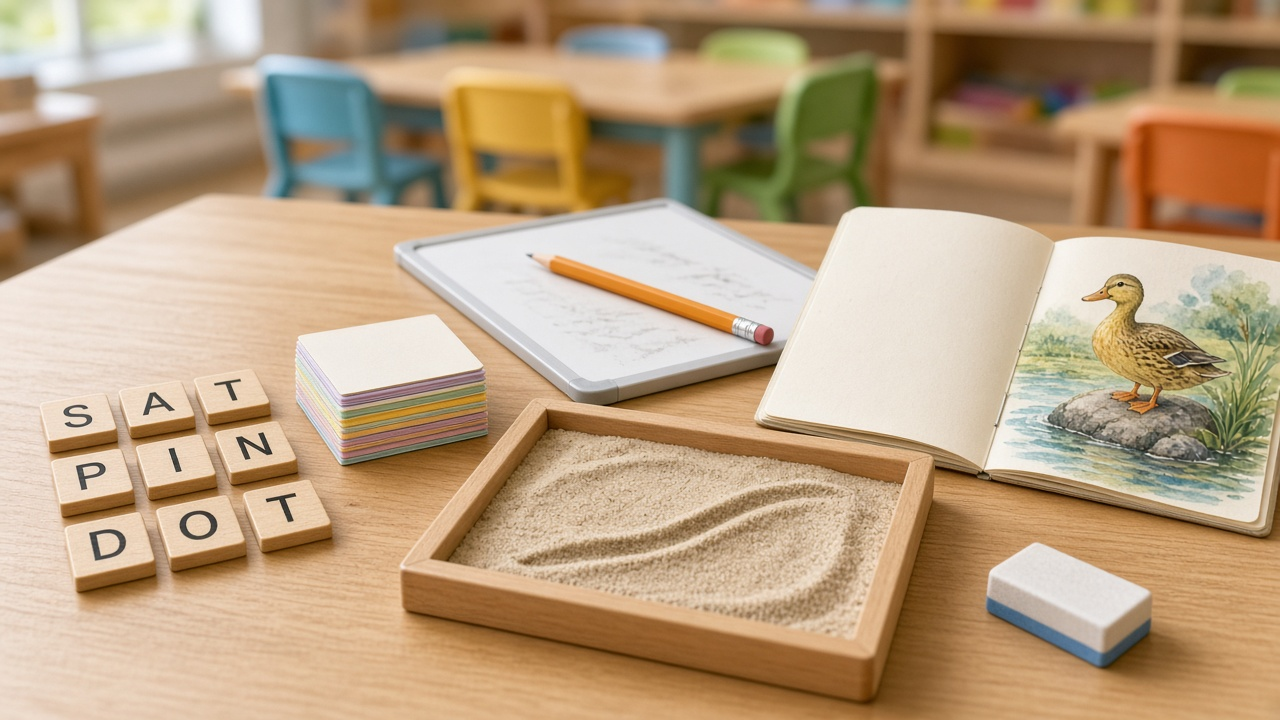
This image was generated using the prompt above.
Examples
Example Input
TaughtSkills: all single consonants; short a, e, i, o, u in closed syllables; digraphs sh, ch, th; FLOSS rule (ff, ll, ss); initial and final consonant blends
TargetPattern: ck after a short vowel at the end of a one syllable word
HeartWords: the, a, to, is, has, was, of
Morphology: suffix -s on nouns and verbs
StudentProfile: second grader, age 7, loves ducks and the pond in the town park
PassageLength: about 70 words, 10 sentences
Format: rule sheet, passage, check table, warm up, dictation, questions
Example Output
Rule sheet
Allowed: closed syllable words with short a, e, i, o, u; sh, ch, th; ff, ll, ss; consonant blends; ck after a short vowel; suffix -s; heart words the, a, to, is, has, was, of.
Not allowed (tempting for this story): quack (qu not taught), wings (ng not taught), water, he, look, swimming.

Passage: Jack and the Duck
Jack has a big red sack. In the sack is a duck. The duck is not glad. It pecks and pecks at the sack. Jack picks up the sack and runs to the pond. Jack sets the duck on a flat rock. The duck naps on the rock in the sun. Then it swims back to the pond. Jack is glad, and the duck is glad. That is a lot of luck!

Decodability check
| Category | Words | Result |
| Target ck | Jack, sack, duck, pecks, picks, rock, back, luck | PASS |
| Closed syllable | big, red, in, not, it, at, up, on, sun, lot | PASS |
| Blends | glad, and, pond, flat | PASS |
| Digraph th | then, that | PASS |
| Suffix -s | pecks, picks, runs, sets, naps, swims | PASS |
| Heart words | the, a, is, has, to, of | PASS |
Replaced in draft: "quacks" became "pecks"; "He runs" became "Jack runs".

Target pattern density
20 ck words in the passage body, 8 different words: Jack (4), sack (4), duck (5), pecks (2), picks (1), rock (2), back (1), luck (1).

Warm up
Phoneme drill: Say back. Change /b/ to /s/: sack. Change /s/ to /l/: lack. Change /a/ to /o/: lock. Change /l/ to /s/: sock.
Real words: deck, neck, lock, sock, tuck, pick, stack, black, truck
Nonsense words: zeck, vock, nuck, jick

Dictation
1. The duck is in the sack.
2. Jack sets a rock on the deck.
3. Pick up the black sock.

Comprehension (teacher reads aloud)
1. Literal: What was inside Jack's sack?
2. Sequence: Where did Jack put the duck after he got to the pond?
3. Inference: Why do you think the duck kept pecking at the sack?