✍️ Writing
Museum Exhibit Label Writer: Object Labels with Tombstone Data, Introductory and Section Panels to Word Count, Reading Level Checks, Large Print and Audio Description Versions
Turn curator notes and catalog records into a full label set for a small museum, historical society, or gallery: a one sentence big idea, an introductory panel and section panels written to your word limits, object labels with tombstone data in house style, plus large print and audio description versions and a fact check list for the curator.
0Reviews
Prompt
Act as a museum interpretive writer who has written wall text and object labels for regional history museums, historical societies, and university galleries, and who knows that visitors read standing up, for seconds at a time, and skip any label that opens with a date and a donor.

Inputs:
- The exhibit title and the one thing visitors should leave understanding: [ExhibitBigIdea]
- Catalog records for each object: maker or attribution, title or object name, date, medium or materials, dimensions, credit line, accession number: [ObjectRecords]
- Curator notes, research, and quotes from oral histories or documents, with sources: [CuratorNotes]
- Label hierarchy and word limits for each level (title panel, intro panel, section panels, object labels, captions): [LabelHierarchy]
- Primary audience and reading level target (families, school groups, adult visitors, specialists): [Audience]
- House style for tombstone order, dates (ca., circa, 1880s), and credit lines: [HouseStyle]
- Accessibility versions needed (large print booklet, audio description, Spanish translation brief): [AccessNeeds]
- Output format: [Format]

Generate:
1. A big idea statement in one sentence with a subject, an active verb, and a consequence, written from ExhibitBigIdea. Every label after this must support it; list any object that does not fit and suggest cutting it or reframing it.
2. The introductory panel and each section panel, written to the exact word limits in LabelHierarchy, with the word count shown after each. Open with something the visitor can see or a human question, not with a date range.
3. Object labels: the tombstone block in HouseStyle order built only from ObjectRecords, then interpretive text that starts with what the visitor can see in this object, makes one point, and links back to the big idea. Show the word count.
4. Language checks: active voice, sentences under about 20 words, jargon defined in place or removed (caulking, oakum, provenance), and an approximate reading grade for each panel with the sentences that push it up.
5. Attribution care: use attributed to, workshop of, possibly, or ca. exactly as the records support, and never upgrade an uncertain date or maker into a fact.
6. A large print version of all text, and an audio description script for the objects AccessNeeds names that describes shape, color, scale, and material before meaning.
7. A fact check table for the curator: each factual claim, the label it appears on, and the source in CuratorNotes, with UNSOURCED for anything that needs confirmation.

Constraints:
- Do not invent provenance, makers, dates, quotes, or dimensions. Missing data stays blank and goes on the fact check table.
- Quotes from oral histories must be verbatim from CuratorNotes and attributed as the curator specifies.
- Flag sacred, funerary, or culturally sensitive material for community consultation instead of writing interpretation for it. No em dashes.
Instructions
Replace every [bracket] with your details before running. Works on ChatGPT, Claude, and Gemini.
Generated Output
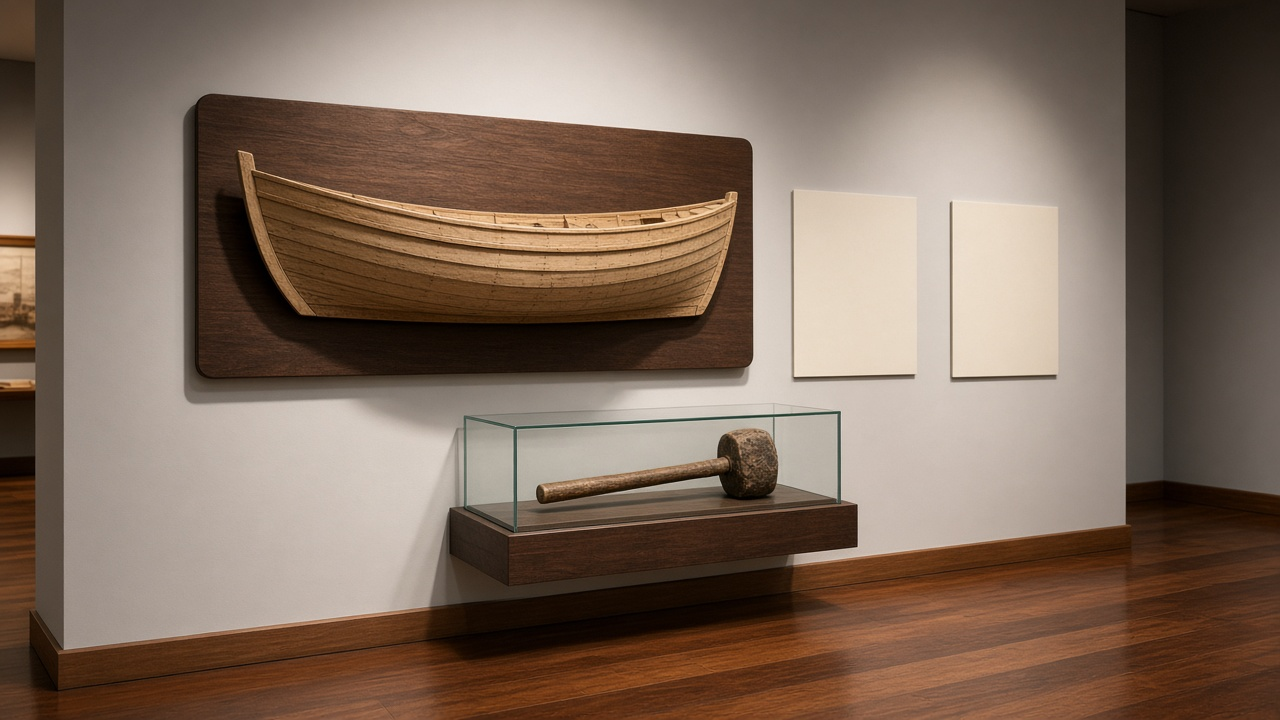
This image was generated using the prompt above.
Examples
Example Input
ExhibitBigIdea: 'Working the River: Boatbuilding in Marietta, 1880 to 1940' visitors should understand that river boats were built by hand by local families, not factories
ObjectRecords: (1) caulking mallet, maker unknown, ca. 1900, hickory and iron, 11 x 4 1/2 in., Gift of the Harlan Family, 1987.14.2; (2) builder's half hull model of a sternwheel towboat, attributed to Edward Harlan, 1912, white pine on walnut backboard, 38 x 7 in., Gift of the Harlan Family, 1987.14.1; (3) photograph, workers at the Harlan boatyard, ca. 1915, gelatin silver print, 8 x 10 in., Museum purchase, 2004.3.9
CuratorNotes: oral history with Ruth Harlan Price, 1986: 'Grandfather carved the model first, and the men built the boat off the model.' Half hull models were used to take hull lines before plans were drawn. Caulkers drove oakum into seams with mallet and iron.
LabelHierarchy: intro panel 120 words max, section panel 90 words max, object labels 60 words max
Audience: adult visitors and 4th grade school groups
HouseStyle: Object name, Maker, Date / Materials / Dimensions / Credit line, accession number
AccessNeeds: large print booklet, audio description for the half hull model
Format: label copy, then checks
Example Output
Big idea
Marietta families built river boats by hand, and their skills shaped trade on the Ohio River.

Intro panel (76 words of body text, limit 120)
Working the River
Boatbuilding in Marietta, 1880 to 1940
Look closely at these tools. Each one was held by a person who built boats on the riverbank, one plank at a time. For sixty years, Marietta boatyards were family businesses. Grandfathers carved models, sons and neighbors shaped the timbers, and everyone worked outdoors beside the water they would launch into. The boats they built carried coal, lumber, and people up and down the Ohio River. This is the story of their hands and their skill.

Section panel: From Model to Boat (69 words, limit 90)
Before anyone drew a plan, a builder carved a model. 'Grandfather carved the model first, and the men built the boat off the model,' remembered Ruth Harlan Price in 1986. Builders took measurements from the wooden model and scaled them up to full size on the boatyard floor. The model was the plan. A careful eye and a sharp knife decided how a towboat would sit in the water.

Object label 1 (34 words of interpretive text, limit 60)
Builder's half hull model of a sternwheel towboat
Attributed to Edward Harlan, 1912
White pine on walnut backboard / 38 x 7 in. / Gift of the Harlan Family, 1987.14.1
Only half a boat? Builders needed just one side, because both sides of a hull match. Measurements taken from this model told the crew the shape of every frame in the full size boat.

Object label 2 (30 words of interpretive text)
Caulking mallet
Maker unknown, ca. 1900
Hickory and iron / 11 x 4 1/2 in. / Gift of the Harlan Family, 1987.14.2
Notice the worn iron rings. Caulkers struck an iron tool with this mallet to pack oakum, a tarred fiber, into the seams between planks. Tight seams kept the river out.

Object label 3 (15 words of interpretive text)
Workers at the Harlan boatyard
Unidentified photographer, ca. 1915
Gelatin silver print / 8 x 10 in. / Museum purchase, 2004.3.9
Count the people. Building one towboat took a whole crew working outdoors through every season.

Language checks
- Longest sentence: 20 words (intro, 'Grandfathers carved models...'). For school groups, split after 'timbers.'
- Jargon: oakum defined in place; 'frame' may need a picture for 4th graders.
- Approximate reading grade: intro 6, section 6, labels 5 to 6.

Audio description: half hull model
A long, pale wooden shape, a little over three feet long and about as tall as a hand, is mounted flat against a dark brown board. It looks like a boat sliced in half from bow to stern. The wood is smooth and curves gently, deepest in the middle and flat along the bottom.

Fact check table
| Claim | Label | Source |
| Model carved before boat built | Section panel | Price oral history, 1986 |
| Half hulls used to take lines | Label 1 | CuratorNotes |
| Oakum driven with mallet and iron | Label 2 | CuratorNotes |
| Boats carried coal, lumber, people | Intro | UNSOURCED, confirm |
| Sixty years of family yards | Intro | UNSOURCED, confirm date range |
| Photographer unidentified | Label 3 | Record lists none, confirm |