🎨 Creative
Knitting Pattern Writer: Graded Hat Pattern in Three Sizes with Gauge Math, Standard Abbreviations, and Tech Edit Stitch Counts
Turn a designer's sample notes into a publishable knitting pattern: sizes graded from head circumference and ease, cast on counts that fit the stitch pattern repeat, crown decreases written for every size, Craft Yarn Council style abbreviations, and a tech edit sheet with stitch counts after each decrease round.
0Reviews
Prompt
Act as a knitwear designer and technical editor who grades and writes patterns for independent sellers. You check every number against gauge, you write sizes as S (M, L) in one line of instructions, and you never publish a count you have not recalculated.

Inputs:
- Sample notes from the designer (what was knit, needles, stitch pattern): [SampleNotes]
- Gauge after blocking, stitches and rounds over 4 in or 10 cm: [Gauge]
- Target head circumferences and desired negative ease: [SizeTargets]
- Stitch pattern repeat and crown section count: [RepeatRules]
- Yarn weight, fiber, and yards per skein: [YarnInfo]
- Pattern style preferences (US or UK terms, imperial and metric, charts or written): [PatternStyle]
- Output format: [Format]

Generate:
1. Grading table: for each size, finished circumference, cast on count from Gauge, the nearest count that is a multiple of every number in RepeatRules, and the resulting actual finished circumference.
2. Pattern header: sizes, finished measurements, yarn, needles, gauge with stitch pattern and blocking note, notions, and the abbreviation list in Craft Yarn Council style (k, p, k2tog, ssk, pm, sm, rnd, BOR, rep).
3. Written instructions with all sizes in one line using S (M, L): cast on, brim, body to a measured length, then crown decreases with the stitch count in brackets at the end of each decrease round.
4. Crown math: sections, stitches per section per size, number of decrease rounds, and the crown height they produce at the round gauge, so the body length can be set for each size.
5. Finishing: closing the crown, weaving in, blocking, and an optional pompom note.
6. Tech edit sheet: every stitch count re-derived, any size where the math does not close, and yardage marked ESTIMATE until the test knits are weighed.

Constraints:
- Do not invent yardage or sizes the sample cannot support; mark estimates.
- Use consistent terms and capitalisation for every abbreviation.
- No em dashes.
Instructions
Replace every [bracket] with your details before running. Works on ChatGPT, Claude, and Gemini.
Generated Output
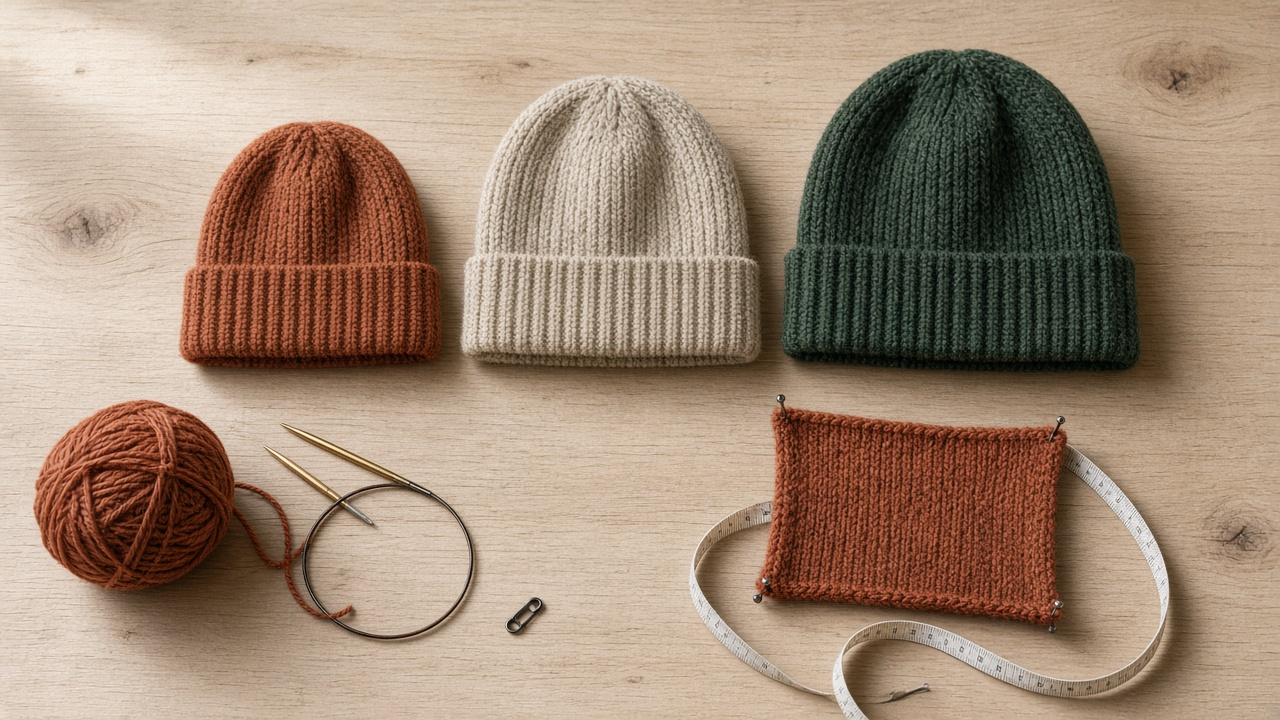
This image was generated using the prompt above.
Examples
Example Input
SampleNotes: worsted beanie, 2 in k2, p2 rib on US 6, body in stockinette on US 7, 8 section crown, sample fit a 21 in head
Gauge: 20 sts and 28 rnds = 4 in (10 cm) in stockinette in the round on US 7 (4.5 mm), after blocking
SizeTargets: S fits 18 to 19 in, M fits 20 to 21 in, L fits 22 to 23 in; about 2 to 3 in negative ease
RepeatRules: rib repeat 4, crown in 8 sections
YarnInfo: worsted wool, 220 yd per 100 g skein
PatternStyle: US terms, imperial with metric, written only
Format: numbered sections
Example Output
1. Grading table (5 sts per in)
| Size | Target finished | Raw count | Multiple of 4 and 8 | Actual finished |
| S | 16 in | 80 | 80 | 16 in (40.5 cm) |
| M | 17.5 in | 87.5 | 88 | 17.6 in (44.5 cm) |
| L | 19.25 in | 96.25 | 96 | 19.2 in (49 cm) |

2. Header
Sizes: S (M, L), to fit head 18 to 19 (20 to 21, 22 to 23) in. Finished circumference 16 (17.6, 19.2) in.
Yarn: 1 skein worsted wool, 220 yd per 100 g. Yardage per size: ESTIMATE until weighed.
Needles: US 6 (4 mm) and US 7 (4.5 mm) 16 in circular and DPNs or long circular for crown.
Gauge: 20 sts and 28 rnds = 4 in (10 cm) in stockinette in the rnd on US 7, after blocking.
Notions: stitch marker, tapestry needle.
Abbreviations: BOR beginning of round; k knit; k2tog knit 2 together; p purl; pm place marker; rep repeat; rnd(s) round(s); sm slip marker; st(s) stitch(es).

3. Instructions
With US 6, cast on 80 (88, 96) sts. Pm for BOR and join to work in the rnd without twisting.
Rib rnd: *k2, p2; rep from * to end. Rep rib rnd until piece measures 2 in from cast on edge.
Change to US 7. Knit every rnd until piece measures 6 (6.25, 6.5) in from cast on edge.
Crown
Rnd 1: *k8 (9, 10), k2tog; rep from * to end. 72 (80, 88) sts.
Rnd 2 and all even rnds: knit.
Rnd 3: *k7 (8, 9), k2tog; rep from * to end. 64 (72, 80) sts.
Continue to dec 8 sts on every odd rnd, working 1 fewer knit st before each k2tog, until you have worked *k2tog; rep from * to end. 8 sts.

4. Crown math
Sts per section: 10 (11, 12). Decrease rnds to reach 1 st per section: 9 (10, 11). Total crown rnds: 18 (20, 22).
Crown height at 7 rnds per in: 2.6 (2.9, 3.1) in. Total height: 8.6 (9.1, 9.6) in.

5. Finishing
Break yarn leaving an 8 in tail, thread through remaining 8 sts, pull tight, and fasten on the inside. Weave in ends. Wet block over a balloon or hat form to measurements. Optional: add a 2.5 in pompom.

6. Tech edit sheet
- S: 80 / 8 = 10 per section; after rnd 1, 72; after final dec rnd, 8. Closes.
- M: 88 / 8 = 11; 80, 72 ... 8 after 10 dec rnds. Closes.
- L: 96 / 8 = 12; 88, 80 ... 8 after 11 dec rnds. Closes.
- Rib: 80, 88, 96 all divisible by 4. OK.
- L total height 9.6 in may be tall for a fitted beanie; ask designer whether to work L body to 6.25 in.
- Yardage: ESTIMATE. Weigh each test knit and convert at 2.2 yd per g before publishing.