⚡ Productivity
Household Paperwork Filing System and Document Retention Schedule Planner: Tax, Medical, Insurance, Property, Vehicle, and ID Categories, Keep Times With Reasons, Scan and Shred Workflow, File Naming, and an Annual Purge Calendar
Get a pile of household papers into a system you will keep using: categories and folders, how long to keep each type with the reason, what goes in a fireproof box versus an encrypted digital vault, a scan then shred routine, consistent file names, and a yearly purge calendar.
0Reviews
Prompt
Act as a professional home organizer and daily money manager who sets up paper and digital filing systems for families, retirees, and freelancers, and who has seen what happens when a deed, a car title, or a home improvement receipt is shredded too early.

Inputs:
- Household: who lives there, work types (W-2, self employed, retired), dependents, and anyone whose papers you also manage: [Household]
- Paper inventory: what is in the piles, drawers, and boxes now, roughly by type and year: [PaperInventory]
- Assets and events that change keep times: home owned and purchase year, improvements, vehicles, investments, rental property, a business: [AssetsEvents]
- Storage on hand: filing cabinet, fireproof box or safe, scanner or phone app, cloud storage, password manager: [StorageTools]
- Time available per week and how much the household will tolerate going paperless: [TimeBudget]
- Output format: [Format]

Generate:
1. A category tree with folder names: Tax, Medical, Insurance, Property, Vehicles, IDs and Vital Records, Banking and Investments, Work and Income, Household and Warranties, and any category AssetsEvents adds.
2. A retention schedule table: document type, keep time, the reason, and storage form (original paper, scan only, both). Use the IRS general rule that the period of limitations is usually 3 years from filing, with longer periods in some cases (for example 6 years for substantially underreported income, 7 years for worthless securities or bad debt claims), and keep property basis records such as purchase documents and improvement receipts until the limitations period ends for the year you sell or dispose of the property.
3. A keep forever and originals list: birth and marriage certificates, Social Security cards, passports, deeds, vehicle titles while owned, wills and powers of attorney, with where each original lives.
4. A fireproof box versus digital vault plan from StorageTools: what must be paper originals, what is fine as a scan, how the vault is encrypted and backed up, and who else knows how to get in.
5. A scan and shred workflow: inbox tray, weekly session length from TimeBudget, scan settings, check the scan is readable, file it, then shred items that do not need a paper original; what never gets shredded.
6. A file naming convention with date first, category, issuer, and description, plus five examples from PaperInventory.
7. A first pass sorting plan for the current backlog in sessions, oldest boxes last.
8. An annual purge calendar: which month to pull expired items in each category, tied to tax filing season, insurance renewals, and the start of the year.

Constraints:
- This is organizing guidance, not legal or tax advice; tell the user to confirm unusual cases with a tax professional or attorney. No em dashes and no invented rules beyond those named here.
Instructions
Replace every [bracket] with your details before running. Works on ChatGPT, Claude, and Gemini.
Generated Output
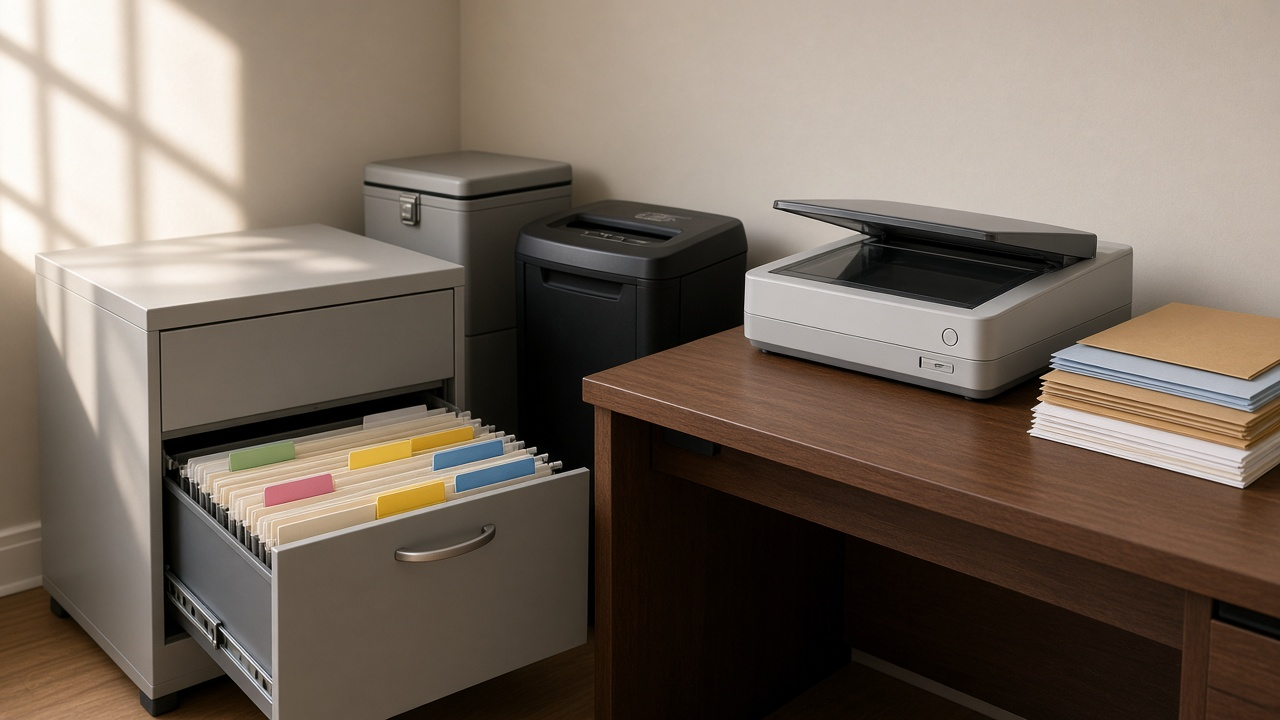
This image was generated using the prompt above.
Examples
Example Input
Household: married couple, Priya (W-2 nurse) and Tom (self employed graphic designer, files Schedule C), two kids ages 7 and 11, also handle Priya's mother's Medicare papers
PaperInventory: three banker boxes of tax returns 2009 to 2024 with receipts, a drawer of medical EOBs, loose insurance policies, home closing binder, two car titles, kids' birth certificates and passports in a dresser
AssetsEvents: house bought 2016 with a kitchen remodel in 2021 and a new roof in 2023; two cars owned outright; Tom's business equipment; a taxable brokerage account
StorageTools: two drawer filing cabinet, no fireproof box yet, phone scanner app, 2 TB cloud drive, a family password manager
TimeBudget: 30 minutes on Sunday, happy to go mostly paperless except originals
Format: tree, retention table, originals, storage plan, workflow, naming, backlog plan, purge calendar
Example Output
Category tree
01 Tax (by year) / 02 Medical (Priya, Tom, Kids, Mom Medicare) / 03 Insurance / 04 Property (House 2016) / 05 Vehicles / 06 IDs and Vital Records / 07 Banking and Investments / 08 Work and Income (Tom Business) / 09 Household and Warranties

Retention schedule
| Document | Keep | Reason | Form |
| Filed tax returns | permanently | proof of filing, basis and carryover history | scan, paper optional |
| Receipts and forms supporting a return | at least 3 years after filing, longer in special cases | IRS general period of limitations; 6 or 7 years in the cases named above | scan |
| Tom's Schedule C receipts, mileage logs | same as supporting records | backs up business deductions | scan |
| Business equipment receipts | until 3 years after the return for the year the equipment is disposed of | depreciation basis | scan |
| Home closing binder | until the limitations period ends for the year you sell | home basis | original and scan |
| Kitchen 2021 and roof 2023 receipts | same as closing binder | add to basis | scan |
| Brokerage annual statements and trade confirmations | until 3 years after the return reporting the sale | cost basis | scan |
| Medical EOBs | 1 year, or longer if used for a medical deduction, HSA, or a dispute | match to bills | scan |
| Mom's Medicare summary notices | 1 year unless appealing | appeals and billing errors | scan |
| Insurance policies | current policy plus prior until claims period passes | prove coverage | scan |
| Car titles | while you own the car | needed to sell | original in fireproof box |
| Monthly bank and card statements | 1 year unless they support taxes | reconcile | download, shred paper |

Originals, keep forever
Birth certificates (4), passports (4), Social Security cards, marriage certificate, house deed, wills and powers of attorney when made: fireproof box. Scans in the vault.

Storage plan
- Buy a fireproof and water resistant box for originals and car titles. Keep it out of the dresser.
- Digital vault: a folder on the 2 TB cloud drive inside an encrypted container, password in the family password manager, emergency access set for Priya's sister.
- Second backup: an encrypted external drive refreshed each January.

Scan and shred workflow (Sunday, 30 minutes)
1. Inbox tray by the door for all mail.
2. Scan at 300 dpi PDF, check every page is readable, file with the naming rule.
3. Shred what does not need a paper original. Never shred: originals list, deed, titles, or anything under dispute.

File naming: YYYY-MM-DD_Category_Issuer_Description
- 2024-04-10_Tax_IRS_Form1040-Filed.pdf
- 2021-06-15_Property_Ruiz-Kitchens_Remodel-Invoice.pdf
- 2023-09-02_Property_Summit-Roofing_Roof-Final-Invoice.pdf
- 2025-01-31_Tax_Brokerage_Form1099-B.pdf
- 2025-03-12_Medical_Mom_Medicare-Summary-Notice.pdf

Backlog plan
Week 1 originals to the fireproof box. Weeks 2 to 4 house binder and remodel receipts. Weeks 5 to 8 tax boxes, newest first: keep filed returns, scan supporting records still in their keep period, ask your tax preparer before shredding the oldest supporting receipts.

Purge calendar
January: bank statements, backups. May (after filing): tax supporting records past their keep period. Insurance renewal month: old policies. December: EOBs and Medicare notices.

Not legal or tax advice; confirm unusual cases with a tax professional.