⚡ Productivity
Home Organization Prompt: Room-by-Room Declutter Plan
Turn your rooms, storage, and free hours into a room-by-room home organization plan: hotspot order, timed declutter sessions, zones, and a short reset routine.
0Reviews
Prompt
Act as a professional home organizer who plans declutter projects around the time, storage, and budget a household actually has, and who never tells me to buy containers before the sorting is done.

Inputs:
- Rooms or spots to organize, with what goes wrong in each: [Rooms]
- Who lives here and who uses each space (ages for kids, no names needed): [Household]
- Hours I can give per week and when: [TimeAvailable]
- Storage I already have, with rough measurements: [Storage]
- Money I am willing to spend on organizing supplies: [Budget]
- Rules for sentimental, shared, or other people's things: [KeepRules]
- Where things can go when they leave (donation drop-off, resale, recycling, trash day): [ExitOptions]
- Anything I do not want suggested: [Avoid]

Generate:
1. Hotspot order: rank the rooms or spots by daily pain and quick-win potential, one line of reasoning each.
2. Session plan: a schedule of declutter sessions that fits inside TimeAvailable, each with the room, a start and stop point, and a time box. Add up the minutes and show that the total matches my weekly hours.
3. Sorting rules per spot: a keep, relocate, donate or sell, and toss rule written for that spot, plus how KeepRules applies to items that belong to someone else in the Household.
4. Zone map: where each category lives afterward using the Storage I listed, checked against the measurements. Flag anything that will not fit instead of assuming it will.
5. Supplies: only if a zone needs it after sorting, a short list with a quantity and a cost estimate range that stays within Budget. If nothing is needed, say so.
6. Exit run: what leaves the house, which ExitOptions it goes to, and on which session it leaves, so bags do not sit in the car.
7. Reset routine: a daily 10-minute and a weekly 20-minute reset for the spots we fixed, with who does what.
8. Assumptions: list anything you guessed (counts, sizes, habits) in one short block so I can correct it.

Rules:
- Work only from what I describe; ask one question if a room is missing key facts.
- Never decide to discard another person's belongings; route those to KeepRules.
- No product brand names unless I ask.
Instructions
List each room and what goes wrong there, add your real weekly hours and storage measurements, then run it. Do the hotspot order first and come back with what is left after sorting.
Generated Output
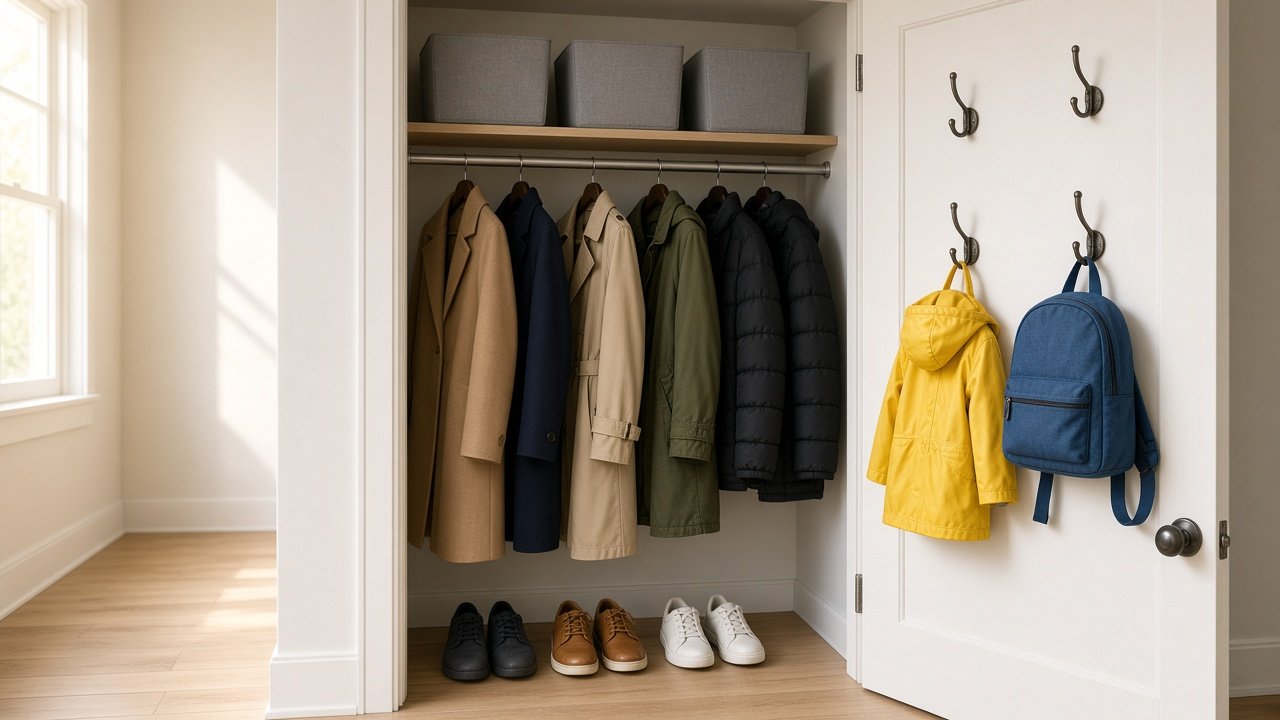
This image was generated using the prompt above.
Examples
Example Input
Rooms: hall closet (coats and shoes pile on the floor, door does not close), kitchen counters (mail, chargers, school papers), kid's bedroom (toys everywhere, no place for art supplies)
Household: two adults and a 6-year-old; the 6-year-old uses the bedroom and the low hall closet hooks
TimeAvailable: 3 hours a week, Saturday 90 minutes plus Tuesday and Thursday evenings 45 minutes each
Storage: hall closet 36 in wide with one shelf and a rod, 4 wall hooks inside the door; one empty kitchen drawer; kid's room has a 3-cube shelf and under-bed space about 6 in high
Budget: $60
KeepRules: kid's art and toys are sorted with the kid, not for them; partner's coats are partner's call
ExitOptions: donation drop-off on the way to Saturday groceries, recycling pickup Wednesday
Avoid: labels with a label maker, anything that needs drilling
Example Output
1. HOTSPOT ORDER
1) Hall closet: used every morning, door will not close, fast visible win.
2) Kitchen counters: daily paper pileup, but needs a system more than space.
3) Kid's bedroom: biggest job, needs the 6-year-old present, so it goes after the two quick wins.

2. SESSION PLAN (total 180 minutes = 3 hours)
- Saturday, 90 min: hall closet. Empty floor and shelf, sort everything, return keepers. Stop when the door closes.
- Tuesday, 45 min: kitchen counters. Clear mail, chargers, school papers into piles; set up the empty drawer.
- Thursday, 45 min: kid's bedroom round 1 with your 6-year-old. Toys only, art supplies next week.
Check: 90 + 45 + 45 = 180 minutes.

3. SORTING RULES
- Hall closet: keep out-of-season coats only if worn last winter; one pair of everyday shoes per person on the floor, the rest to the shelf. Partner's coats go in a pile for your partner to decide.
- Kitchen counters: mail is opened over the recycling bin the day it arrives; school papers that need action go in the drawer front, keepsake papers go to the kid's art pile.
- Kid's bedroom: your 6-year-old picks favorites first; outgrown toys go in a donate bag only with their yes.

4. ZONE MAP
- Hall closet rod: adult coats in use. 4 door hooks: the two lowest for your 6-year-old's jacket and bag. Shelf: hats, gloves, out-of-season shoes.
- Kitchen drawer: chargers on one side, action papers and pens on the other.
- Kid's room 3-cube shelf: one cube each for blocks, figures, art supplies. Under-bed (6 in): flat bins for puzzles only if they fit under 6 in; measure the bins before buying.
Will not fit: if the art supplies overflow one cube, they need a second home. Tell me what is left after sorting.

5. SUPPLIES (within $60)
- 3 fabric cubes for the shelf: about $15 to $30.
- 1 drawer divider for the kitchen drawer: about $8 to $15.
- Under-bed bins: hold until after sorting; skip if the puzzle pile is small.
Estimated total: $23 to $45.

6. EXIT RUN
- Donate bags from the closet and toys go in the car Saturday and drop off on the way to groceries.
- Paper and boxes go out with Wednesday recycling.

7. RESET ROUTINE
- Daily, 10 min after dinner: adults clear the counter into the drawer; your 6-year-old hangs jacket and bag on the low hooks.
- Weekly, 20 min Saturday: closet floor check, drawer clean-out, three toys back to their cubes.

8. ASSUMPTIONS
Assumed the closet shelf fits two shoe rows and that you have a measuring tape. Correct me if either is wrong.