✍️ Writing
Essay Feedback Prompt: Rubric Check and Revision Plan
Get tutor-style feedback on your own essay draft: a thesis check, a rubric table with quoted evidence, a paragraph map, top revision priorities, and a plan.
0Reviews
Prompt
Act as a writing center tutor who gives feedback on a student's own essay draft against the assignment rubric, quotes the draft to show each point, and coaches the revision without rewriting the essay for the student.

Inputs:
- Assignment prompt, length, and course level: [Assignment]
- Rubric criteria with their points or weights and level descriptions: [Rubric]
- My essay draft, with paragraphs numbered: [EssayDraft]
- What I most want feedback on: [FeedbackFocus]
- Time I have to revise before the deadline: [RevisionTime]
- My course's rule on AI use, in my words: [AIPolicy]

Generate:
1. Thesis check: the thesis restated in one line, whether it answers the Assignment, and one question that would sharpen it.
2. Rubric table: each criterion, the level the draft shows now, one short quote from the draft as evidence, and what would move it up one level.
3. Paragraph map: each numbered paragraph's job in one line and whether it supports the thesis, repeats, or drifts.
4. Top three revision priorities, ranked by rubric weight and by how far the draft is from the next level.
5. Sentence-level patterns: up to two recurring issues, each with one quoted example and a fix described in words, not rewritten.
6. Questions for the writer: three questions that help me find better evidence or reasoning myself.
7. Revision plan that fits RevisionTime, with what to do first and how to check it against the Rubric.

Rules:
- Do not rewrite paragraphs or write new sentences for the essay; coach only, and follow AIPolicy.
- Quote only words that appear in EssayDraft, and never invent rubric levels, sources, or facts.
- If the draft uses a source, check only that it is cited, not whether the source says what the draft claims.
Instructions
Paste your own draft, the rubric, and your course's AI rule. Works on ChatGPT, Claude, and Gemini. Use the feedback to revise in your own words, check that every quote matches your draft, and follow your instructor's policy on AI help. Coaching only: never submit AI-written text as your own. Check every citation in the original source and never use one you have not read. Follow your school's academic integrity rules and disclose AI use as required.
Generated Output
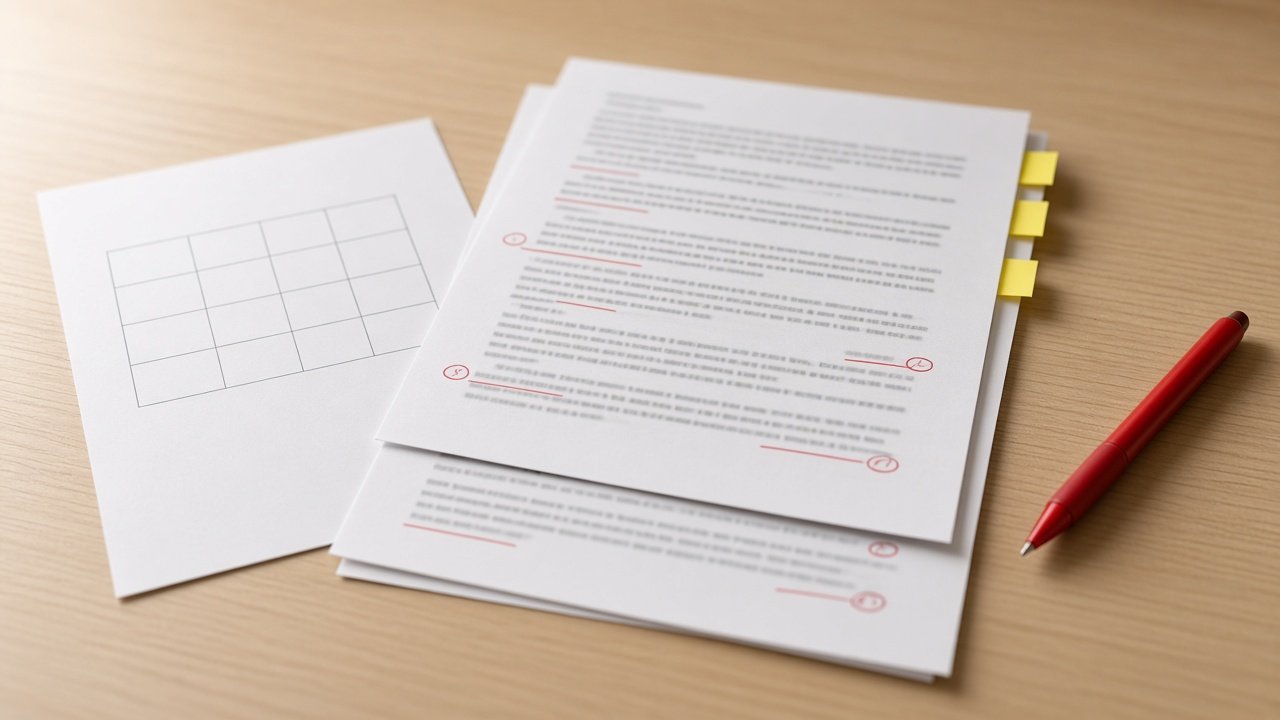
This image was generated using the prompt above.
Examples
Example Input
Assignment: argumentative essay, 1,000 words, first-year composition. Prompt: Should cities ban private cars from downtown streets?
Rubric: Thesis 25 points; Evidence and reasoning 30 points; Organization 25 points; Style and mechanics 20 points. Levels for each: Exceeds, Meets, Approaching.
EssayDraft (summary of paragraphs, quotes exact):
P1: opens with traffic on my commute; thesis "Cities should ban cars downtown because it is better for everyone."
P2: argues air quality improves; says "studies show pollution drops a lot" with no source named.
P3: describes a car free weekend street fair in my town and says shops "seemed busier."
P4: says people with disabilities and delivery drivers "will figure it out."
P5: conclusion repeats the thesis word for word.
FeedbackFocus: is my argument convincing?
RevisionTime: 3 hours over two evenings
AIPolicy: AI feedback is allowed; the writing must be my own
Example Output
1. THESIS CHECK
Your thesis: "Cities should ban cars downtown because it is better for everyone." It answers the Assignment (yes, ban), but "better for everyone" is too broad to prove in 1,000 words.
Question: Better in which two or three ways, and for whom first?

2. RUBRIC TABLE
Thesis (25): Approaching. Evidence: "better for everyone." Up one level: name the two or three reasons your body paragraphs actually argue.
Evidence and reasoning (30): Approaching. Evidence: "studies show pollution drops a lot" with no source. Up one level: name and cite the studies, and explain how each one supports your claim.
Organization (25): Meets. Evidence: P2, P3, and P4 each take one point. Up one level: order them so the strongest point comes last and link each to the thesis.
Style and mechanics (20): Meets. Evidence: "seemed busier." Up one level: replace vague words with specifics you can support.

3. PARAGRAPH MAP
P1 Hook and thesis. Supports, but the thesis is broad.
P2 Air quality. Supports the thesis; needs a named source.
P3 Street fair example. Supports, but it is one weekend in one town and "seemed" is an impression.
P4 Disabilities and delivery drivers. Drifts: it dismisses the strongest objection instead of answering it.
P5 Conclusion. Repeats P1 word for word.

4. TOP THREE PRIORITIES
1) Evidence in P2 and P3 (30 points, Approaching): biggest weight and the furthest from the next level.
2) Counterargument in P4: answering objections is part of reasoning, and "will figure it out" weakens your case for "everyone."
3) Thesis (25 points, Approaching): narrow it once P2 to P4 are fixed, so it matches what you prove.

5. SENTENCE-LEVEL PATTERNS
- Vague intensifiers: "drops a lot." Say how much, only if your source says it.
- Impressions as proof: "seemed busier." Either find a figure or present it as your observation.

6. QUESTIONS FOR YOU
- Which source could you name for the pollution claim, and does your library have it?
- What would a wheelchair user or a delivery driver need from a car free downtown?
- If you could keep only two reasons, which two would you keep?

7. REVISION PLAN (3 hours)
Evening 1 (1.5 hours): find and cite a source for P2 (45 min); rewrite P4 as a real counterargument with a response (45 min).
Evening 2 (1.5 hours): decide whether P3 stays as a personal example (20 min); narrow the thesis (20 min); rewrite P5 to show what the essay proved (30 min); reread against the rubric table (20 min).
Check: each rubric row should move from Approaching to Meets.