📚 Education
Cheat Sheet Prompt: Course Notes to One Page Exam Sheet
Condense your own course notes into a one page cheat sheet that fits your instructor's rules: triage, a zone layout, exact formulas, mini examples, and drills.
0Reviews
Prompt
Act as a teaching assistant who condenses a student's own course notes into a one page cheat sheet that fits the instructor's allowed size and rules, keeping every formula, definition, and worked example pattern exactly as the notes give it.

Inputs:
- My course notes, formulas, and worked examples: [CourseNotes]
- The instructor's rules for the sheet (size, sides, typed or handwritten, smallest font): [SheetRules]
- Topics the exam covers: [ExamTopics]
- Topics I struggle with: [WeakTopics]
- How I want it laid out (columns, order, color coding): [Layout]

Generate:
1. Rules check: restate SheetRules. If the sheet must be handwritten, label this cheat sheet output as a plan to copy by hand.
2. Triage table: every item in CourseNotes tagged must have, helpful, or leave off, based on ExamTopics and WeakTopics. Things I already know cold go to leave off.
3. Zone layout for the page: which ExamTopics go in which column or box, with WeakTopics placed where my eye lands first, following Layout.
4. Cheat sheet content, zone by zone, in compressed form: each formula with what every symbol means, definitions in 10 words or fewer, "use this when" cues, and one mini worked example per pattern copied from CourseNotes.
5. Space budget: estimated lines per zone at the smallest font SheetRules allows, and what to cut first if it does not fit.
6. Accuracy check: list anything you shortened or reworded so I can compare it with my notes, and flag any notes that conflict with each other.
7. Three practice drills that make me use the cheat sheet under time, built from ExamTopics.

Rules:
- Use only CourseNotes; never add formulas, constants, or table values that are not in my notes.
- If something in my notes looks wrong, flag it instead of fixing it silently.
- Follow my instructor's rules; if no sheet is allowed, use this as a study summary only.
Instructions
Paste your own notes and the exact sheet rules from your syllabus or instructor. Works on ChatGPT, Claude, and Gemini. Check every formula on the finished sheet against your notes, and only bring a cheat sheet into an exam if your instructor allows it.
Generated Output
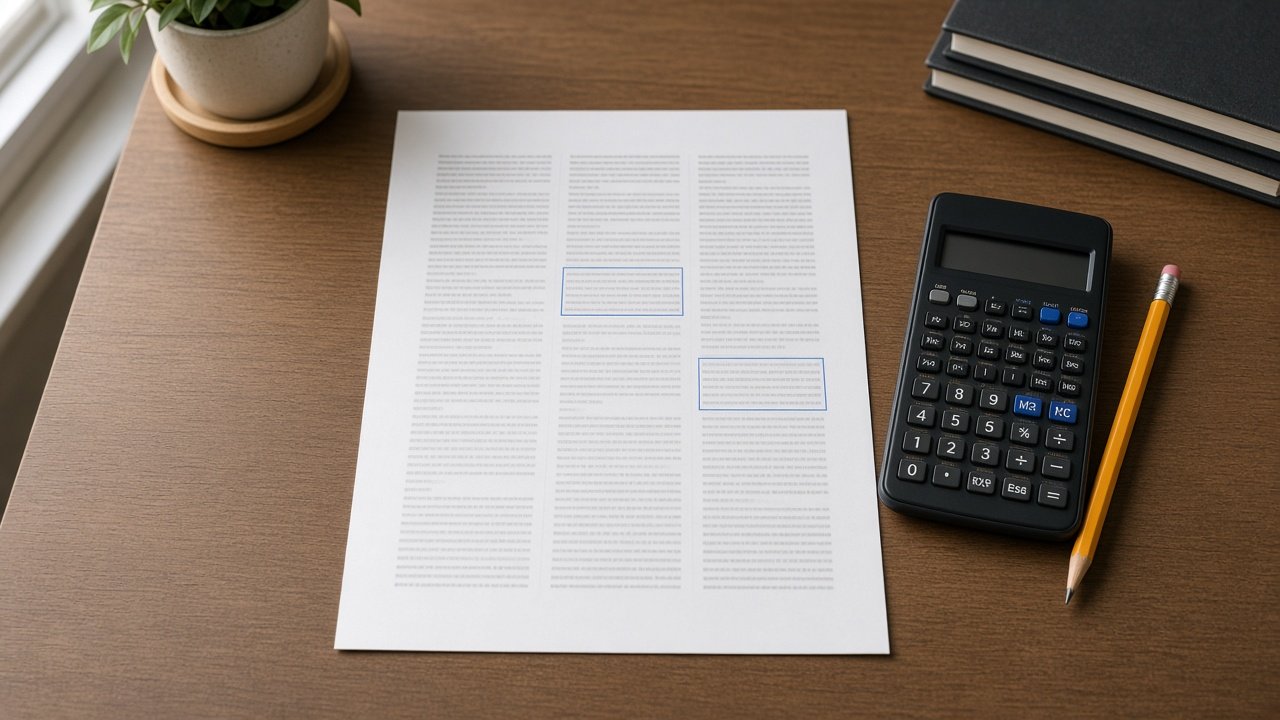
This image was generated using the prompt above.
Examples
Example Input
CourseNotes: STAT 101 notes. Mean x-bar = sum of x / n. Sample SD s = sqrt( sum of (x - x-bar)^2 / (n - 1) ). z = (x - mu) / sigma. Empirical rule 68-95-99.7. Standard error of the mean SE = s / sqrt(n). Confidence interval x-bar +/- t* x SE, df = n - 1. Use t when sigma is unknown. t* for df = 24 at 95% = 2.064 (from class table). Binomial P(X = k) = C(n, k) p^k (1 - p)^(n - k), mean np, SD sqrt(np(1 - p)). Class examples: z for x = 82, mu = 70, sigma = 8; CI for x-bar = 50, s = 10, n = 25; binomial n = 10, p = 0.3.
SheetRules: one side of an 8.5 x 11 page, typed allowed, smallest font 8 pt
ExamTopics: descriptive statistics, normal distribution and z-scores, binomial distribution, confidence intervals
WeakTopics: when to use t instead of z; binomial mean and SD
Layout: 3 columns, top to bottom in exam topic order, weak topics boxed
Example Output
1. RULES CHECK
One side of 8.5 x 11, typed, 8 pt minimum. This is the full typed sheet.

2. TRIAGE
| Item | Tag |
| Mean formula | leave off (you know it) |
| Sample SD with n - 1 | must have |
| z-score and empirical rule | must have |
| SE = s / sqrt(n) | must have |
| CI with t*, df = n - 1, t* = 2.064 for df 24 | must have (weak topic) |
| Binomial formula, mean, SD | must have (weak topic) |
| Class examples | helpful, one per pattern |

3. ZONE LAYOUT
Column 1: Descriptive statistics, Normal and z-scores
Column 2: [BOX] t or z decision, Confidence intervals
Column 3: [BOX] Binomial, Mini examples overflow

4. CHEAT SHEET CONTENT
COLUMN 1
Descriptive: s = sqrt( sum (x - x-bar)^2 / (n - 1) ). s = sample SD, n = sample size. Use n - 1 for a sample.
Normal: z = (x - mu) / sigma. mu = mean, sigma = SD. Use this when you need how many SDs x sits from the mean.
Empirical rule: about 68% within 1 SD, 95% within 2, 99.7% within 3.
Example: x = 82, mu = 70, sigma = 8, so z = (82 - 70) / 8 = 12 / 8 = 1.5.

COLUMN 2
[BOX] t OR z? sigma unknown: use t with df = n - 1. sigma known: z.
CI: x-bar +/- t* x SE, with SE = s / sqrt(n).
t* for df = 24 at 95% = 2.064 (class table).
Example: x-bar = 50, s = 10, n = 25. SE = 10 / 5 = 2. Margin = 2.064 x 2 = 4.128. CI = 45.87 to 54.13.

COLUMN 3
[BOX] BINOMIAL: P(X = k) = C(n, k) p^k (1 - p)^(n - k).
n = trials, k = successes, p = chance of success. Use this when trials are fixed, independent, and success or fail.
Mean = np. SD = sqrt(np(1 - p)).
Example: n = 10, p = 0.3. Mean = 3. SD = sqrt(10 x 0.3 x 0.7) = sqrt(2.1), about 1.45.

5. SPACE BUDGET (8 pt, 3 columns, about 70 lines each)
Column 1 about 12 lines, Column 2 about 10, Column 3 about 10. Plenty of room: add one more class example per weak topic. If it ever runs over, cut the empirical rule line first.

6. ACCURACY CHECK
- "Use this when" lines are reworded from your notes; compare them.
- Rounding of the CI (45.87 to 54.13) and the binomial SD (1.45) is mine; your instructor may want more decimals.
- No conflicts found in your notes.

7. DRILLS (with the sheet, 3 minutes each)
- A sample of 25 has x-bar = 62 and s = 15. Find the 95% CI.
- n = 20 trials, p = 0.4: find the mean and SD.
- x = 55, mu = 70, sigma = 10: find z and say whether it is within 2 SDs.