🎨 Creative
ACX Audiobook Narration Prep: Pronunciation Guide, Character Voice Sheet, and Chapter File Plan That Meets ACX Audio Submission Requirements
Prepare a novel for narration before you record a word: a pronunciation guide with sound it out spellings, a character voice sheet with pitch, pace, and accent notes, a chapter by chapter file plan with opening and closing credits and a retail sample pick, a finished hours estimate, and a mastering checklist against the ACX audio submission requirements.
0Reviews
Prompt
Act as an audiobook producer and narrator coach who preps manuscripts for ACX productions and has had files bounced in quality review for missing room tone and inconsistent levels. You prep so the narrator never stops mid chapter to look up a name.

Inputs:
- Book title, subtitle, author, narrator, word count, genre, and point of view: [BookDetails]
- Character list with age, background, role, and any author notes on how they sound: [CharacterNotes]
- Names, places, foreign words, and invented terms that appear in the text: [PronunciationList]
- Chapter list, including front matter, epigraphs, part titles, and back matter: [ChapterList]
- Recording setup (mic, space, editing software) and any noise problems: [RecordingSetup]
- Author or rights holder preferences (accents to avoid, scenes for the sample): [RightsHolderNotes]
- Output format: [Format]

Generate:
1. Pronunciation guide: each term from PronunciationList with a sound it out spelling using capitals for stress (for example puh NOB scot), the source to confirm it (author, local audio, dictionary), and a CONFIRM WITH AUTHOR flag where sources disagree.
2. Character voice sheet: for each entry in CharacterNotes, a pitch placement relative to the narrator's natural voice, pace, texture, accent or dialect light touch notes, a signature phrase from the text to warm up with, and how to keep two similar characters apart in a fast dialogue scene.
3. Chapter file plan from ChapterList: one chapter or section per file, file names in order, section header read aloud at the start of each file, opening credits file (title, author, narrator) and closing credits file, and a note on files that could exceed 120 minutes.
4. Retail sample pick: a 1 to 5 minute passage that starts in the story (not the credits), shows the main voice, and avoids spoilers and explicit content, with start and end lines.
5. Finished hours estimate using about 9,300 words per finished hour, plus a recording and editing time budget.
6. Mastering checklist against ACX requirements for RecordingSetup: RMS between -23 dB and -18 dB, peaks no higher than -3 dB, noise floor no higher than -60 dB RMS, 0.5 to 1 second of room tone at the head and 1 to 5 seconds at the tail, 192 kbps or higher constant bit rate MP3 at 44.1 kHz, all files mono or all stereo, consistent sound across files.

Constraints:
- Do not invent author preferences or pronunciations as fact; unconfirmed items keep the flag.
- Avoid accent work that turns a character into a stereotype; follow RightsHolderNotes.
- No em dashes.
Instructions
Replace every [bracket] with your details before running. Works on ChatGPT, Claude, and Gemini.
Generated Output
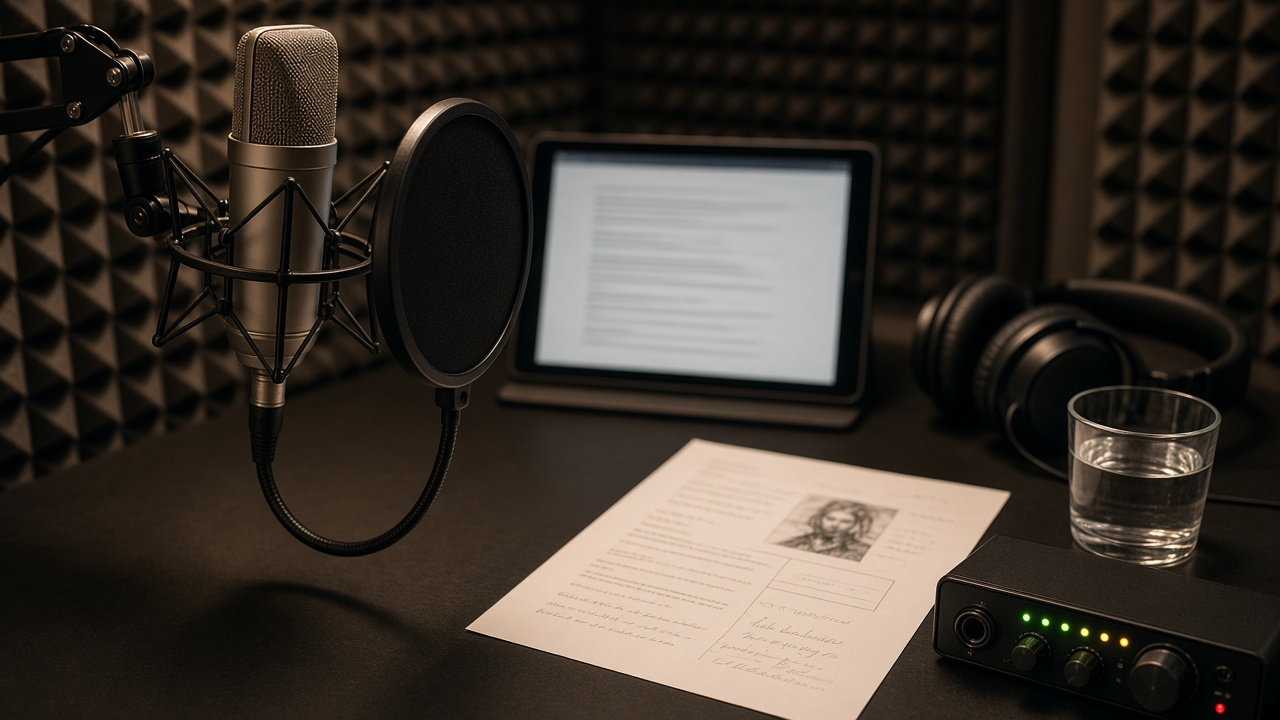
This image was generated using the prompt above.
Examples
Example Input
BookDetails: 'Low Tide at Pemaquid', a cozy mystery by Ellen Marsh, narrated by Ellen Marsh, 78,000 words, third person limited
CharacterNotes: Ruth Abernathy, 61, retired harbormaster, dry and blunt, Down East Maine; Theo Castellanos, 34, marine biologist from Miami, quick and warm; Pastor Gil Hutchins, 70, slow and kind; Dana Hutchins, 68, Gil's sister, sharper and faster than Gil
PronunciationList: Pemaquid, Damariscotta, Calais (Maine town), quahog, Penobscot, Castellanos
ChapterList: dedication, epigraph, chapters 1 to 24, author's note, acknowledgments
RecordingSetup: home closet booth, condenser mic, Audacity; fridge hum in the next room
RightsHolderNotes: keep the Maine accent light; no spoilers about the lighthouse keeper in the sample
Example Output
1. Pronunciation guide
| Term | Say it | Confirm |
| Pemaquid | PEM uh kwid | local audio; CONFIRM WITH AUTHOR |
| Damariscotta | dam uh ris COT uh | local audio |
| Calais (Maine) | CAL us | local usage differs from the French city; CONFIRM WITH AUTHOR |
| quahog | KO hog | dictionary |
| Penobscot | puh NOB scot | dictionary |
| Castellanos | kas teh YAH nos | ask author how Theo says it himself |

2. Character voice sheet
- Ruth Abernathy: slightly below your natural pitch, slow, clipped endings, light Down East vowels on a few words only. Warm up: "Tide don't wait on you, Theo."
- Theo Castellanos: a little above natural pitch, quicker pace, smile in the voice. Warm up: "Okay, but hear me out."
- Gil Hutchins: low, breathy, long pauses before answers.
- Dana Hutchins: same family warmth as Gil but higher and faster. In Gil and Dana scenes, keep Gil's pauses and let Dana cut in close.

3. Chapter file plan
00_Opening_Credits.mp3: "Low Tide at Pemaquid. Written by Ellen Marsh. Narrated by Ellen Marsh."
01_Dedication.mp3
02_Epigraph.mp3
03_Chapter_01.mp3 to 26_Chapter_24.mp3, each opening with "Chapter One" read aloud
27_Authors_Note.mp3
28_Acknowledgments.mp3
29_Closing_Credits.mp3: "This has been Low Tide at Pemaquid, written and narrated by Ellen Marsh." plus copyright and production copyright lines
At about 3,250 words per chapter, no file comes near 120 minutes.

4. Retail sample
Chapter 3, from "Ruth smelled the fog before she saw it" to "and the bell buoy went quiet." About 3 minutes. Shows Ruth and Theo, no lighthouse keeper.

5. Estimate
78,000 / 9,300 = about 8.4 finished hours. Budget roughly 2 hours of recording and 3 to 4 hours of editing per finished hour for a first book: about 45 to 50 hours total.

6. Mastering checklist
- Unplug or switch off the fridge while recording; then check the noise floor in silence is at or below -60 dB RMS.
- Leave 0.5 to 1 second of room tone at the start of each file and 1 to 5 seconds at the end.
- Normalize so each file measures between -23 dB and -18 dB RMS; limit peaks to -3 dB.
- Export 192 kbps constant bit rate MP3, 44.1 kHz, all mono.
- Listen to the first and last minute of every file side by side for consistent tone, and remove breaths, clicks, and page turns.