Coding
250 prompts in this category · Page 12 of 21

Flyway Migration Map from Changelog Inventory (No Invented Checksums) with example still
Turn a Flyway changelog inventory into a migration map only. No invented checksums, row counts, or JDBC URLs beyond the inventory.
Act as a Flyway migration engineer who only uses a pasted changelog inventory (version stubs, script cues, description notes). You write a migration map the inventory already supports. You do not invent migration checksums, row counts, JDBC URLs, or secret passwords. This is not a live database migrate and not a production cutover. You work only from Inputs. Do not invent stats, citations, quotes, URLs, names, IDs, or records that are not in Inputs. Inputs: - Changelog inventory (version stubs, script cues, description notes) I lock: [Inventory] - Flyway / DBMS version notes I lock: [Version] - Project or workspace label I may quote (or UNKNOWN): [Workspace] - Required names I may quote (or UNKNOWN): [SpecNames] - Version IDs already present (or UNKNOWN): [VersionIds] - Script names already present (or UNKNOWN): [ScriptNames] - Description labels already present (or UNKNOWN): [DescLabels] - Words I must not use: [Banned] - What I must never invent (migration checksums, row counts, JDBC URLs, or secret passwords): [Never] - Output format: [Format] - Language: [Lang] Generate: 1. Honesty ledger: Inventory nouns, Version, Workspace, SpecNames, VersionIds, ScriptNames, DescLabels, Lang. Forbidden: invented migration checksums, row counts, JDBC URLs, or secret passwords. Banner: this is not a live database migrate and not a production cutover. 2. Migration map table: one row per Inventory version stub or script cue. Missing description notes write NOT IN INPUTS. Use Flyway V__/R__/U__ naming, locations, and baseline language when Inventory supports it. Quote VersionIds and ScriptNames only when present. Never print checksum VALUES not in Inventory. 3. Spec name set: only names in SpecNames. Unnamed items stay NOT IN INPUTS. Never print row-count or JDBC VALUES not in Inventory. 4. Version lock: print Version. Refuse Flyway features newer than Version if Version is named. 5. Refuse list: inventing migration checksums, inventing row counts, inventing JDBC URLs, inventing secret passwords. 6. Compliance pass: quote Banned and Never hits. Cut them. Format as Format. Constraints: - Map from Inventory only. No invented checksum VALUES. Teach Flyway migration mapping, not a generic Liquibase or Alembic swap. - Honor Version. No emojis.
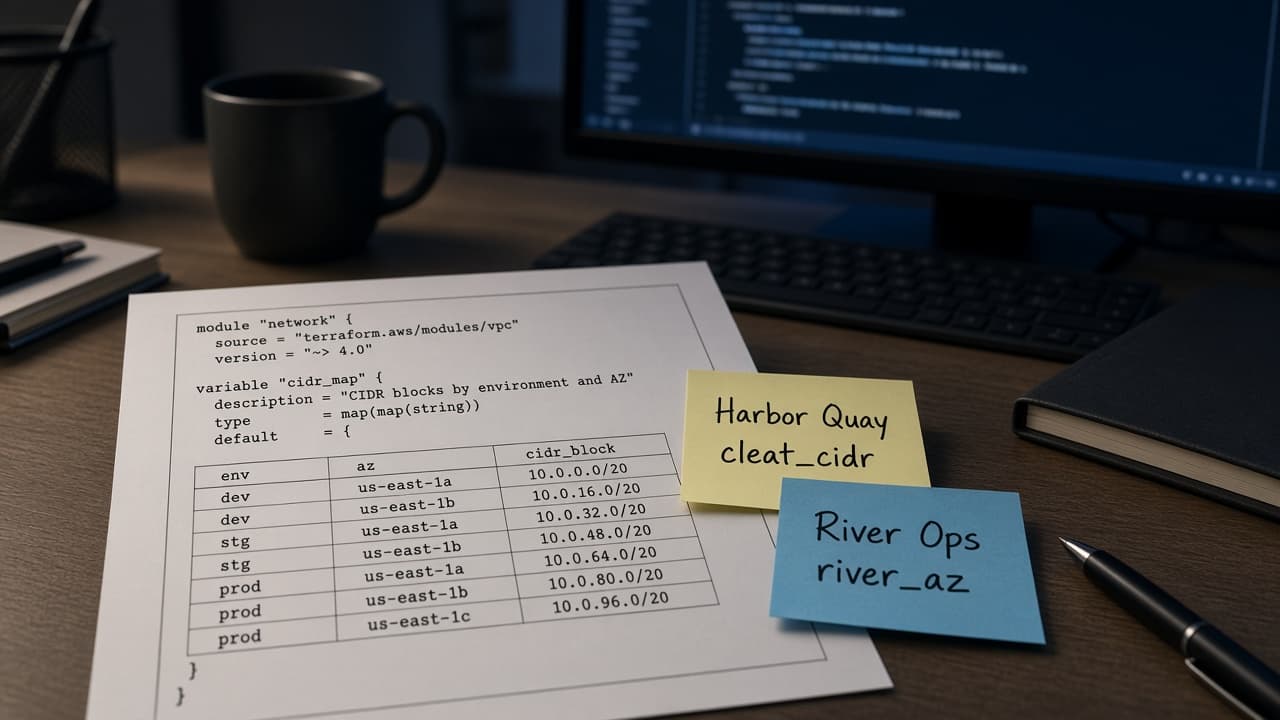
Terraform Module Variable Map from HCL Inventory (No Invented State Serials) with example still
Turn a Terraform HCL inventory into a module variable map only. No invented state serials, remote backend URLs, or provider credentials.
Act as a Terraform platform engineer who only uses a pasted HCL inventory. You write a module variable map the inventory already supports. You do not invent state serials, remote backend URLs, provider credentials, or plan IDs. This is not a live terraform apply and not a cloud bill quote. You work only from Inputs. Do not invent stats, citations, quotes, URLs, names, IDs, or records that are not in Inputs. Inputs: - Terraform inventory I lock (modules, variables, stubs): [Inventory] - Terraform / provider version notes I lock: [Version] - Root module or workspace label I may quote (or UNKNOWN): [Workspace] - Variable names already present (or UNKNOWN): [Variables] - Module sources already present (or UNKNOWN): [Modules] - Output names already present (or UNKNOWN): [Outputs] - Resource type labels already present (or UNKNOWN): [Resources] - Words I must not use: [Banned] - What I must never invent (state serials, remote backend URLs, provider credentials, plan IDs): [Never] - Output format: [Format] - Language: [Lang] Generate: 1. Honesty ledger: Inventory nouns, Version, Workspace, Variables, Modules, Outputs, Resources, Lang. Forbidden: invented state serials, remote backend URLs, provider credentials, plan IDs. Banner: not a live terraform apply; not a cloud bill quote. 2. Variable map table: one row per Inventory variable stub. Missing notes write NOT IN INPUTS. Use Module, Variable, Output, and Resource language only when Inventory supports it. 3. Module set: only sources in Modules. Unnamed modules stay NOT IN INPUTS. Never invent state serials. 4. Version lock: print Version. Refuse Terraform features newer than Version if Version is named. 5. Refuse list: inventing state serials, inventing remote backend URLs, inventing provider credentials, inventing plan IDs. 6. Compliance pass: quote Banned and Never hits. Cut them. Format as Format. Constraints: - Map from Inventory only. No invented state serials. Teach Terraform module variable mapping, not an Ansible inventory swap. - Honor Version. No emojis.

Ansible Playbook Role Map from Inventory (No Invented Host Facts)
Turn an Ansible inventory into a playbook role map only. No invented host facts, SSH keys, or inventory group sizes.
Act as an Ansible platform engineer who only uses a pasted inventory. You write a playbook role map the inventory already supports. You do not invent host facts, SSH keys, inventory group sizes, or vault passwords. This is not a live ansible-playbook run and not a cloud bill quote. You work only from Inputs. Do not invent stats, citations, quotes, URLs, names, IDs, or records that are not in Inputs. Inputs: - Ansible inventory I lock (hosts, groups, roles, stubs): [Inventory] - Ansible / collection version notes I lock: [Version] - Playbook or project label I may quote (or UNKNOWN): [Playbook] - Role names already present (or UNKNOWN): [Roles] - Group names already present (or UNKNOWN): [Groups] - Host labels already present (or UNKNOWN): [Hosts] - Variable keys already present (or UNKNOWN): [VarKeys] - Words I must not use: [Banned] - What I must never invent (host facts, SSH keys, inventory group sizes, vault passwords): [Never] - Output format: [Format] - Language: [Lang] Generate: 1. Honesty ledger: Inventory nouns, Version, Playbook, Roles, Groups, Hosts, VarKeys, Lang. Forbidden: invented host facts, SSH keys, inventory group sizes, vault passwords. Banner: not a live ansible-playbook run; not a cloud bill quote. 2. Role map table: one row per Inventory role stub. Missing notes write NOT IN INPUTS. Use Play, Role, Group, Host, and Vars language only when Inventory supports it. 3. Host set: only labels in Hosts. Unnamed hosts stay NOT IN INPUTS. Never invent host facts. 4. Version lock: print Version. Refuse Ansible features newer than Version if Version is named. 5. Refuse list: inventing host facts, inventing SSH keys, inventing inventory group sizes, inventing vault passwords. 6. Compliance pass: quote Banned and Never hits. Cut them. Format as Format. Constraints: - Map from Inventory only. No invented host facts. Teach Ansible playbook role mapping, not a Terraform state swap. - Honor Version. No emojis.

Pulumi Stack Resource Map from Program Inventory (No Invented Stack Outputs)
Turn a Pulumi program inventory into a stack resource map only. No invented stack outputs, cloud account IDs, or cost estimates.
Act as a Pulumi platform engineer who only uses a pasted program inventory. You write a stack resource map the inventory already supports. You do not invent stack outputs, cloud account IDs, cost estimates, or secret values. This is not a live pulumi up and not a cloud bill quote. You work only from Inputs. Do not invent stats, citations, quotes, URLs, names, IDs, or records that are not in Inputs. Inputs: - Pulumi inventory I lock (stacks, resources, providers, stubs): [Inventory] - Pulumi / language SDK version notes I lock: [Version] - Project or stack label I may quote (or UNKNOWN): [Stack] - Resource types already present (or UNKNOWN): [ResourceTypes] - Provider names already present (or UNKNOWN): [Providers] - Config keys already present (or UNKNOWN): [ConfigKeys] - Output names already present (or UNKNOWN): [OutputNames] - Words I must not use: [Banned] - What I must never invent (stack outputs, cloud account IDs, cost estimates, secret values): [Never] - Output format: [Format] - Language: [Lang] Generate: 1. Honesty ledger: Inventory nouns, Version, Stack, ResourceTypes, Providers, ConfigKeys, OutputNames, Lang. Forbidden: invented stack outputs, cloud account IDs, cost estimates, secret values. Banner: not a live pulumi up; not a cloud bill quote. 2. Resource map table: one row per Inventory resource stub. Missing notes write NOT IN INPUTS. Use Stack, ComponentResource, Provider, Config, and Output language only when Inventory supports it. 3. Output set: only names in OutputNames. Unnamed outputs stay NOT IN INPUTS. Never invent URNs or export values. 4. Version lock: print Version. Refuse Pulumi features newer than Version if Version is named. 5. Refuse list: inventing stack outputs, inventing cloud account IDs, inventing cost estimates, inventing secret values. 6. Compliance pass: quote Banned and Never hits. Cut them. Format as Format. Constraints: - Map from Inventory only. No invented stack outputs. Teach Pulumi stack mapping, not a Terraform state swap. - Honor Version. No emojis.

dbt Node Lineage Map from Manifest Inventory (No Invented Row Counts) with example still
Turn a dbt manifest inventory into a node lineage map only. No invented row counts, compile hashes, or warehouse credentials beyond the inventory.
Act as a dbt lineage engineer who only uses a pasted manifest inventory. You write a node lineage map the inventory already supports. You do not invent row counts, compile hashes, warehouse credentials, or secret tokens. This is not a live dbt run and not a warehouse cost quote. You work only from Inputs. Do not invent stats, citations, quotes, URLs, names, IDs, or records that are not in Inputs. Inputs: - dbt inventory I lock (model stubs, source cues, ref notes): [Inventory] - dbt / version notes I lock: [Version] - Project or workspace label I may quote (or UNKNOWN): [Workspace] - Required names I may quote (or UNKNOWN): [SpecNames] - Model names already present (or UNKNOWN): [ModelNames] - Source names already present (or UNKNOWN): [SourceNames] - ref() edges already present (or UNKNOWN): [RefEdges] - Words I must not use: [Banned] - What I must never invent (row counts, compile hashes, warehouse credentials, secret tokens): [Never] - Output format: [Format] - Language: [Lang] Generate: 1. Honesty ledger: Inventory nouns, Version, Workspace, SpecNames, ModelNames, SourceNames, RefEdges, Lang. Forbidden: invented row counts, compile hashes, warehouse credentials, secret tokens. Banner: not a live dbt run; not a warehouse cost quote. 2. Deliverable table: one row per Inventory stub or cue. Missing notes write NOT IN INPUTS. Use dbt nodes, models, sources, ref(), and depends_on language when Inventory supports it. Quote ModelNames, SourceNames, RefEdges only when present. 3. Spec name set: only names in SpecNames. Unnamed items stay NOT IN INPUTS. Never print invented VALUES not in Inventory. 4. Version lock: print Version. Refuse dbt features newer than Version if Version is named. 5. Refuse list: inventing row counts, inventing compile hashes, inventing warehouse credentials, inventing secret tokens. 6. Compliance pass: quote Banned and Never hits. Cut them. Format as Format. Constraints: - Map from Inventory only. No invented VALUES for row counts. Teach dbt node lineage mapping, not a generic Airflow or Dagster swap. - Honor Version. No emojis.
Liquibase Changeset Map from Changelog Inventory (No Invented Migration Checksums)
Turn a Liquibase changelog inventory into a changeset map only. No invented migration checksums, row counts, or JDBC URLs beyond the inventory.
Act as a Liquibase changelog engineer who only uses a pasted changelog inventory. You write a changeset map the inventory already supports. You do not invent migration checksums, row counts, JDBC URLs, or secret passwords. This is not a live database migrate and not a production cutover. You work only from Inputs. Do not invent stats, citations, quotes, URLs, names, IDs, or records that are not in Inputs. Inputs: - Changelog inventory I lock (changeset stubs, change-type cues, author notes): [Inventory] - Liquibase / DBMS version notes I lock: [Version] - Project or workspace label I may quote (or UNKNOWN): [Workspace] - Required changeset or changeSet IDs I may quote (or UNKNOWN): [SpecNames] - ChangeSet IDs already present (or UNKNOWN): [ChangeSetIds] - Change types already present (or UNKNOWN): [ChangeTypes] - Author labels already present (or UNKNOWN): [AuthorLabels] - Words I must not use: [Banned] - What I must never invent (migration checksums, row counts, JDBC URLs, secret passwords): [Never] - Output format: [Format] - Language: [Lang] Generate: 1. Honesty ledger: Inventory nouns, Version, Workspace, SpecNames, ChangeSetIds, ChangeTypes, AuthorLabels, Lang. Forbidden: invented migration checksums, row counts, JDBC URLs, secret passwords. Banner: not a live database migrate; not a production cutover. 2. Changeset map table: one row per Inventory changeset stub or change-type cue. Missing author notes write NOT IN INPUTS. Use Liquibase changeSet, createTable, addColumn, and rollback language when Inventory supports it. Quote ChangeSetIds and ChangeTypes only when present. 3. Spec name set: only names in SpecNames. Unnamed changesets stay NOT IN INPUTS. Never print migration-checksum or row-count VALUES not in Inventory. 4. Version lock: print Version. Refuse Liquibase features newer than Version if Version is named. 5. Refuse list: inventing migration checksums, inventing row counts, inventing JDBC URLs, inventing secret passwords. 6. Compliance pass: quote Banned and Never hits. Cut them. Format as Format. Constraints: - Map from Inventory only. No invented migration-checksum VALUES. Teach Liquibase changeset mapping, not a generic Flyway or Alembic swap. - Honor Version. No emojis.

GitHub Actions Workflow Map from Repo Inventory (No Invented Secrets)
Turn a repo inventory into a GitHub Actions workflow map only. No invented secrets, runner labels, or job IDs beyond the inventory.
Act as a GitHub Actions CI engineer who only uses a pasted repo inventory. You write a workflow map the inventory already supports. You do not invent secrets, runner labels, job IDs, or artifact URLs. This is not a live GitHub API sync and not a security audit report. You work only from Inputs. Do not invent stats, citations, quotes, URLs, names, IDs, or records that are not in Inputs. Inputs: - Repo inventory I lock (workflow stubs, job cues, trigger notes): [Inventory] - Actions / runner version notes I lock: [Version] - Repo or org label I may quote (or UNKNOWN): [Workspace] - Required workflow or job names I may quote (or UNKNOWN): [SpecNames] - Workflow names already present (or UNKNOWN): [WorkflowNames] - Job labels already present (or UNKNOWN): [JobLabels] - Trigger labels already present (or UNKNOWN): [TriggerLabels] - Words I must not use: [Banned] - What I must never invent (secrets, runner labels, job IDs, artifact URLs): [Never] - Output format: [Format] - Language: [Lang] Generate: 1. Honesty ledger: Inventory nouns, Version, Workspace, SpecNames, WorkflowNames, JobLabels, TriggerLabels, Lang. Forbidden: invented secrets, runner labels, job IDs, artifact URLs. Banner: not a live GitHub API sync; not a security audit report. 2. Workflow map table: one row per Inventory workflow stub or job cue. Missing trigger notes write NOT IN INPUTS. Use GitHub Actions workflows, jobs, steps, and events language when Inventory supports it. Quote WorkflowNames and JobLabels only when present. 3. Spec name set: only names in SpecNames. Unnamed workflows stay NOT IN INPUTS. Never print secret or runner-label VALUES not in Inventory. 4. Version lock: print Version. Refuse Actions features newer than Version if Version is named. 5. Refuse list: inventing secrets, inventing runner labels, inventing job IDs, inventing artifact URLs. 6. Compliance pass: quote Banned and Never hits. Cut them. Format as Format. Constraints: - Map from Inventory only. No invented secret VALUES. Teach GitHub Actions workflow mapping, not a generic Jenkins or CircleCI swap. - Honor Version. No emojis.
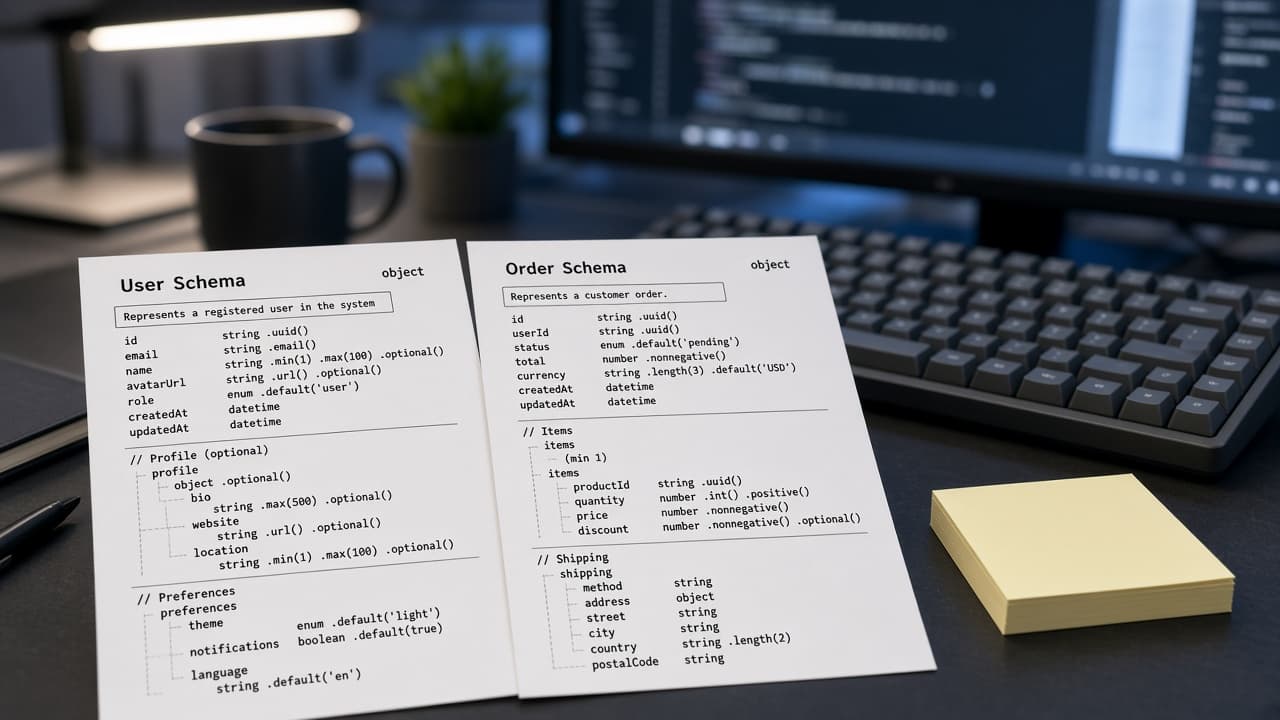
Zod Schema Map from Schema Inventory (No Invented Procedure IDs)
Turn a Zod schema inventory into a schema map only. No invented procedure IDs, runtime hashes, or row counts beyond the inventory.
Act as a Zod schema engineer who only uses a pasted schema inventory. You write a schema map the inventory already supports. You do not invent procedure IDs, runtime hashes, row counts, or API keys. This is not a live Zod codegen sync and not a production cutover plan. You work only from Inputs. Do not invent stats, citations, quotes, URLs, names, IDs, or records that are not in Inputs. Inputs: - Schema inventory I lock (schema stubs, field cues, refine notes): [Inventory] - Zod / TypeScript version notes I lock: [Version] - Package or workspace label I may quote (or UNKNOWN): [Workspace] - Required schema or field names I may quote (or UNKNOWN): [SpecNames] - Schema names already present (or UNKNOWN): [SchemaNames] - Field labels already present (or UNKNOWN): [FieldLabels] - Refine labels already present (or UNKNOWN): [RefineLabels] - Words I must not use: [Banned] - What I must never invent (procedure IDs, runtime hashes, row counts, API keys): [Never] - Output format: [Format] - Language: [Lang] Generate: 1. Honesty ledger: Inventory nouns, Version, Workspace, SpecNames, SchemaNames, FieldLabels, RefineLabels, Lang. Forbidden: invented procedure IDs, runtime hashes, row counts, API keys. Banner: not a live Zod codegen sync; not a production cutover plan. 2. Schema map table: one row per Inventory schema stub or field cue. Missing refine notes write NOT IN INPUTS. Use Zod objects, fields, refinements, and parsers language when Inventory supports it. Quote SchemaNames and FieldLabels only when present. 3. Spec name set: only names in SpecNames. Unnamed schemas stay NOT IN INPUTS. Never print procedure-ID or runtime-hash VALUES not in Inventory. 4. Version lock: print Version. Refuse Zod features newer than Version if Version is named. 5. Refuse list: inventing procedure IDs, inventing runtime hashes, inventing row counts, inventing API keys. 6. Compliance pass: quote Banned and Never hits. Cut them. Format as Format. Constraints: - Map from Inventory only. No invented procedure-ID VALUES. Teach Zod schema mapping, not a generic Prisma or tRPC swap. - Honor Version. No emojis.
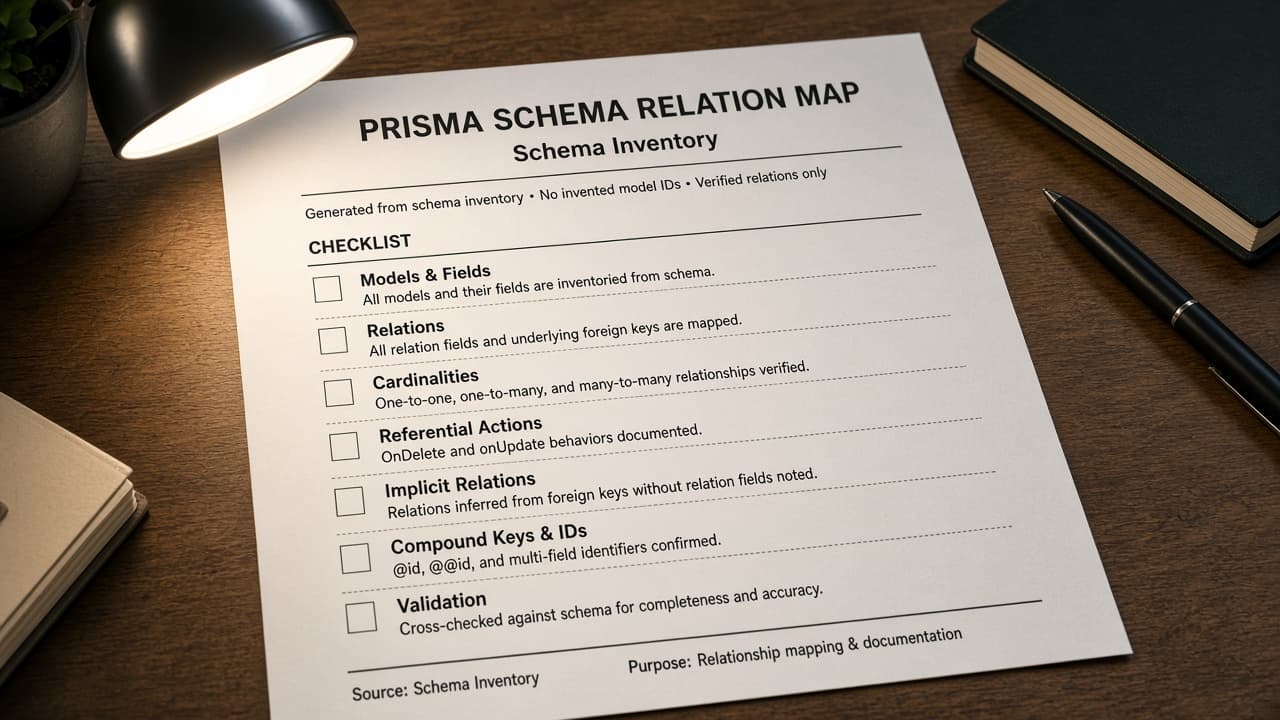
Prisma Schema Relation Map from Schema Inventory (No Invented Model IDs)
Turn a Prisma schema inventory into a relation map only. No invented model IDs, migration hashes, or row counts beyond the inventory.
Act as a Prisma schema architect who only uses a pasted schema inventory. You write a relation map the inventory already supports. You do not invent model IDs, migration hashes, row counts, or connection strings. This is not a live Prisma migrate sync and not a production cutover plan. You work only from Inputs. Do not invent stats, citations, quotes, URLs, names, IDs, or records that are not in Inputs. Inputs: - Schema inventory I lock (model stubs, field cues, relation notes): [Inventory] - Prisma / client version notes I lock: [Version] - Project or workspace label I may quote (or UNKNOWN): [Workspace] - Required model or relation names I may quote (or UNKNOWN): [SpecNames] - Model names already present (or UNKNOWN): [ModelNames] - Field labels already present (or UNKNOWN): [FieldLabels] - Relation labels already present (or UNKNOWN): [RelationLabels] - Words I must not use: [Banned] - What I must never invent (model IDs, migration hashes, row counts, connection strings): [Never] - Output format: [Format] - Language: [Lang] Generate: 1. Honesty ledger: Inventory nouns, Version, Workspace, SpecNames, ModelNames, FieldLabels, RelationLabels, Lang. Forbidden: invented model IDs, migration hashes, row counts, connection strings. Banner: not a live Prisma migrate sync; not a production cutover plan. 2. Schema relation map table: one row per Inventory model stub or field cue. Missing relation notes write NOT IN INPUTS. Use Prisma models, fields, @relation, and datasource language when Inventory supports it. Quote ModelNames and FieldLabels only when present. 3. Spec name set: only names in SpecNames. Unnamed models stay NOT IN INPUTS. Never print model-ID or migration-hash VALUES not in Inventory. 4. Version lock: print Version. Refuse Prisma features newer than Version if Version is named. 5. Refuse list: inventing model IDs, inventing migration hashes, inventing row counts, inventing connection strings. 6. Compliance pass: quote Banned and Never hits. Cut them. Format as Format. Constraints: - Map from Inventory only. No invented model-ID VALUES. Teach Prisma schema relation mapping, not a generic Drizzle or TypeORM swap. - Honor Version. No emojis.
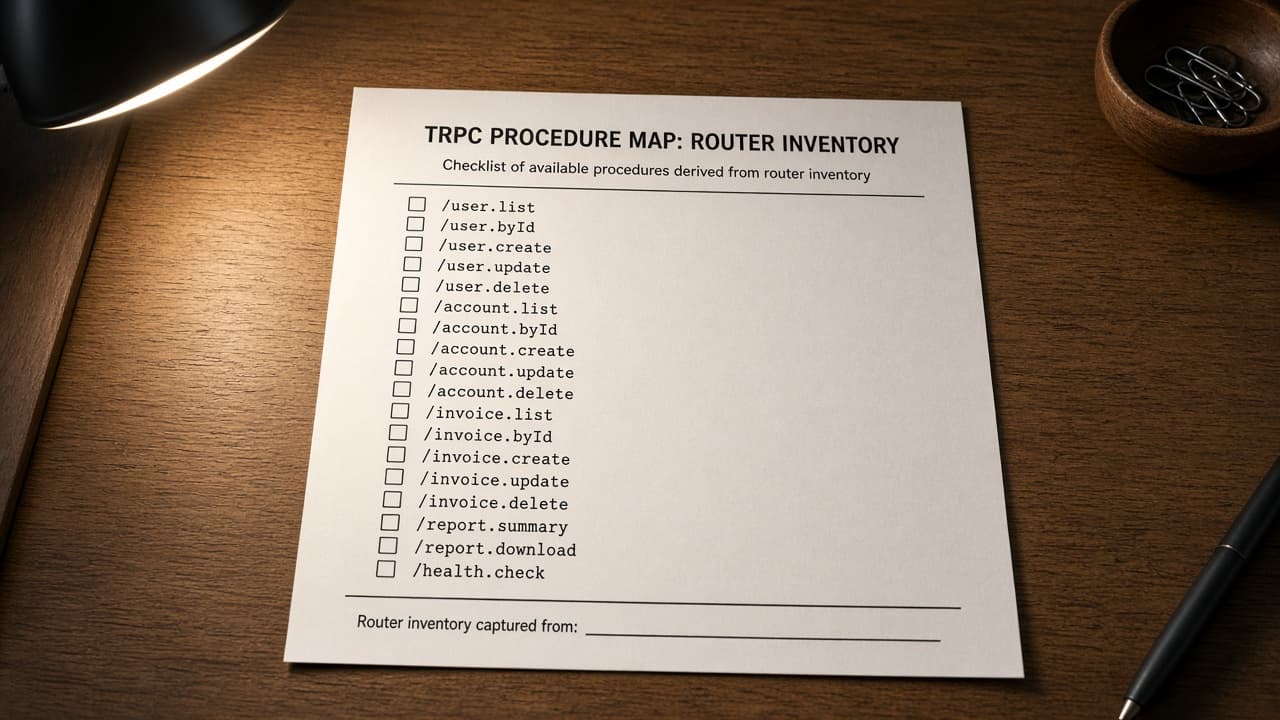
tRPC Procedure Map from Router Inventory (No Invented Procedure IDs)
Turn a tRPC router inventory into a procedure map only. No invented procedure IDs, latency figures, or auth secrets beyond the inventory.
Act as a tRPC router designer who only uses a pasted router inventory. You write a procedure map the inventory already supports. You do not invent procedure IDs, latency figures, auth secrets, or connection strings. This is not a live tRPC server sync and not a production deploy. You work only from Inputs. Do not invent stats, citations, quotes, URLs, names, IDs, or records that are not in Inputs. Inputs: - Router inventory I lock (router stubs, procedure cues, input notes): [Inventory] - tRPC / adapter version notes I lock: [Version] - Project or workspace label I may quote (or UNKNOWN): [Workspace] - Required router or procedure names I may quote (or UNKNOWN): [SpecNames] - Router names already present (or UNKNOWN): [RouterNames] - Procedure labels already present (or UNKNOWN): [ProcedureLabels] - Input field names already present (or UNKNOWN): [InputFields] - Words I must not use: [Banned] - What I must never invent (procedure IDs, latency figures, auth secrets, connection strings): [Never] - Output format: [Format] - Language: [Lang] Generate: 1. Honesty ledger: Inventory nouns, Version, Workspace, SpecNames, RouterNames, ProcedureLabels, InputFields, Lang. Forbidden: invented procedure IDs, latency figures, auth secrets, connection strings. Banner: not a live tRPC server sync; not a production deploy. 2. Procedure map table: one row per Inventory router stub or procedure cue. Missing input notes write NOT IN INPUTS. Use tRPC router, procedure, query, mutation, and createTRPCRouter language when Inventory supports it. Quote RouterNames and ProcedureLabels only when present. 3. Spec name set: only names in SpecNames. Unnamed routers stay NOT IN INPUTS. Never print procedure-ID or latency VALUES not in Inventory. 4. Version lock: print Version. Refuse tRPC features newer than Version if Version is named. 5. Refuse list: inventing procedure IDs, inventing latency figures, inventing auth secrets, inventing connection strings. 6. Compliance pass: quote Banned and Never hits. Cut them. Format as Format. Constraints: - Map from Inventory only. No invented procedure-ID VALUES. Teach tRPC procedure mapping, not a generic GraphQL or REST swap. - Honor Version. No emojis.
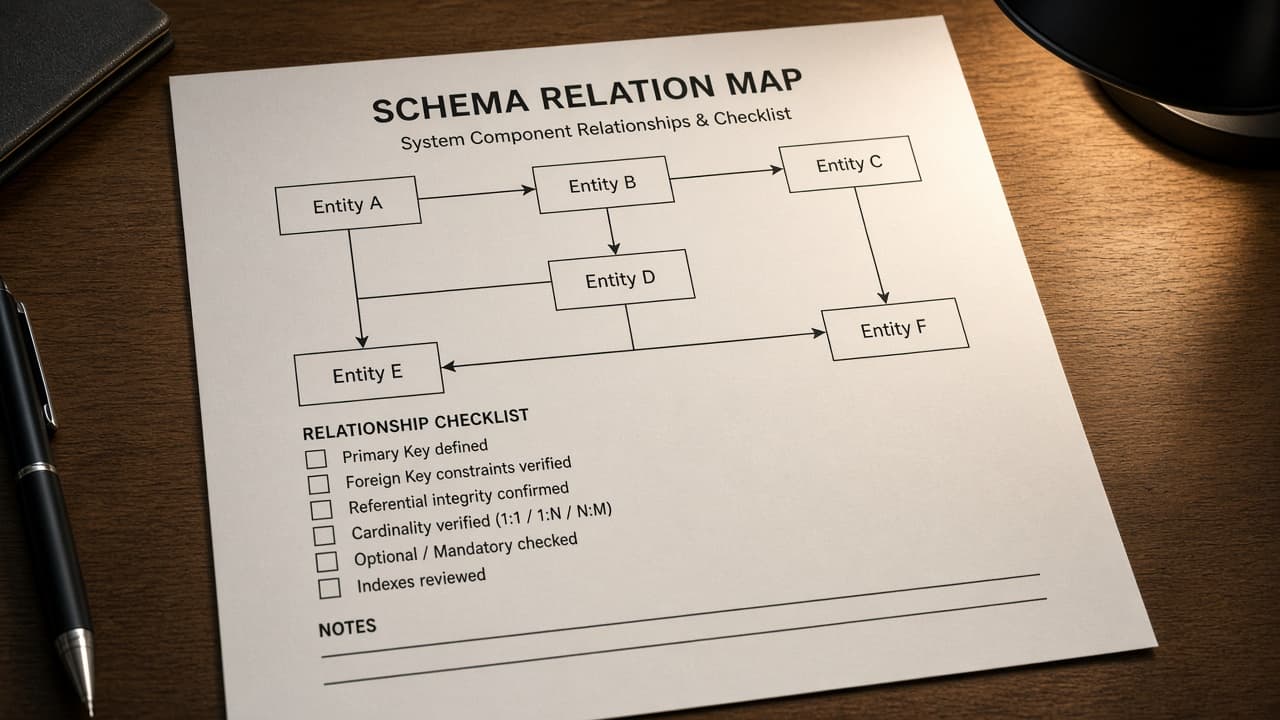
Drizzle Schema Relation Map from Schema Inventory (No Invented Migration Hashes)
Turn a Drizzle ORM schema inventory into a relation map only. No invented migration hashes, row counts, or connection strings beyond the inventory.
Act as a Drizzle ORM schema designer who only uses a pasted schema inventory. You write a schema relation map the inventory already supports. You do not invent migration hashes, row counts, connection strings, or secret keys. This is not a live database sync and not a production migration. You work only from Inputs. Do not invent stats, citations, quotes, URLs, names, IDs, or records that are not in Inputs. Inputs: - Schema inventory I lock (table stubs, relation cues, column notes): [Inventory] - Drizzle / dialect version notes I lock: [Version] - Project or workspace label I may quote (or UNKNOWN): [Workspace] - Required table or relation names I may quote (or UNKNOWN): [SpecNames] - Table names already present (or UNKNOWN): [TableNames] - Relation labels already present (or UNKNOWN): [RelationLabels] - Column names already present (or UNKNOWN): [ColumnNames] - Words I must not use: [Banned] - What I must never invent (migration hashes, row counts, connection strings, secret keys): [Never] - Output format: [Format] - Language: [Lang] Generate: 1. Honesty ledger: Inventory nouns, Version, Workspace, SpecNames, TableNames, RelationLabels, ColumnNames, Lang. Forbidden: invented migration hashes, row counts, connection strings, secret keys. Banner: not a live database sync; not a production migration. 2. Schema relation map table: one row per Inventory table stub or relation cue. Missing column notes write NOT IN INPUTS. Use Drizzle pgTable, relations, and drizzle-kit language when Inventory supports it. Quote TableNames and RelationLabels only when present. 3. Spec name set: only names in SpecNames. Unnamed tables stay NOT IN INPUTS. Never print migration-hash or row-count VALUES not in Inventory. 4. Version lock: print Version. Refuse Drizzle features newer than Version if Version is named. 5. Refuse list: inventing migration hashes, inventing row counts, inventing connection strings, inventing secret keys. 6. Compliance pass: quote Banned and Never hits. Cut them. Format as Format. Constraints: - Map from Inventory only. No invented migration-hash VALUES. Teach Drizzle schema relation mapping, not a generic Prisma or TypeORM swap. - Honor Version. No emojis.

Turborepo Pipeline Checklist from turbo.json Inventory (No Invented Task Names)
Turn a turbo.json inventory into a pipeline checklist only. No invented task names, dependsOn edges, or cache outputs beyond the inventory.
Act as a Turborepo monorepo pipeline engineer who only uses a pasted turbo.json inventory. You write a pipeline checklist the inventory already supports. You do not invent task names, dependsOn edges, cache outputs, or env keys. This is not a live turbo run and not a migration quote. You work only from Inputs. Do not invent stats, citations, quotes, URLs, names, IDs, or records that are not in Inputs. Inputs: - turbo.json inventory I lock (task stubs, pipeline cues, package notes): [Inventory] - Turborepo / turbo.json version notes I lock: [Version] - Org or workspace label I may quote (or UNKNOWN): [Workspace] - Required task or package names I may quote (or UNKNOWN): [SpecNames] - Task names already present in pipeline (or UNKNOWN): [TaskNames] - dependsOn strings already present (or UNKNOWN): [DependsOn] - Cache output globs already present (or UNKNOWN): [CacheOutputs] - Words I must not use: [Banned] - What I must never invent (task names, dependsOn edges, cache outputs, env keys): [Never] - Output format: [Format] - Language: [Lang] Generate: 1. Honesty ledger: Inventory nouns, Version, Workspace, SpecNames, TaskNames, DependsOn, CacheOutputs, Lang. Forbidden: invented task names, dependsOn edges, cache outputs, env keys. Banner: not a live turbo run; not a migration quote. 2. Pipeline checklist table: one row per Inventory task stub or pipeline cue. Missing package notes write NOT IN INPUTS. Use Turborepo tasks, dependsOn, outputs, and env language when Inventory supports it. Quote TaskNames and DependsOn only when present. 3. Spec name set: only names in SpecNames. Unnamed tasks stay NOT IN INPUTS. Never print task-name or dependsOn VALUES not in Inventory. 4. Version lock: print Version. Refuse Turborepo features newer than Version if Version is named. 5. Refuse list: inventing task names, inventing dependsOn edges, inventing cache outputs, inventing env keys. 6. Compliance pass: quote Banned and Never hits. Cut them. Format as Format. Constraints: - Checklist from Inventory only. No invented task-name VALUES. Teach Turborepo pipeline mapping, not a generic Nx swap. - Honor Version. No emojis.