How to Use: Covidence Full-Text Conflict Checklist from Review Notes (No Invented Inclusion Counts)
How to use the Covidence Full-Text Conflict Checklist from Review Notes (No Invented Inclusion Counts) PromptDig prompt without inventing metrics.
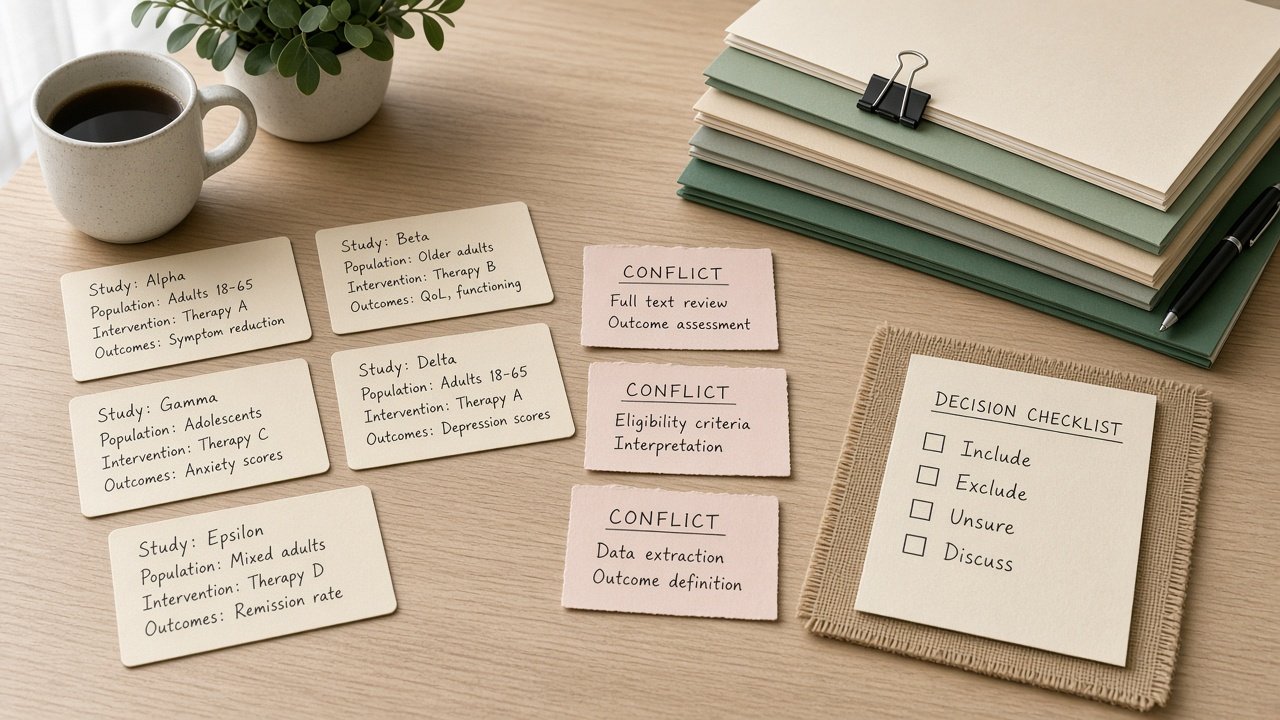
You pasted messy Covidence review notes and need a clean deliverable without invented numbers. This PromptDig prompt turns only what you already listed into a structured full-text conflict resolution checklist for full-text conflict handoffs.
What this prompt does
It locks your review notes, version, labels, and domain fields, then builds a ledger plus a table that refuses fake metrics. Missing cells stay NOT IN INPUTS instead of guessing.
Use it when you already have real stubs from Covidence and want a teachable full-text conflict resolution checklist for this job, not a generic template swap from another vendor. The Generate steps name Covidence nouns on purpose so a title swap into another category would fail the swap-title test.
The deliverable is aimed at Covidence full-text conflict resolution checklists. Reviewers should see your locked nouns echoed in the table rows, not marketing fluff. Cap style limits stay soft unless you add them later in Extra.
How to fill the brackets
- Paste your review notes with concrete nouns only. Prefer two labeled rows so the example shape stays visible after you swap names.
- Lock Version to what you actually run. If you do not know the version, write unknown rather than guessing a marketing release name.
- Fill labels you may quote only when you already have names you are allowed to use.
- Complete the domain fields that match this job. Leave blanks as UNKNOWN instead of inventing inclusion counts, citation totals, agreement-rate percentages.
- Set Banned and Never to the phrases you refuse. Keep Format and Lang explicit.
Keep Harbor Quay sample nouns out of your production paste. Those labels exist only so the example_input shows two concrete rows. Replace them with your real labels before you run the prompt.
Who it is for
Systematic review aides who inherit messy Covidence review notes. It is also useful when a teammate hands you a partial export and you need a full-text conflict resolution checklist that stays honest about gaps.
How to run it
- Open Covidence Full-Text Conflict Checklist from Review Notes (No Invented Inclusion Counts) on PromptDig.
- Copy the prompt into ChatGPT, Claude, or Gemini.
- Replace every bracket with your locked review notes. Do not leave sample Harbor nouns in place if they are not yours.
- Run once, then fix only the gaps list. Do not ask the model to invent missing metrics.
- Paste the full-text conflict resolution checklist into your handoff doc and keep NOT IN INPUTS visible for reviewers.
What good output looks like
A strong run starts with an honesty ledger that quotes your locked nouns and Version. The tables attach only names that appeared beside each other in Inputs. Refuse lines explicitly reject fake inclusion counts, citation totals, agreement-rate percentages.
Weak output invents metrics, adds vendor features not in Version, or swaps in another tool's nouns. If you see that, tighten Banned and Never, then rerun.
Common mistakes
- Inventing inclusion counts, citation totals, or agreement-rate percentages the notes never stated.
- Treating UNKNOWN as a cue to guess defaults.
- Dropping the gaps list so reviewers cannot see what is still owed.
- Softening Never so the model pads with industry averages.
- Swapping the title to Rayyan or DistillerSR and expecting the body to stay useful.
Why notes-first compilers beat guesswork
Most failed runs happen when the model fills empty cells with confident fiction. This prompt is built to refuse that pattern. It asks for an honesty ledger first so you can see which nouns were actually locked before any table rows appear.
Keep your review notes short and concrete. Two labeled stubs are enough for a teachable example. If a teammate later adds more stubs, re-run with the same Version so the full-text conflict resolution checklist stays comparable across handoffs.
When you share the result with a reviewer, point them at the refuse list and the gaps bullets. Those sections are the audit trail. They show what the model was not allowed to invent, which is the whole point of this PromptDig job.
Honesty also protects you from soft plagiarism of vendor marketing pages. The prompt refuses testimonials, star ratings, and press logos that were never in Inputs. Your wiki stays a map of what you pasted, not a brochure.
When to skip this prompt
Skip it if you need live Covidence cloud automation, paid analytics claims, or legal advice. This job is a notes-first full-text conflict resolution checklist only. For broader catalogs, use Browse more prompts. If you ship a better variant, Share a prompt.
Related PromptDig links
- Prompt: Covidence Full-Text Conflict Checklist from Review Notes (No Invented Inclusion Counts)
- Browse: Browse more prompts
- Contribute: Share a prompt
- Home: PromptDig
Reviewer pass
Ask a second person to scan for invented numbers, tool nouns from another vendor, and missing gaps bullets. If any appear, tighten Never and rerun once. Keep the original review notes block attached so audits stay cheap.