Blog
Architecting Autonomy: Prompt Engineering for the Age of AI Agents
Move from static chats to autonomous agents. Learn the prompt engineering techniques required to build reasoning-capable AI agents on PromptDig.
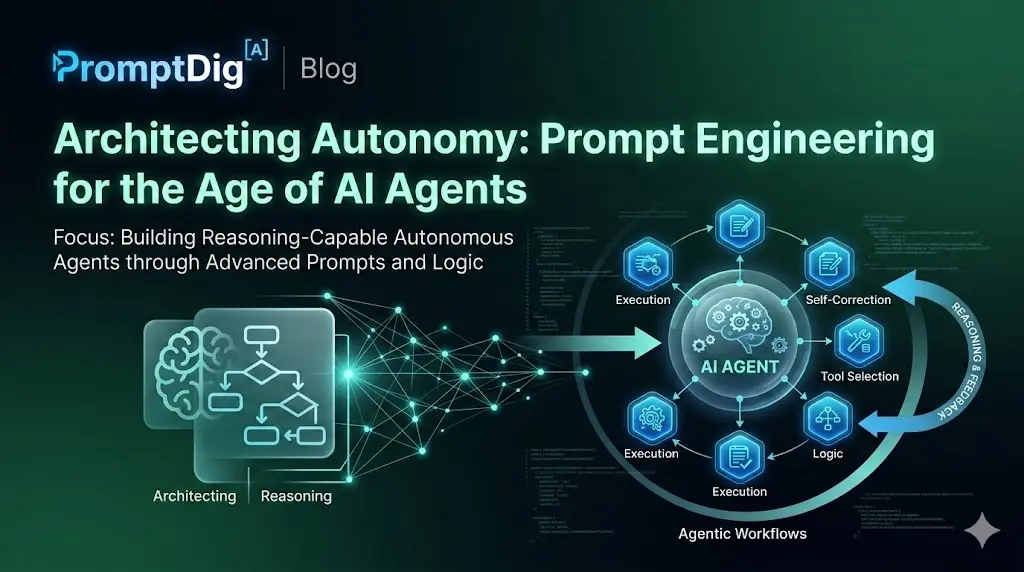
The landscape of artificial intelligence is shifting from passive chatbots to proactive agents. Unlike traditional LLM interactions where you ask a single question, autonomous AI agents are designed to reason, plan, and execute multi-step tasks. To guide these agents effectively, a new level of prompt engineering for AI agents is required—one that focuses on logic, recursive feedback, and objective-setting.
Key Elements of Agentic Prompts
Modular Design: Break complex agent prompts into smaller, manageable sub-prompts.
Leverage Constraints: Check out The Power of Constraints to see why limiting an agent's scope actually makes it more powerful.
Are you building something autonomous? Head over to the PromptDig Dashboard and show the community how you architect your AI agents!
The Shift from Completion to Reasoning
Standard prompts focus on getting a specific text output. However, agentic workflows require reasoning prompts that allow the model to think through a problem before acting. This is often achieved through "Chain of Thought" (CoT) techniques, where the AI is instructed to verbalize its internal logic.Key Elements of Agentic Prompts
- Objective Clarity: Instead of a task, provide a high-level goal.
- Tool Definitions: Explicitly state what the agent can and cannot do.
- Self-Correction Loops: Instruct the agent to review its own work before final delivery.
Step-by-Step: Crafting an Agentic Workflow
When sharing your next agent-focused tool on PromptDig, consider this structure to ensure high AI accuracy.1. Establish the "Inner Monologue"
Force the agent to use a "Thought" block before every "Action" block. This prevents the model from jumping to conclusions without considering the variables.2. Define Constraints and Boundaries
In autonomous AI, safety is paramount. Clearly define the "No-Go" zones to prevent the agent from infinite loops or incorrect data processing.3. Implement Multi-Shot Reasoning
Provide examples of how a problem should be broken down. Showing the AI how to think is more valuable than showing it what to say.Pro Tips for the PromptDig Community
Iterative Testing: Use The Art of Iteration guide to refine how your agent handles unexpected edge cases.Modular Design: Break complex agent prompts into smaller, manageable sub-prompts.
Leverage Constraints: Check out The Power of Constraints to see why limiting an agent's scope actually makes it more powerful.
Conclusion
We are entering the "Next Act" of generative AI, where agents will handle our scheduling, coding, and research autonomously. Mastering agentic workflows today will place you at the forefront of this technological shift.Are you building something autonomous? Head over to the PromptDig Dashboard and show the community how you architect your AI agents!